|
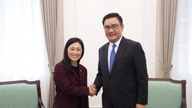
| Japanese Defense Minister Shinjiro Koizumi and his South Korean counterpart Ahn Gyu Back. (Source: Korea JoongAng Daily) |
The thawing symbol
Japanese Defense Minister Koizumi Shinjiro made a two-day visit to Seoul, South Korea (June 27-28) and held direct talks with his counterpart, Ahn Gyu-Back. This was Shinjiro Koizumi's first official visit in his current capacity, in return for Ahn Gyu-Back's visit to Tokyo in January 2026.
For the two ministers personally, this was their fourth face-to-face meeting since November 2025, out of a total of six meetings to date. Notably, the two ministers jointly visited the South Korean Black Eagles aerobatic team at Wonju Air Base. This was the first time a foreign defense minister had visited the base of this aerobatic team.
Previously, the last time Japan conducted a similar visit to Seoul, with Defense Minister Nakatani Gen exchanging views with his counterpart Han Min Koo, was in September 2025.
While the aforementioned trip marked the end of a 10-year diplomatic hiatus between the two countries, this meeting also holds significant importance for Japan-South Korea diplomatic relations: the second direct bilateral dialogue (excluding meetings on the sidelines of multilateral forums) in the same year between the Japanese and South Korean defense ministers, a first in 23 years.
New advances
Beyond its symbolic significance, Mr. Koizumi Shinjiro's visit to Seoul also signals the stability and gradual development of high-level defense cooperation between the two countries. In May 2026, Japan and South Korea held their first "2+2" Security Dialogue at the Vice Minister level in Seoul; marking the upgrading of the security dialogue mechanism at the Director-General level, which had been maintained since 1998.
The Japanese Defense Minister's visit also comes just weeks after Tokyo and Seoul resumed their joint maritime search and rescue exercise, SAREX, after a nine-year hiatus. This demonstrates a gradual improvement in relations between the two countries' defense agencies since the 2018 incident when a South Korean naval vessel aimed its fire control radar at a Japanese Maritime Self-Defense Force patrol aircraft.

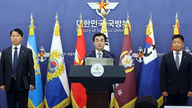

In the joint statement released after the talks, the two defense ministers also mentioned deepening cooperation between Japan's Blue Impulse aerobatic team and South Korea's Black Eagles. This is seen as a significant step forward because Japan had previously refused to refuel the Black Eagles in November 2025 due to the sovereignty dispute between the two countries over the Takeshima/Dokdo islands.
Furthermore, the fact that Koizumi Shinjiro and his South Korean counterpart reaffirmed their commitment to the "complete denuclearization of the Korean Peninsula" and ensuring "lasting peace in the region" at their meeting, just one day after a joint air exercise between China and Russia was conducted near the Korean Peninsula, also sent a clear message.
Tokyo and Seoul are demonstrating closer military coordination to proactively respond to complex developments in the regional security environment, such as North Korea's nuclear program, Russia-North Korea military cooperation, and Beijing's efforts to bolster its military power, amidst US demands for its two Northeast Asian allies to increase their defense autonomy and share the burden with Washington.
 |
| The two ministers visited the Black Eagles Air Force Base in Wonju and personally experienced the cockpit of one of the squadron's fighter jets. (Source: Yonhap) |
The boundaries of cooperation
However, what is even more noteworthy is that the Joint Statement makes no mention of the possibility of the two countries signing an Acquisition and Cross-Support Agreement (ACSA), a military logistics support agreement that Tokyo has actively promoted with Seoul under President Lee Myung Bak since 2012, but which has met with strong public backlash in the latter country.
South Korean public opinion is concerned that ACSA will pave the way for Japanese military activities on their territory. Currently, negotiations on ACSA are being restarted amidst the need for both countries to proactively promote cooperation to ensure strategic autonomy in the face of numerous external uncertainties.
If signed, the ACSA would help improve interoperability, facilitating joint operations between the two countries' forces, especially in emergencies when the U.S. Forces in Japan and the United Nations Command in Korea need to mobilize logistical support.
That prospect will not be easy, as Seoul has consistently maintained a cautious stance, viewing this as a politically sensitive issue, especially since the scope of cooperation within the ACSA framework could expand over time. On the one hand, this requires public support in South Korea, while historical memories from the colonial era (1910-1945) still persist.
On the other hand, Seoul needs to avoid being drawn into U.S.-led Japanese military activities in the region that extend beyond the Korean Peninsula, because then Beijing or Pyongyang would perceive Seoul as actively strengthening trilateral cooperation between the U.S., Japan, and South Korea.


The consequences would be detrimental to South Korea, especially as the current administration of President Lee Jae-myung is striving to maintain relations with the United States, Japan, China, and Russia to lobby for their support in resuming contact and improving relations with Pyongyang.
Overall, this meeting between the two Defense Ministers further demonstrates the consistent commitment of Tokyo and Seoul to building a "future-oriented" friendship, as agreed upon by the two leaders.
With the current high frequency of "shuttle diplomacy" activities, the trend of frequent mutual visits and defense negotiations between Japan and South Korea is likely to remain stable, at least during the terms of Prime Minister Takaichi Sanae and President Lee Jae Myung.
Source: https://baoquocte.vn/nhat-han-hoa-giai-than-trong-412721.html