

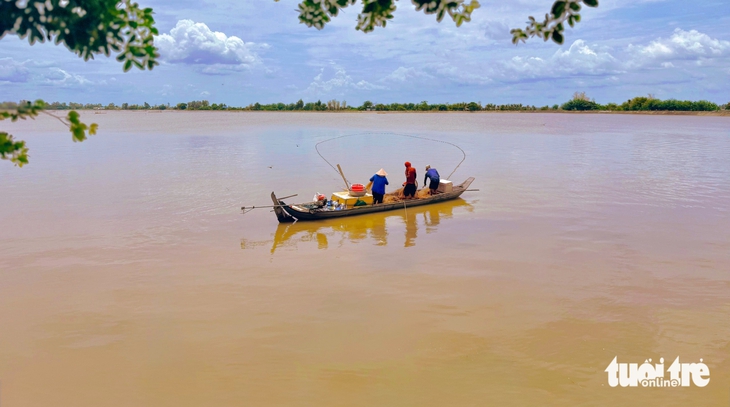
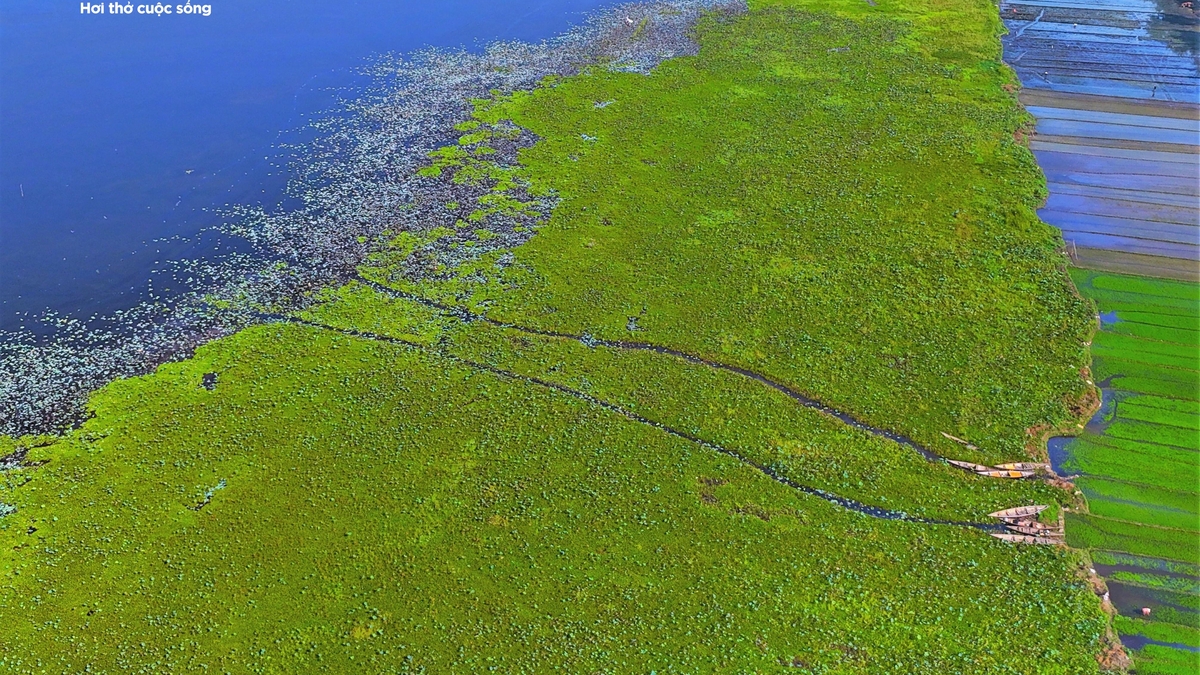
Mekong Delta - Photo: VAN BUU
The Mekong Delta is a key agricultural region of the country, but for many years it has been developing below its potential.
The Mekong Delta plays a particularly important role not only in agricultural economics , but also because of its strategic significance for food security, livelihoods, and social stability.
The long-standing paradox is that this region, despite making a significant contribution to the nation, is underdeveloped, has low average income, and the highest rate of labor migration out of the country.
The new Party Congress term is opening up new expectations, but it also poses a major challenge for the region.
The Mekong Delta has no shortage of resolutions, investment programs, or resources, but it needs a new growth model to overcome bottlenecks.
The region's growth model over the years, heavily reliant on resource exploitation, increased production, and labor-intensive practices, is no longer suitable in the context of climate change, intense competition, and the need for sustainable development.
If the new term only continues to "reinforce" old ways of doing things, it will be difficult to create a real turning point; what is needed is a breakthrough change.
The first requirement of this major challenge is to redefine the role of the Mekong Delta in the national development strategy.
This cannot simply be a "rice granary, fruit granary, and seafood producing region," but must be a modern, ecological agricultural economic center with high added value, an energy center, especially one with advantages in renewable energy and the marine economy.
Modern agricultural development goes beyond just production; it must encompass the entire chain, from science and technology , processing, and logistics to markets and branding.
If the value chain problem is not solved, the Mekong Delta will remain at the bottom of the value chain and fall further and further behind other regions of the country.
Secondly , there's the issue of infrastructure and regional connectivity. Highways, seaports, and logistics are receiving significant investment, but the problem isn't just about the construction itself, but about how the development space is organized. Without a truly interconnected approach, highways might only help goods move out of the Mekong Delta faster, while the added value continues to remain outside the region.
The new term should view infrastructure as a tool for restructuring the regional economy, not just as an investment target; moreover, it should leverage the advantages of infrastructure projects to accelerate development.
Thirdly , and crucially, is the role of intellectuals, scientists, and the business community. The Mekong Delta does not lack knowledge, but it lacks the mechanisms for knowledge to become a driving force for development.
Many valuable opinions remain at the level of workshops and reports; consultations are extensive, but institutionalization is limited. It is time to shift from "formal consultation" to co-creation of policies, considering intellectuals as key actors in designing, critiquing, and taking responsibility for regional development decisions.
This is linked to the need to create innovation spaces for the Mekong Delta. The region currently lacks "common spaces" where scientists, businesses, and the government can meet and experiment with new solutions.
A creative space is not just a laboratory or research center, but an institutional environment: one that respects critical thinking, encourages academic diversity, allows for policy experimentation, and accepts controlled risks. Respecting knowledge means not just rewarding it, but fostering an environment of dedication and trust.
Fourth, the new term requires a sufficiently strong and substantive regional linkage institution capable of breaking through bottlenecks.
Developing the Mekong Delta cannot be a mechanical summation of localities. The merger of provinces and cities has created more development space and opportunities, but also greater challenges.
If each province continues to focus solely on its own interests, and regional cooperation remains merely a slogan, it will be difficult to achieve a dynamic and thriving economy in this "era of self-improvement." Only with a mechanism for effective coordination, linking responsibility with common interests, can a region function as a unified economic entity.
If this term brings about a breakthrough in development, the region can completely transform itself. Conversely, if change is slow, the paradox of "great potential - slow development" will continue, not only as a problem for the Mekong Delta but as a major challenge for the entire nation.
Source: https://tuoitre.vn/nhiem-ky-moi-va-bai-toan-lon-20260125174340931.htm


![[Photo] National Assembly Chairman Tran Thanh Man attends the policy seminar to promote Vietnam-Türkiye cooperation.](https://vphoto.vietnam.vn/thumb/1200x675/vietnam/resource/IMAGE/2026/04/16/1776351415367_vna-potal-chu-tich-quoc-hoi-tran-thanh-man-du-toa-dam-chinh-sach-thuc-day-hop-tac-viet-nam-tho-nhi-ky-8705791-jpg.webp)





















![[Image] Bridges and roads connecting the eastern part of Ho Chi Minh City](https://vphoto.vietnam.vn/thumb/1200x675/vietnam/resource/IMAGE/2026/04/16/1776328595108_ndo_br_bh-vt5-jpg.webp)



























![[Infographic] Details of the Hanoi-Quang Ninh High-Speed Railway Project](https://vphoto.vietnam.vn/thumb/402x226/vietnam/resource/IMAGE/2026/04/16/1776338188424_anh-man-hinh-2026-04-16-luc-18-16-10.png)

![[Photo] National Assembly Chairman Tran Thanh Man meets with the Speaker of the Georgian Parliament](https://vphoto.vietnam.vn/thumb/402x226/vietnam/resource/IMAGE/2026/04/16/1776338494029_anh-man-hinh-2026-04-16-luc-18-21-21.png)














Comment (0)