

Starting in February, several particularly important educational policies and changes will come into effect, predicted to have a significant impact on teaching and examinations in secondary schools.
"Breakthrough" Regulations on Tutoring
The new circular on extracurricular tutoring, issued by the Ministry of Education and Training on December 31, 2024, and effective from February 14th, includes several significant changes. Instead of a series of "bans" forcing students to attend extra classes as in the old regulations, the new circular allows teachers to provide extra tutoring for their own students, including remedial and supplementary classes, but clearly stipulates that no fees should be charged. Specifically: "Teachers currently teaching at schools are not allowed to provide extra tutoring outside of school for students they are assigned to teach." According to the Ministry of Education and Training, this aims to limit teachers from taking their own students outside for extra tutoring.
Regarding extracurricular tutoring within schools, the new circular restricts the target group for such tutoring to three categories: students under the school's responsibility and those for whom no fees are charged; students whose end-of-semester grades in the relevant subject are below the required level; students selected by the school for advanced training; and final-year students who voluntarily register for entrance exam preparation or graduation exam preparation according to the school's educational plan.
Notably, according to the Ministry of Education and Training, to curb the negative practice of forcing students to attend extra classes, the new circular stipulates that extra classes should not be scheduled to overlap with the regular school curriculum timetable; and that extra classes should not cover content ahead of the curriculum outlined in the school's educational plan.
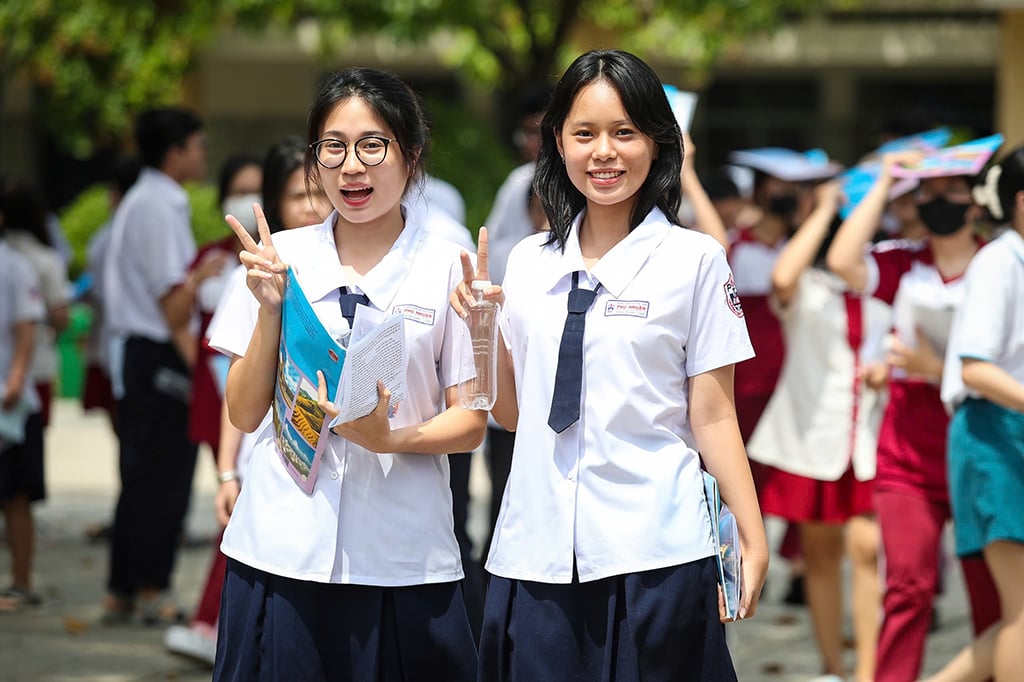
The Ministry of Education and Training's circular stipulating the regulations for the high school graduation exam, with many new points, will take effect from February 8th.
The circular also states: "No extra classes should be organized for primary school students, except for cases involving training in arts, physical education and sports , and life skills development."
The Ministry of Education and Training stated: "The above regulations aim to ensure increased responsibility of schools in fully implementing the required learning outcomes as stipulated in the general education program. Schools have the opportunity to utilize underutilized time and space to organize educational activities, life skills training, cultural and artistic activities, physical education, and sports... to comprehensively develop students; at the same time, it limits the practice of 'forcing students to attend extra classes' which causes public outrage."
According to the new circular, organizations and individuals that organize extracurricular tutoring outside of school and collect fees from students must register their businesses to be subject to management under the provisions of the Enterprise Law.
Many secondary school teachers shared that, for a long time, teaching afternoon classes and providing intensive review sessions for graduating students to prepare for exams have been paid for according to general regulations and the school's internal spending rules, contributing to improving teachers' income. However, from February 14th, if the school does not have any funding to support teachers, all of the above activities will have to stop. Teachers will only be responsible for completing their regular teaching hours according to the teaching hour quota stipulated by the Ministry of Education and Training.
ENTRANCE EXAM TO GRADE 10 WITH A THIRD SUBJECT THAT IS NOT FIXED
Also effective from February 14th, Circular 30/2024 of the Ministry of Education and Training stipulates the regulations on admission to junior high schools and high schools, most notably the new regulations related to the entrance exam for grade 10 in public high schools. The Ministry of Education and Training stipulates that localities can choose to take an entrance exam, apply for admission based on academic records, or combine both methods.
However, if an entrance exam is required, students must take three subjects, with mathematics and literature being compulsory; the third subject (or combined subject exam) will be chosen by the Department of Education and Training from subjects graded with scores. However, the Ministry of Education and Training requires provinces not to repeat the third exam subject for more than three consecutive years. Local authorities may announce the third exam subject after the end of the first semester, but no later than March 31st of each year, in order to achieve the goal of comprehensive education and avoid rote learning or unbalanced learning.
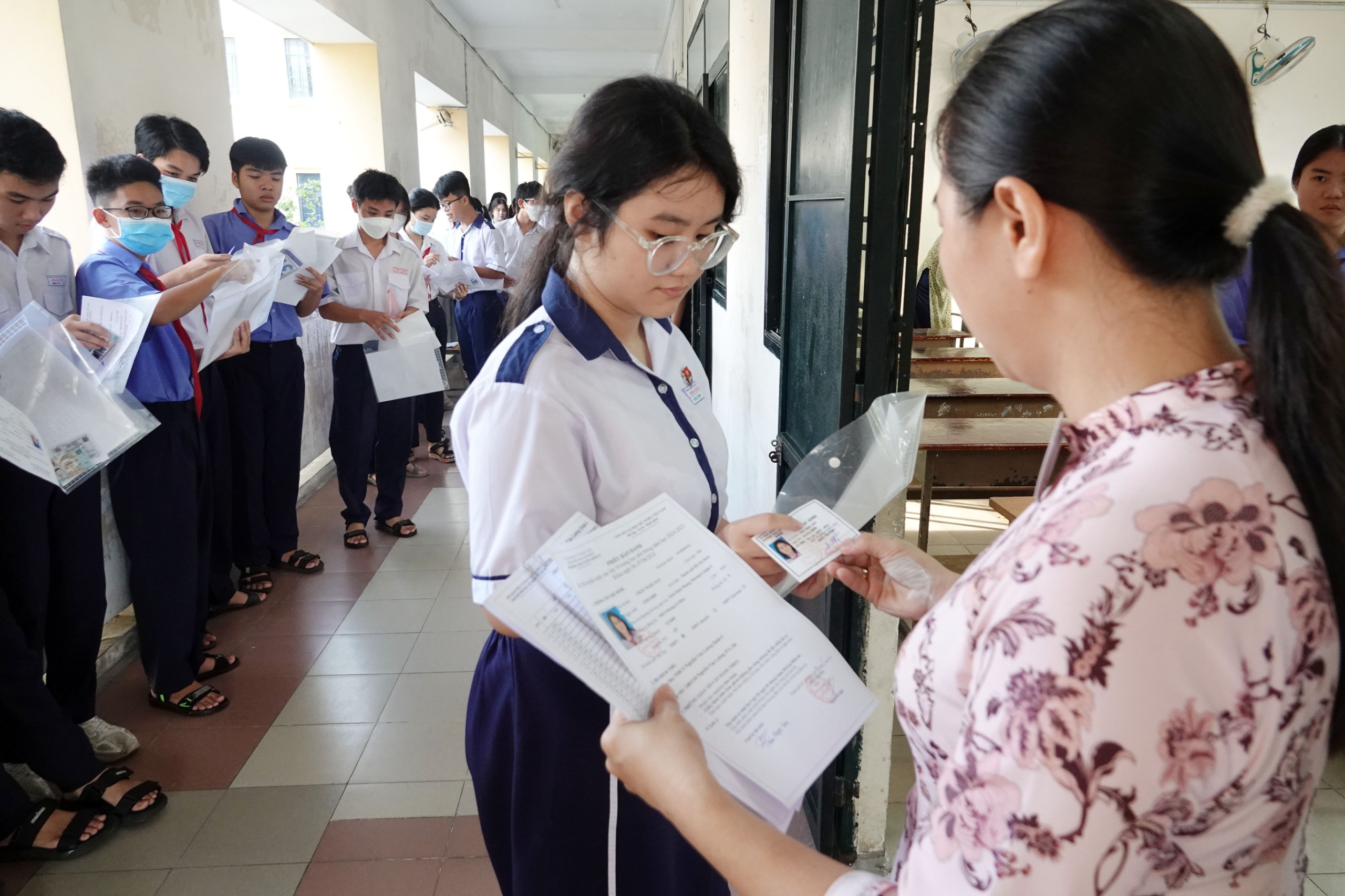
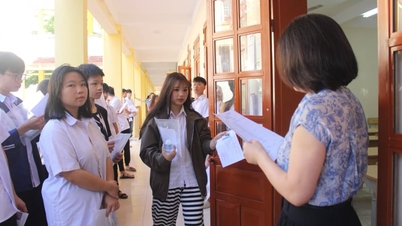
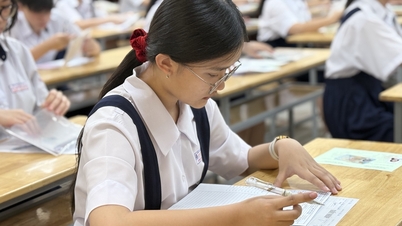
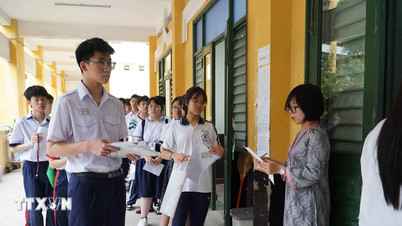
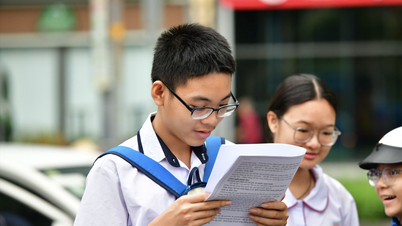
The 10th grade exam will consist of 3 subjects, with the third subject not being repeated for more than 3 consecutive years.
Photo: Jadeite
To date, more than 10 localities, with Ho Chi Minh City being the earliest, have announced the third subject for the 10th grade entrance exam. All of these localities have chosen English as the third subject . Hanoi , however, which has the largest number of students taking the 10th grade entrance exam in the country and the most intense competition, remains silent, much to the impatience and anxiety of students, parents, and schools.
HIGH SCHOOL GRADUATION EXAM : REDUCED SUBJECTS, REDUCED NUMBER OF EXAM SESSIONS
Circular 24/2024 of the Ministry of Education and Training, effective from February 8th, stipulates the regulations for the high school graduation exam with many new points, including a reduction in the number of subjects and exam sessions.
Specifically, candidates will take exams in 4 subjects instead of 6 as before, with only 2 compulsory subjects: mathematics and literature; the 2 elective subjects will be chosen from chemistry, physics, biology, geography, history, economics and law education, informatics, technology, and foreign languages. This is the first time informatics and technology (industrial and agricultural) have become subjects in the high school graduation exam.
The number of high school graduation exam sessions has also been reduced to only 3 instead of 4 as before. The Ministry of Education and Training expects that reducing one exam session and two subjects compared to previous years will help reduce pressure on candidates and lower costs for society from the 2025 exam onwards.
The criteria for recognizing high school graduation have changed, increasing the proportion of students' academic results from grades 10, 11, and 12 to 50%, with graduation exam scores accounting for the remaining 50%.
Additionally, candidates with a foreign language certificate as per regulations are exempt from this subject, but it will no longer be converted to 10 points in the graduation assessment as before. The graduation score calculation formula will no longer include the foreign language score in this case.
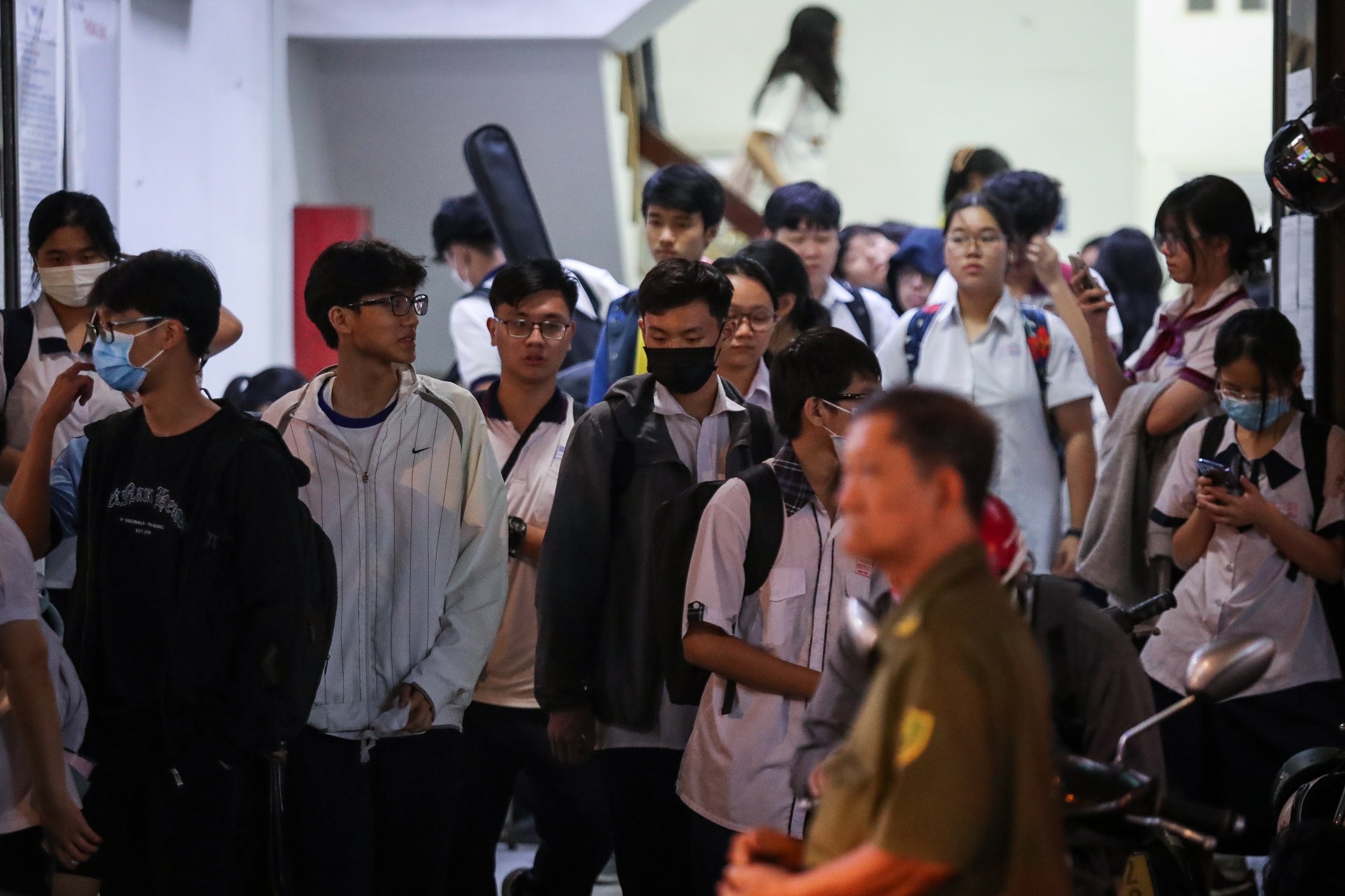
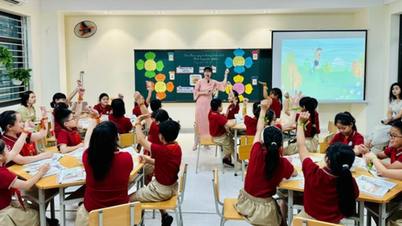
The new circular on tutoring, effective from February 14th, includes several significant changes.
The Minister of Education and Training shared the major tasks for 2025.
Speaking to the press on the occasion of the Lunar New Year of the Snake, Minister of Education and Training Nguyen Kim Son said that the education sector has many major tasks that it will focus on implementing in 2025.
Specifically, in the first half of 2025, the draft Law on Teachers will be submitted to the 15th National Assembly for the second time at its 9th session. The Ministry of Education and Training has been focusing intensely on finalizing the draft after the initial consultation with the National Assembly. "We hope that our dedication and aspirations for a draft law that will develop the teaching force and resolve numerous issues related to teacher management over the past period will convince National Assembly representatives and society. Not only us, but more than 1.6 million teachers nationwide are eagerly awaiting the official passage and implementation of the Law on Teachers. We will review the Law on Education, the Law on Higher Education, and the Law on Vocational Education to consider amendments and additions," Minister Kim Son shared.
According to Mr. Kim Son, after four years of implementing the 2018 General Education Program, in 2025, the Ministry of Education and Training will summarize the initial phase of the program to set more in-depth goals and innovative solutions for the next phase.
As soon as the 2018 General Education Program completed its first cycle, the new Preschool Education Program was piloted in 20 provinces and cities. 2025 will mark the beginning of the reform of preschool education – a foundational level of education but one that currently faces the most challenges.
According to Mr. Kim Son, in 2025, the education sector will continue to have many tasks and responsibilities in the journey of fundamental and comprehensive reform of education and training. A major task is for the Ministry of Education and Training to continue coordinating with relevant ministries, sectors, and agencies to finalize the Government's action program to implement Conclusion 91 of the Politburo on continuing the fundamental and comprehensive reform of education and training.
Furthermore, 2025 is also the year when the Ministry of Education and Training and the education sector will implement streamlining and improved efficiency in state management. Currently, the Ministry of Education and Training is organizing the reduction of administrative units, mergers, and the acquisition of units... as directed by the Central Committee.
Source: https://thanhnien.vn/nhieu-thay-doi-lon-cua-giao-duc-co-hieu-luc-tu-dau-nam-185250203213311571.htm
![[Photo] General Secretary and President To Lam and the President of the Philippines hold talks.](https://vphoto.vietnam.vn/thumb/1200x675/vietnam/resource/IMAGE/2026/06/01/1780283481955_vna-potal-tong-bi-thu-chu-tich-nuoc-to-lam-va-tong-thong-philippines-hoi-dam-8797519-1429-jpg.webp)






























































Comment (0)