

According to many accounts, Trịnh Công Sơn visited the capital city many times. A year after the country's reunification, in 1976, Trịnh made his first trip to Hanoi to visit a musical talent who was a generation younger than him – composer Văn Cao. After that, Trịnh Công Sơn occasionally visited to see friends and interact with admirers. But he still hadn't written a complete song specifically for the capital city…
In 1985, after a long business trip at the invitation of the Soviet Union's Ministry of Culture, upon flying back to Hanoi , a certain feeling compelled the musician Trinh to pick up his guitar, paper, and pen. And so flowed out a stream of trembling, vague, clear, poignant, and captivating sounds, just like the autumn in Hanoi itself.
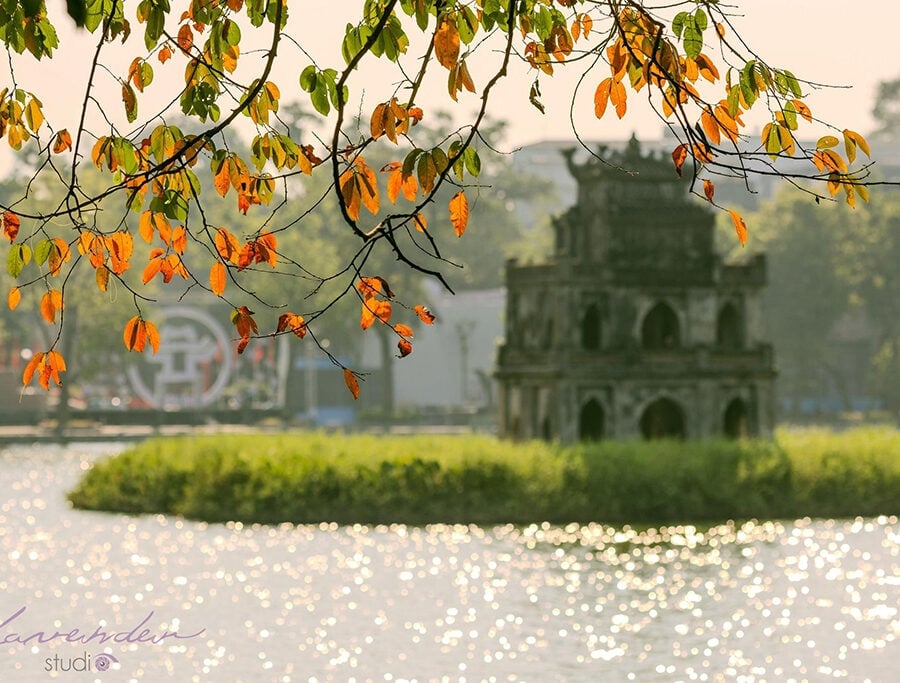 |
| Illustration photo: Internet |
The lyrics begin the song like a narrator's voice, sitting somewhere by West Lake, amidst the moss-covered, centuries-old tiled roofs: Hanoi in autumn, the crape myrtle trees turning yellow, the banyan trees with red leaves / Lying side by side, old streets and ancient houses, dark brown tiled roofs…
And a charming, beloved Hanoi in autumn flows into the song. It's the gentle scent of milk flowers in the breeze, the aroma of green rice flakes wrapped in lotus leaves, and the golden, crisp surface of West Lake in autumn. A beautiful nature unfolds like a painting alongside the silhouette of people. Their faces are unclear, their identities unknown, yet a sense of wistfulness lingers. It's because the scent of rice flakes remains on small hands, on every passing step. And then the scenery and the people dissolve into each other; even the mist knows longing, and the wings of wild geese soaring into the sky awaken the gentle light of the autumn sun.
"Remembering Hanoi's Autumn" is a short song, like a three-stanza poem, each stanza consisting of four lines. Short, yet with just a few musical strokes, it paints a picture of the enchanting and elegant autumn in the capital city, capturing the human emotion caught in a dilemma: wanting to fade away yet wanting to hold on, wanting to say goodbye yet wanting to meet again.
If the opening lines of the lyrics are like sketches capturing the essence of autumn in a beloved land with a thousand years of cultural heritage, then in the latter half, the author suddenly shifts his gaze inward, a look full of emotion and sentiment: Hanoi in autumn, walking among the people, my heart silently asks, who am I missing? One day, the autumn sky of Hanoi will answer me, one day, every small street will answer me… Reading this section of the lyrics reveals a slow, four-line stanza rhythm, not too long for melodic recitation, but not too short to diminish the emotion. It's like the wandering footsteps of an artist along "long streets rustling with the autumn breeze" ( The Country - Nguyen Dinh Thi), searching for the "beloved old streets of Hanoi" ( Marching Towards Hanoi - Van Cao). A gaze, a question, an expectation, a longing filled with wistfulness and reflection.
Why is it said to be full of contemplation? Because the lyrics of musician Trịnh Công Sơn often leave gaps. Readers and listeners project and feel according to their own personal experiences. Missing someone, why miss them without knowing who they are missing? And why must the autumn sky of Hanoi and each small street answer the author? In fact, this short string of lyrics is an emotional thread carrying aesthetic, even philosophical, meaning that the author perceived in a moment. Don't explain it; see it as the mist over West Lake, like a wild goose landing and then flying away in memory.
In a story, artist and musician Van Thao, son of the late musician Van Cao, recounts that the first person to hear Trinh Cong Son sing "Remembering Hanoi's Autumn" was Van Cao himself. After listening, the renowned elderly musician praised the song but wondered why it didn't end with the line: "One day, every small road will answer me." According to Van Thao, Trinh Cong Son smiled and explained that he added the two concluding lines: "Hanoi in autumn. Autumn in Hanoi. Remembering one person, to remember everyone" to express his admiration for the shared talent between Trinh and Van Cao!
Once a work of art is created, it immediately belongs to the public. The story above only adds another perspective on the work and its author. "Remembering someone" in Trinh's memory could be Van Cao, it could be someone else, or it could be no one at all. Here, there is a silence, an emptiness, a void… a pause and a lingering unease, before opening up to an unexpected and poignant new level: "Remembering someone… to remember everyone."
Everyone, meaning all of us who were present, lived through the song with the author. We went, saw, gazed, remembered one person and remembered everyone on a breathtakingly beautiful autumn day in the heart of the cultured and elegant capital city.
Nguyen Dynasty
Source: https://baodaklak.vn/van-hoa-du-lich-van-hoc-nghe-thuat/202509/nho-mua-thu-ha-noi-e0c0695/














































































Comment (0)