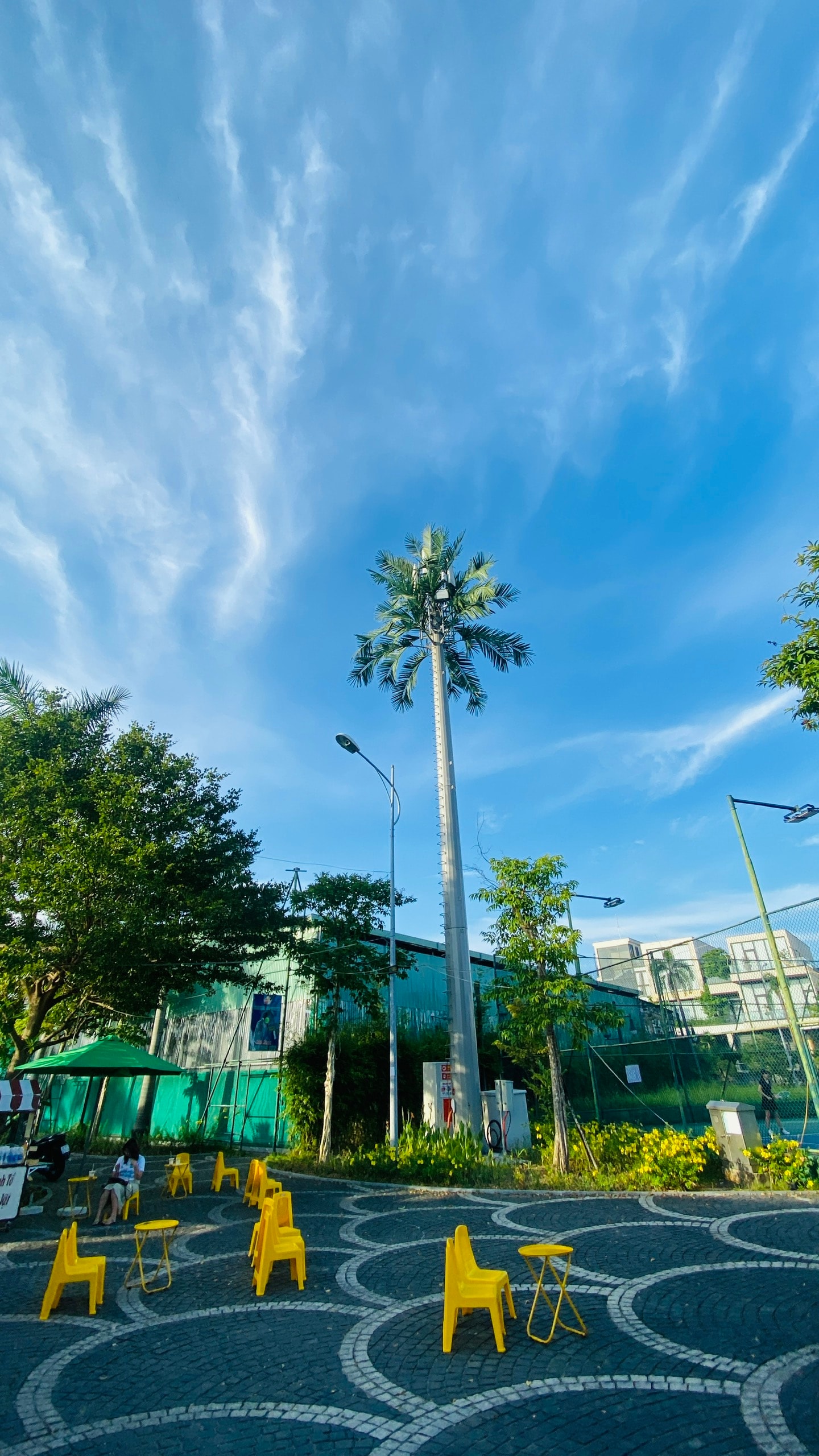
In Da Nang, such "coconut trees" are no longer rare; they can be found throughout eco-urban areas, public beaches, and luxury tourist resorts.
Coconut... BTS
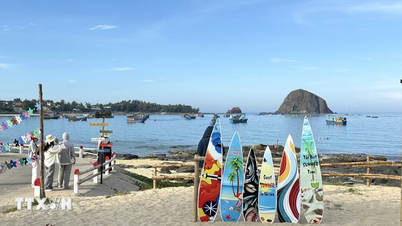
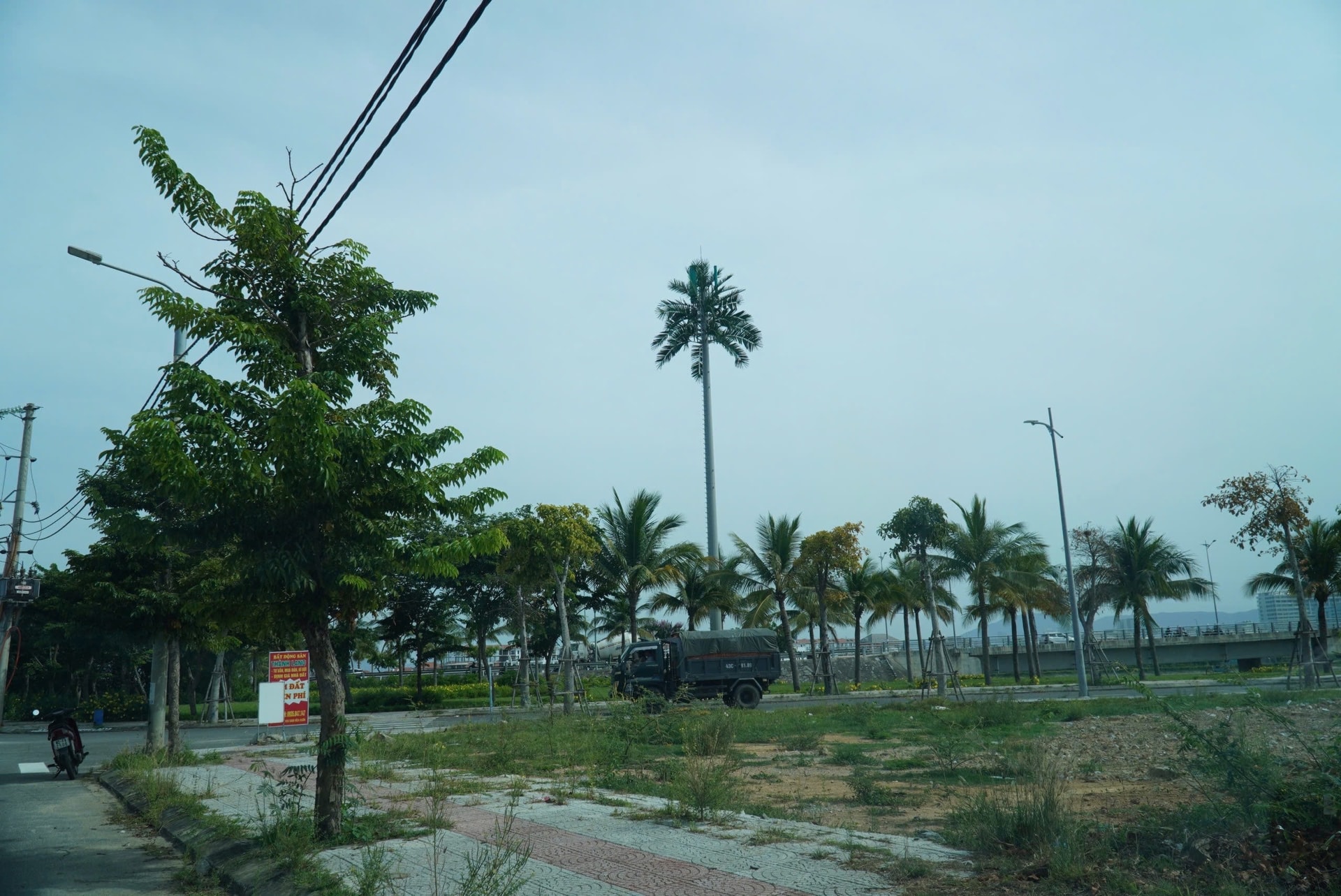
Nestled among the coconut trees at Tan Tra beach, at the end of Vo Quy Huan street (Ngu Hanh Son ward), is a rather tall "coconut tree trunk." Without the shadow cast on the asphalt, many people probably wouldn't notice it's a fake tree.
“These kinds of transmission towers have become very common in recent years. Almost every beach has one, so I’m used to seeing them,” explained Ms. Phuong, a vendor, to a beachgoer from another province. In Da Nang, these “coconut trees without fruit” are no longer unfamiliar to city dwellers. They appear along the green parks of new urban areas, beaches, and high-end coastal resorts. Mobile phone transmission towers are “disguised” to minimize their impact on the urban landscape.
Most of these structures are 20-25 meters tall, equivalent to a 5-story building. The "coconut leaves" are made from synthetic plastic, while the "trunk" consists of dark brown painted metal columns that resemble real coconut trees. In some areas where coconut trees are grown nearby, these transmission towers are only a few meters taller than the coconut trees, making them difficult for many people to notice.
"I have to admit, it looks very realistic from a distance. Compared to the old iron pillars, it's much more pleasant to look at," said Ms. Le Thi Xuan, a resident ofthe FPT urban area.
According to Ms. Xuan, in her area, the landscaped riverside areas and coconut-growing parks are predominant. With such a dense concentration of trees, it would be difficult to notice anything unusual if it weren't for the height of the "BTS coconut trees." Therefore, the presence of these BTS stations doesn't seem to disrupt daily life.
Since 2010, Da Nang has been a pioneer in deploying compact, environmentally friendly base transceiver stations (BTS), a move that has been well-received by many network operators. The "camouflage" of these base stations in Da Nang stems from several reasons. In the context of rapid urban development and tourism as a key economic sector, aesthetics are increasingly important. The exposed antenna masts and tangled wires used to cause concern among residents, not only for their appearance but also for the perceived lack of safety.



At many seminars, some opinions also pointed out that people reacted negatively due to concerns about the aesthetic appeal and safety of old-style BTS stations. They also expressed concerns about health-related issues, even if they didn't fully understand them.
In this context, designing BTS stations in a way that is user-friendly and inconspicuous is considered a compromise between coverage requirements and public sentiment. In central areas, base stations are integrated into streetlights or existing structures. In residential areas, they are discreetly incorporated into water tanks or technical cabinets. In coastal areas, the image of a coconut tree is chosen as a suitable way to "hide" them.
Harmonious with the urban landscape
According to current regulations, the construction and installation of BTS (Base Transceiver Station) equipment are carried out according to standards issued by relevant ministries. However, depending on the terrain and different conditions, the construction of stations in rural and urban areas varies.
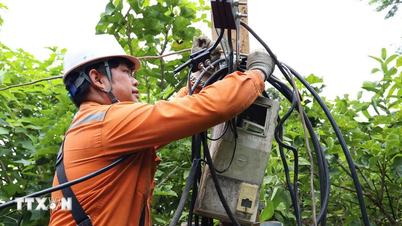
In rural areas, the terrain is flat, houses are low, the space is open, and the population density is low. Therefore, base transceiver stations (BTS) are usually deployed using tall towers, with distances between stations ranging from 1.5km to 3km depending on population density. In hilly and mountainous areas, stations are often placed in high locations to expand coverage and optimize investment efficiency. In addition, base transceiver stations are also positioned along national highways and expressways to ensure stable communication connections for major transportation routes.
Meanwhile, in urban areas, the terrain is complex due to buildings of varying heights, interspersed and constantly changing with the rate of urbanization; and the population density is high.
A representative from a telecommunications company stated that for urban areas, the requirements go beyond simply ensuring signal quality; they must also consider the visual and sensory experiences of residents. Technical infrastructure must find ways to integrate into the living space, rather than remaining isolated as before.
Therefore, BTS stations are arranged with a higher density, with distances between stations ranging from 200m to 500m, applying flexible deployment plans to suit the actual construction conditions and ensure urban aesthetics. From an urban perspective, these "coconut trees without fruit" can be seen as an effort to both meet the growing demand for connectivity and preserve the image of a livable city.

To date, the core urban area of Da Nang has replaced the old-style base stations with cumbersome cables that occupied a lot of space and were unsuitable for the urban landscape. To enhance coverage in tourist areas, public spaces, and parks, Da Nang authorities have collaborated with businesses to develop modern base station designs that integrate multiple functions within a single area. As a result, these stations not only ensure convenience but also improve the city's urban appearance.
According to the general direction, in urban areas, there will be increased sharing of telecommunications infrastructure between businesses and other technical infrastructure, and a push to invest in multi-functional base station infrastructure (4G and 5G broadcasting integrated with utilities such as electronic bulletin boards, free Wi-Fi coverage, cameras, sensors, etc.). In the near future, these "coconut trees" in the air, swaying in the wind, will not only be operational broadcasting systems connecting millions of calls, messages, and data every day, but also an integrated infrastructure with many utilities serving urban residents.
According to statistics, Da Nang currently has over 1,800 environmentally friendly BTS stations, accounting for the majority of the total number of base stations in the area. Besides being disguised as coconut trees, these BTS stations are also disguised as streetlights, air conditioning units, and water tanks placed on the rooftops of high-rise buildings.
Source: https://baodanang.vn/nhung-cay-dua-khong-trai-3320568.html