


Some traditional crafts haven't completely disappeared, but they've quietly faded from life, remaining only in the memories of a few elderly people or in faint traces here and there. Therefore, there are also people who refuse to let those memories fade. They search for, piece together, and reawaken what was thought to belong to the past, so that these legacies are not only revived but continue to be present in life today, in a different way.
The story of Ngo Quy Duc and Nguyen Cong Dat, from Chuon village, also known as An Truyen (Hue), to Thanh Lieu ( Hai Phong ), is a connecting thread like that.
Heritage seekers
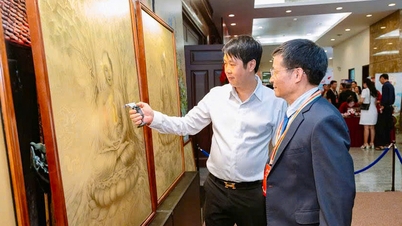
To successfully organize two exhibitions showcasing the traditional Vietnamese ceremonial scrolls (literally, "liễn" refers to the red paper scrolls used for writing calligraphy and couplets to decorate homes during the Lunar New Year) in Chuồn village, one in Hue in early January and the other in Hanoi in early February, few people know that Duc had "moved his residence" from Hanoi to Hue over a year ago. It seems like a predestined fate for this young man born in 1985, as he returned to Hue after months of traveling through central Vietnam exploring traditional craft villages in 2022. Duc finally settled at Ngự Hà Viên. Here, he not only saw an architectural heritage but also felt the heartfelt message, the unfulfilled dreams, and the aspirations of the late artisan, the "king of traditional houses," Dương Đình Vinh. Ngự Hà Viên was then reborn and carried the new missions that Duc had cherished for so many years.
According to Duc, Hue is truly the land that can help him revive the essence of Vietnamese handicrafts. The ancient capital once proudly possessed three famous folk painting styles: Sinh Village paintings, Chuon Village couplets, and Tay Ho Village paintings. However, time and the vicissitudes of history have been cruel. The Tay Ho Village paintings have completely disappeared over the past 80 years. Meanwhile, Chuon Village couplets have also faded away more than 10 years after the last artisan, Mr. Huynh Ly, passed away. Only Sinh Village paintings have been luckier, but that luck is so fragile, with only artisan Ky Huu Phuoc remaining, highlighting the immense regret.
Therefore, the project to revive the Chuồn village's traditional couplets was initially very difficult due to the lack of artisans and original woodblocks. Đức and his colleagues had to travel to other traditional folk painting villages (Hàng Trống, Đông Hồ, Kim Hoàng, Sình) many times to gather and piece together fragments of memories that remained. And in early January 2026, the set of woodblocks that Đức and the artisans of Thanh Liễu woodblock printing village restored was announced, featuring a large character "Phúc" (meaning "blessing" or "fortune") interwoven with the four mythical creatures (dragon, unicorn, tortoise, phoenix) and a pair of couplets "Thiên địa tam dương thái/Càn khôn vạn sự xuân" (Heaven and Earth, Three Auspicious Signs/The Universe, All Things in Spring) on a golden-yellow persimmon wood background, with exquisite carvings down to the smallest detail.
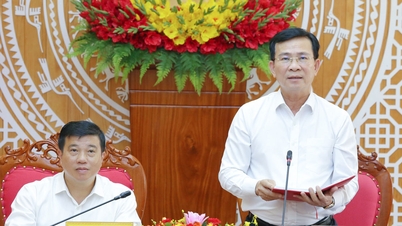
According to Duc, the project not only restores a handicraft but also fills the gaps in Hue's cultural memory, so that heritage items like Chuon village couplets, and possibly Tay Ho paintings, can be revived and shine as brightly as they once did. He emphasized that heritage should not remain confined to museums or in nostalgic memories. This view was also shared by Phan Thanh Hai, Director of the Hue City Department of Culture and Sports: Chuon village couplets need to be brought into life and their value promoted in the contemporary context, instead of just being restored.
The one who carries the heritage
While Đức chose to stay in a place to rediscover what had been lost, in Thanh Liễu, Nguyễn Công Đạt chose a different path: to travel. He traveled, following in the footsteps of the founder of the craft, Lương Như Hộc (1420-1501), who went on an embassy to China and passed on the woodblock printing craft to the three villages of Hồng Lục, Liễu Tràng, and Khuê Liễu. He traveled, just as the village's artisans had done. And he traveled, partly to make a living, and partly to keep the craft from being confined to the narrow space of the village. According to this young man born in 1992, for 20 years the Thanh Liễu woodblock printing village was not mentioned as machines gradually replaced the skillful hands of the artisans. This image is completely contrary to the fact that Hồng Lục, now Thanh Liễu, was once the printing center of our country for five centuries until before 1945.
Fortunately for Dat, he grew up knowing that his village had a tradition of woodblock printing. Even as a child, he watched his elders carve woodblocks for printing characters, seals, and pictures. With a passion for art, he decided to study interior design at the Open University (Hanoi) and never imagined that one day he would be able to revive the craft.
Driven by a desire to learn more about woodblock printing, Dat visited the Temple of Literature to see the stele commemorating the founder of the craft, Luong Nhu Hoc, as well as the history of printing in his village and the names of previous artisans. In 2010, he officially entered the profession, initially just carving small stamps to stamp onto paintings… In 2015, he graduated and returned to his village to work in painting, creating miniature landscapes, and carving stamps.
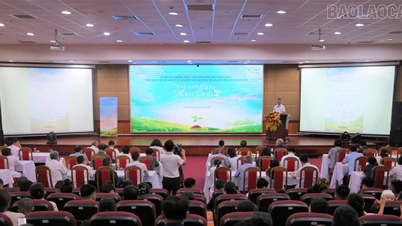
In addition, he continued to search for information about the craft village and collect related documents. After several years of meeting with historians and making requests to Hai Duong province, Dat's desire to clarify the history of the craft village was successful when Thanh Lieu was recognized as a traditional craft village. In 2024, he collaborated with Duc to organize the program "Thanh Lieu Woodblocks - A Journey to Revive a Craft Village" at Bach Nghe Ward (Center for Research, Development, and Application of Vietnamese Craft Village Products).
It can be said that the collaboration between Duc and Dat is a meeting of two currents: one side is trying to rediscover memories, while the other has begun to preserve the lifeblood of the craft. Thanks to this, from the woodblock carvings, from the technique of using horizontal knives, from the experience accumulated over many years, the craftsman Thanh Lieu has contributed to the revival of Chuon village's couplets with a complete version consisting of five panels (with the addition of two "Crane on the Turtle's Back" panels).
Artisans are not only practitioners of a craft but also living legacies, manifested in their role in shaping identity, accompanying others, showing gratitude, taking responsibility, and preserving that identity.
Interestingly, a quiet cycle is unfolding. Over 500 years ago, the people of Thanh Lieu took their craft to various places to earn a living, creating three woodblock collections recognized by UNESCO as World Documentary Heritage in the Asia-Pacific region: the Nguyen Dynasty woodblocks, the Vinh Nghiem Pagoda woodblocks, and the Phuc Giang School woodblocks; four national treasures; and participating in the printing of folk paintings in Henri Oger's book "Techniques of the Annamese People ." Now, young artisans are taking their craft with them, both producing products and contributing to the revival of other traditional craft villages.
And from then on, the story of Thanh Lieu no longer stopped at the revival of a traditional craft village. It became the story of how a living heritage continues – by being given away, received, and then revived elsewhere, in a new form, but still retaining the essence of its ancestors. According to Associate Professor, Dr. Tran Thi An, President of the Hanoi Folk Arts Association, artisans are not only practitioners of a craft but also living heritage, manifested in the elements of creating identity, accompanying, showing gratitude, responsibility, and preserving identity.
When talking about the road ahead, Dat doesn't focus on specific plans or painting collections. What he cares about is how to ensure that woodblock prints don't remain in display cases, but return to their proper function: being printed, being used, and being present in everyday life. Just as Duc chose to stay in Hue to rediscover the memories of the craft village, Dat and the Thanh Lieu artisans continue their journeys, bringing the techniques and spirit of the craft to many places. Perhaps, that is also the most natural way for a heritage to survive, not by being preserved intact in memory, but by still being touched and carried by people today in their lives.
Source: https://nhandan.vn/nhung-di-san-song-cua-lang-nghe-post959694.html














































































Comment (0)