The joy of a new project.
The Nam Giang 1 residential community cultural center (Bac Giang ward) was completed and put into use in early 2024. It features a modern design with 250 seats, a sturdy covered courtyard, and other convenient amenities. The total construction cost was over 4.2 billion VND, of which 3.5 billion VND was contributed by the local budget, and the remainder by the people and benefactors. Ms. Ha Thi Sap, Secretary of the residential area Party branch, said: “Previously, the old cultural center was cramped, dilapidated, and did not meet the needs of community activities. With the attention and investment from higher authorities, the people are very happy and willing to contribute more funds to complete the project as soon as possible.”
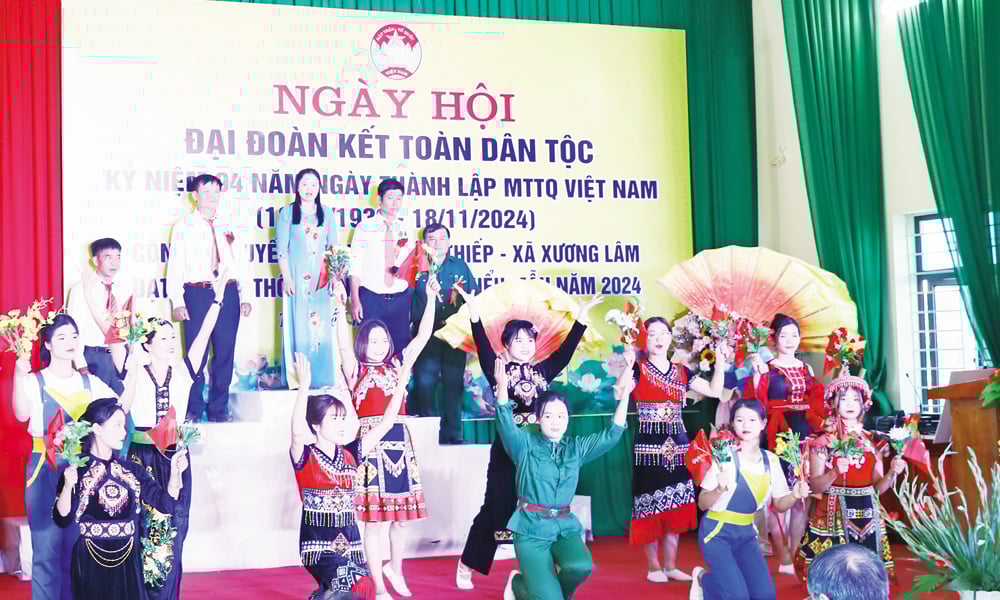 |
The cultural center in Tan Thiep village (Lang Giang commune) meets the needs of community activities. |
Nowadays, cultural centers are not only places for meetings and disseminating the Party and State's policies and guidelines, but also spaces for cultural activities, artistic exchanges, sports training, and improving the health and spiritual life of the people.
Going back to the period when the Project for the Development of Grassroots Cultural and Sports Facilities in the 2022-2024 period was implemented, the People's Committee of Bac Giang City (formerly) allocated budget to support up to 95% of the cost of building new cultural centers (not exceeding 3.5 billion VND/project) and 2 billion VND/project for repairs. Over three years, the locality built and repaired 127 cultural centers and 30 sports fields with a total cost of nearly 530 billion VND. In addition, wards and communes actively mobilized social contributions, with each household contributing an average of 300,000 - 800,000 VND; many businesses and philanthropists donated equipment and supplies to support activities.
Ms. Le Thi Kiem, Chairwoman of the Tan Tien Ward People's Committee, said: "Along with state funding, the locality proactively allocates land and mobilizes additional resources to build and expand cultural and sports facilities. Currently, all residential areas in the ward have spacious community centers with modern equipment, meeting the needs of community activities well."
In recent years, localities in the province have prioritized funding for the construction, renovation, and upgrading of cultural centers in wards, communes, villages, and residential areas. For example, in the former Bac Giang province, over the past 10 years, from the state budget, national target programs, and social contributions, communes have allocated more than 440 billion VND to build and repair 166 cultural centers; villages have been allocated more than 1.8 trillion VND to upgrade and build more than 1,800 cultural centers. By June 2025, most villages, hamlets, and residential areas in the province will have cultural centers, with nearly 95% of the facilities meeting the standards set by the Ministry of Culture, Sports and Tourism .


With open and transparent approaches, and skillful mobilization by villages and residential areas, people and businesses enthusiastically responded and contributed money to build these projects. For example, in Buoi village (Cam Ly commune), in addition to state funding, residents contributed over 1 billion VND to build a multi-functional cultural center with complete equipment. In Lai residential area (Viet Yen ward), the new cultural center, along with a spacious and beautiful playground and grounds, was quickly completed. This project was a joint effort between the State and the people.
For the former Bac Ninh province, as of early 2025, nearly 84% of village and neighborhood cultural centers met the required standards. A prime example is Chi Ho village (Tan Chi commune), which received significant investment to build a 30,000 m² cultural and sports complex, including a 500-seat cultural center, a regulating lake, and football, badminton, and volleyball courts. Additionally, the province has constructed 11 Quan Ho folk singing performance venues in Quan Ho villages, creating unique cultural spaces that preserve and disseminate this valuable heritage. The province's policies and projects for developing cultural and sports facilities have been implemented in several stages, contributing to the mobilization of resources and the gradual, comprehensive upgrading of the cultural and sports infrastructure at the grassroots level.
Active participation, spreading the movement
The increasingly modern cultural and sports facilities not only transform the appearance of rural and urban areas but also strongly promote the development of cultural and sports movements at the grassroots level. According to the Department of Culture and Family Management (Bac Ninh Department of Culture, Sports and Tourism), villages and residential areas have strengthened their management boards to oversee and establish regulations for the organization and operation of cultural centers. Approximately 60% of cultural centers are open daily to serve community activities. Most facilities are utilized effectively, serving not only as venues for meetings and dissemination of Party and State policies but also as places for children to play, for young people to play volleyball and football, and for women and the elderly to practice Tai Chi, dance, and participate in cultural and artistic activities.
According to the Bac Ninh Department of Culture, Sports and Tourism, in the coming period, wards and communes need to focus their investments on key areas, avoiding scattered efforts, to ensure that the system of cultural and sports facilities meets the prescribed standards. Villages, hamlets, and residential areas should improve the efficiency of managing and utilizing facilities, diversify activities, and enhance the quality of cultural, artistic, and sports movements at the grassroots level, attracting people's participation. |
In Chi Ho village, Tan Chi commune, the cultural and sports complex is bustling daily with clubs for football, volleyball, health exercises, folk dance, Quan Ho singing, poetry exchange, and more. Ms. Do Thi Ho, head of the village's Elderly Health Exercise Club, shared: “With a spacious and clean environment, over 100 club members maintain regular exercise, improving their health and strengthening their bonds. Cultural, artistic, and sports activities in the village are thriving, and the people's spiritual lives are increasingly improving.”
Modern infrastructure has facilitated the vibrant activities of nearly 4,000 amateur arts clubs and groups, and over 3,800 sports clubs throughout the province. Many facilities have become "common homes" for meetings, funerals, and weddings, helping people save costs and build a civilized lifestyle. This has contributed to improving the quality of the "All People Unite to Build a Culturally Rich Life" movement. In 2024, both Bac Giang and Bac Ninh (formerly) provinces had over 94% of their villages and residential areas recognized as culturally advanced.



In the coming period, Bac Ninh province will continue to invest in a comprehensive system of cultural and sports facilities, especially in disadvantaged areas. Simultaneously, priority will be given to building traditional art theaters, high-quality cinemas, and cultural facilities in industrial zones. Along with state budget funding, the province aims to promote social mobilization to increase investment resources and maximize operational efficiency. According to the leaders of the Department of Culture, Sports and Tourism, localities need to invest strategically and strategically, avoiding scattered investments, to ensure that the cultural and sports facilities meet the required standards. The department will strengthen training and professional development for cultural and sports officials at the grassroots level to improve their awareness, professional skills, and ability to advise and organize attractive and effective activities. The wards and communes direct and guide villages, hamlets, and residential areas to increase the efficiency of managing and using facilities, diversify activities, improve the quality of cultural and artistic movements at the grassroots level, and attract a large number of people to participate.
Source: https://baobacninhtv.vn/nhung-diem-hen-ket-noi-cong-dong-postid422116.bbg


![[Photo] General Secretary and President To Lam works with the Party Committee of the Government on the work of preventing and combating storms, floods, extreme natural disasters and climate change.](https://vphoto.vietnam.vn/thumb/1200x675/vietnam/resource/IMAGE/2026/06/29/1782729441945_a1-bnd-0385-9454-jpg.webp)
![[Photo] National Assembly Chairman Tran Thanh Man attends the Conference to announce the Master Plan for Hanoi Capital City with a 100-year vision.](https://vphoto.vietnam.vn/thumb/1200x675/vietnam/resource/IMAGE/2026/06/29/1782709639728_ndo_br_1-jpg.webp)
![[Image] A look back at the capital's preparations for the century-long master plan.](https://vphoto.vietnam.vn/thumb/1200x675/vietnam/resource/IMAGE/2026/06/29/1782750453122_quy-hoach-100-nam-minh-duy-1-2118-jpg.webp)









































![[Image] Building an elevated road through the Ma Da forest.](https://vphoto.vietnam.vn/thumb/402x226/vietnam/resource/IMAGE/2026/06/29/1782724737750_anh-man-hinh-2026-06-29-luc-16-18-43.png)