

HPV can be transmitted through sharing towels and underwear, in addition to sexual contact, silently causing genital infections and cancer.
Hien, 25 years old, had been experiencing menstrual irregularities and abnormal vaginal discharge for three months. After a gynecological examination, Hien was diagnosed with HPV type 16 infection, suspected of causing cervical cancer. At the Ho Chi Minh City Oncology Hospital, she received the diagnosis of stage 2 cervical cancer.
"I was shocked because I had never had sex. During my student years, I shared a room with many people. There was only one washing machine in the entire dorm, so we often gathered dirty clothes and underwear to wash together with my roommates. I'm not sure if this was the source of infection," Hien said, feeling confused.
Viet Anh, 30 years old, discovered several pimples on his foreskin in mid-June, which grew into clusters. Initially, he chose laser treatment to remove the pimples because he was hesitant to go to the hospital. Only when the pimples recurred and multiplied did he go to the hospital for examination and was diagnosed with genital warts. The man stated that he is married, has no extramarital affairs, and only works out at the gym daily, using towels provided by the gym.
Dr. Doan Ngoc Thien, from the Andrology Department at Tam Anh General Hospital in Ho Chi Minh City, stated that HPV (Human papillomavirus) is a type of virus that causes papillomas in humans. HPV infection is very common; men and women are infected with HPV at least once in their lifetime. HPV is primarily transmitted through sexual contact. Even if one has not had sexual intercourse, they can still be infected with HPV through many undetected and inconspicuous routes.
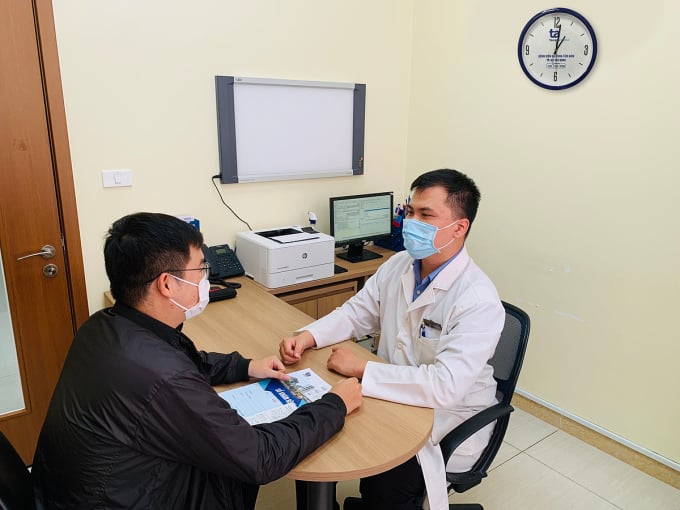
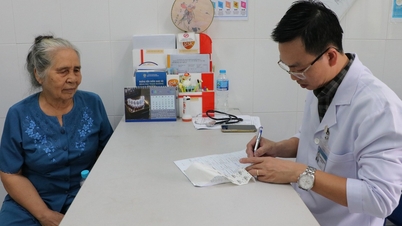
Doctor Ngoc Thien examines a patient at Tam Anh General Hospital in Ho Chi Minh City. Photo: Moc Thao
Dr. Bach Thi Chinh, Medical Director of the VNVC Vaccination System, shares this view. The notion that HPV is only transmitted through sexual contact leads many people to associate it with a "promiscuous" and unsafe sex life. However, HPV can still be transmitted in many other ways.
To elaborate, Dr. Chinh cited a scientific article published in the US National Library of Medicine in 2020 on the topic of non-sexual HPV transmission. HPV can survive for many days on surfaces such as clothing, personal hygiene items, and frequently used gynecological devices. The virus survives in water and can be infectious after 7 days (even in a dry environment afterward), with a 30% infection rate. HPV DNA has also been found in water, further suggesting the possibility of virus spread; however, there is no clear evidence of this transmission route.
Standard hygiene practices are ineffective in preventing HPV transmission. There is evidence that HPV type 16 survives even after alcohol disinfection.
"Therefore, even without sexual intercourse, people can still be exposed to pathogens by sharing clothes, underwear, or towels; or pathogens can be transmitted through scratches on the skin," Dr. Chinh said.
HPV is the leading cause of genital cancer in women. In Vietnam, a 2013-2014 study by Hanoi Medical University, funded by UNFPA and conducted in Hai Phong and Can Tho, showed that the rate of HPV infection in patients with invasive cervical cancer reached 91%; of which HPV type 16 accounted for 45%, HPV type 18 for 19%, and types 33, 52, and 58 accounted for 1-3%.
Currently, there are no studies on the prevalence of HPV infection in Vietnamese men. Globally , HPV is the causative agent for over 600,000 cases of cervical cancer, 80,000 cases of oropharyngeal cancer, and 11,000 cases of anal cancer.
Therefore, experts advise everyone to be vigilant about HPV. In addition to measures such as safe sex and regular HPV screening (for women), people should pay attention to their lifestyle, avoiding sharing underwear and towels with others. When doing laundry, underwear, towels, and daily clothing should be washed separately.
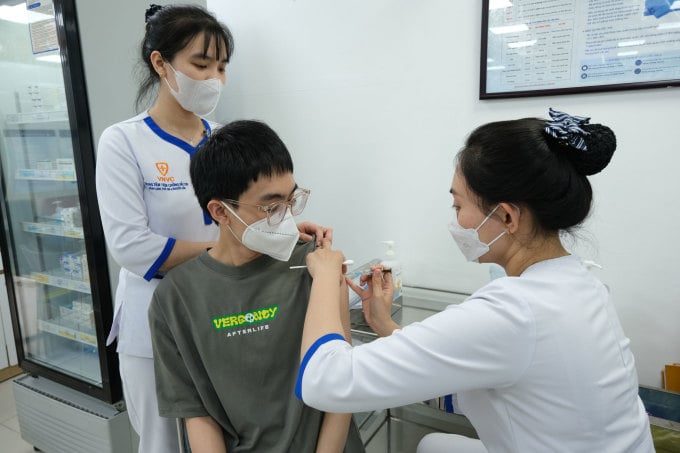
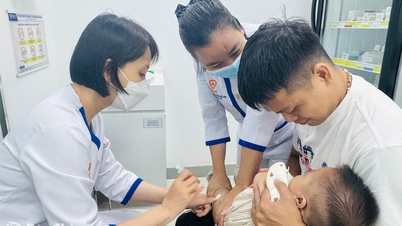
Men receiving HPV vaccination at VNVC Hoang Van Thu. Photo: Moc Thao
According to Dr. Chinh, everyone should proactively get vaccinated against HPV to prevent the disease. Currently, the HPV vaccine is indicated for males and females aged 9-26; it can be extended to age 45 if there is a risk.
Dr. Chinh believes that people should also pay attention to HPV vaccination for children aged 9-14. Vaccination at this age helps children better prevent the disease because they have not yet engaged in sexual activity.
Currently, Vietnam uses two types of HPV vaccines: Gardasil and Gardasil 9. Gardasil contains four HPV strains (6, 11, 16, and 18) to prevent HPV-related diseases such as cervical cancer, vulvar and vaginal cancer, oropharyngeal cancer, and genital warts. Gardasil 9 contains nine high-risk HPV strains (6, 11, 16, 18, 31, 33, 45, 52, and 58) and can be administered to both men and women. Individuals who have been sexually active or previously infected with HPV can still receive the vaccine to protect against other strains and prevent reinfection.
Chile
*Character names have been changed.
Source link




![[Photo] Prime Minister Pham Minh Chinh receives the Chinese Ambassador to Vietnam](https://vphoto.vietnam.vn/thumb/1200x675/vietnam/resource/IMAGE/2026/04/05/1775397481797_ndo_br_dsc-5512-jpg.webp)





































































![[INFOGRAPHICS] Exploiting children's personal images for profit can result in fines of up to 50 million VND.](https://vphoto.vietnam.vn/thumb/402x226/vietnam/resource/IMAGE/2026/04/06/1775442200854_1775442148.webp)




















Comment (0)