

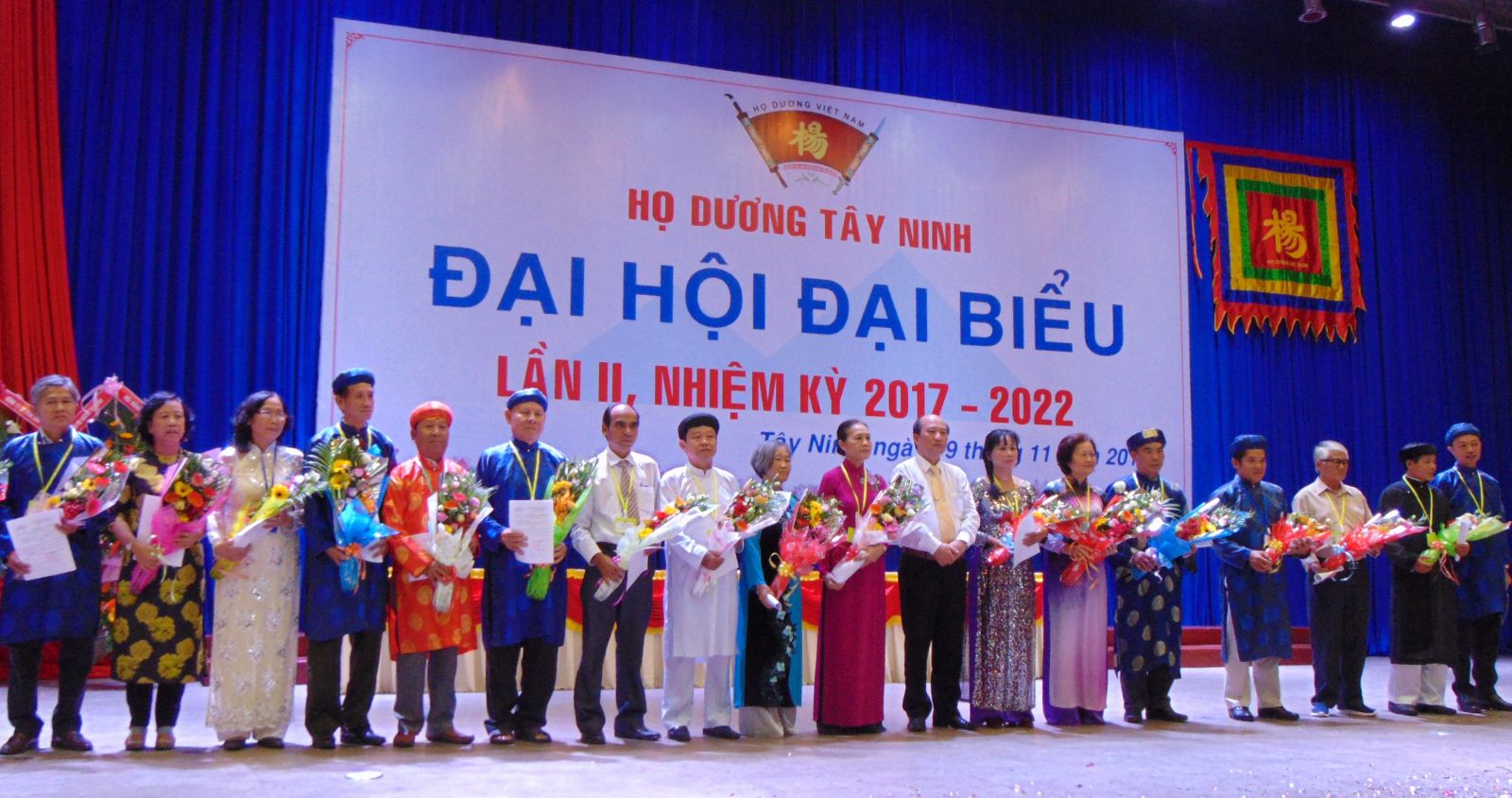
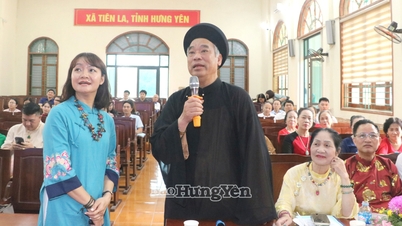
The Second Congress of the Duong Family Association of Tay Ninh . Photo: NQV
The Dang family clan…
Mr. Dang Van Tach (83 years old, residing in Gia Loc ward, Trang Bang town) - a fifth-generation descendant of the Dang family in Trang Bang, and Head of the Ritual Committee of the Dang Van Truoc temple - recounted that before the 17th century, due to the Trinh-Nguyen conflict and prolonged civil war, many people from Central Vietnam left their homeland to settle in the South. Among them was Mr. Dang Van Truoc (titled Dang Uy Dua), from An Nam district, Binh Dinh province.
In 1811, Mr. Dang Van Truoc settled in Ben Don (Bung Binh hamlet, Hung Thuan commune, Trang Bang town today) to reclaim land for farming and livelihood. However, because the land in Ben Don was rocky and sandy, making cultivation difficult, in 1818, Mr. Truoc and a number of prominent figures went to Binh Tinh village (Trang Bang town today) to request the transfer of some land plots to reclaim and establish a village called Phuoc Loc village.
At that time, Trang Bang was a wild, densely forested area teeming with wild animals. In 1821, Mr. Truoc led the people in digging a canal connecting to the Trang Bang stream to open a trade route and establish a market there. He expanded the roads and built streets, transforming a desolate area into a prosperous agricultural and commercial hub, bustling with activity as buyers and sellers exchanged goods along the docks.
With the growing needs of the residents, Mr. Truoc purchased more land to expand the boundaries of Phuoc Loc village. In 1836, the 17th year of Minh Mang's reign, Phuoc Loc village was renamed "Gia Loc village" (now part of Gia Loc ward, Trang Bang town). At this time, Cambodian invaders frequently crossed the border to harass and plunder the people's property, but Mr. Dang Van Truoc and his militia repelled them all. The village enjoyed peace and prosperity, so he was appointed "Cả" (village headman).
On March 5th, 1826 (the year of Bính Tuất), Mr. Đặng Văn Trước passed away. To commemorate his contributions in reclaiming land, digging canals, establishing markets, and defending the village against invaders, after his death, the people of the region buried him and built a tomb at his first stop in Bến Đồn. Every year, on the night of the 11th and the morning of the 12th of the 10th lunar month, local people and relatives flock to his tomb to offer incense and remember the man who contributed to the development of the Trảng region.
The people revered Mr. Dang Van Truoc as their tutelary deity and, together with the local government, built Gia Loc communal house (now Trang Bang ward, Trang Bang town) to worship him. During the reign of Emperor Bao Dai VIII, the communal house was bestowed the title "Duc Bao Trung Hung Linh Phu Chi Than". In 1994, Gia Loc communal house was recognized by the Ministry of Culture and Information as a national historical and cultural relic.

Thai Binh Temple - the place of worship for Mr. Vo Van Oai.
However, Mr. Phi Thanh Phat, a member of the Vietnam Folk Arts Association and a researcher of the Dang family in Trang Bang town for many years, said that perhaps due to the taboo of using the family name and the turmoil of war leading to the loss of records, there was confusion between Mr. Dang The Vua and Mr. Dang Van Truoc. Currently, the temple of Mr. Dang Van Truoc preserves the family's genealogy written in Han Nom script, which records the life and activities of the ancestors of the Dang family.
According to this family tree, Mr. Dang The Vua held the position of "Trùm Xụi" (Head of Tax Collection), overseeing tax collection. He, along with his family and some migrants, pioneered a vast area stretching from Bung Binh to the Dau Tieng region, passing through Tra Vo, Go Dau, and the western part of the area, now comprising Phuoc Chi and Phuoc Binh communes in Trang Bang town. He was the founder of the villages of Gia Loc, Loc Ninh, and Phuoc Hoi.
Besides reclaiming land, Mr. Vừa also gathered people from many places to help them cultivate the land, providing them with rice and money to make a living. He repeatedly recruited militia, purchased weapons, and trained soldiers with the motto "farmers in peacetime, soldiers in wartime." In 1821, he led the people of Phước Lộc village in digging a canal connecting to Trảng Bàng stream to open a trade route and establish a market there. He also built more roads and streets, developing local commerce. However, the canal passing through Bình Tịnh village led to a lawsuit from the village officials, resulting in Mr. Vừa being sentenced to 80 lashes and having a written confession of guilt recorded.
Due to a long-standing feud with Binh Tinh village, on one occasion, while returning from work, Mr. Dang The Vua stopped to rest in the Cay Cao area, where he was poisoned by three villains. After mounting his horse, he began to feel the effects of the poison but managed to make it back to Trang Bang market before passing away. The villagers mourned him and built both a temple and a communal house in his honor. These are the temple of Mr. Dang Van Truoc and the Gia Loc communal house that exist today.
...Along with many other clans
In 2012, the Ho Chi Minh City Genealogical Research and Practice Center completed the recording and compilation of the Tran family genealogy book in An Tinh ward, Trang Bang town. According to the book, the ancestors of the Tran family resided in An Tinh since the area was still Binh Tinh village, belonging to Binh Cach commune, Thuan An district, Gia Dinh province. From then until now, over 160 years, the Tran clan has experienced countless ups and downs and losses, along with other families, toiling to clear the wilderness, shedding blood to fight foreign invaders, and preserving An Tinh as it is today.
The book "Southeastern Vietnam - People and Culture" by Dr. Phan Xuan Bien states that in An Khuong hamlet, also known as Cay Sao hamlet, the Phan family is considered the first to settle there. In An Phu village (also known as Hoc Ot hamlet), there was the Ho family; in An Thanh village (Sinh Tranh), there was the Le family (ancestor Le Van Phi), later changed to the Nguyen family; in An Binh village (Cay Cau), there was the Truong family and their descendants Truong Tung Quan and the Dinh family; in An Thoi village (Trau hamlet), there was the Tran family; in Tinh Phong village, there was the Doan family; and in An Duoc village (Bau May, Tra Nguon), there was the Le family…
Mr. Nguyen Quoc Viet, former Vice Chairman of the Tay Ninh Provincial Association of Literature and Arts, wrote an article about clans during the land reclamation period (published in Tay Ninh Newspaper in 2017). In it, he mentioned that in 1836, when Tay Ninh prefecture was established, policies encouraging migrants to clear land and establish villages in the new area led to an increasing number of people settling in Tay Ninh. Around 1700, Mr. Duong Tan Phong arrived in Gia Binh village, establishing the Duong clan in Tay Ninh.
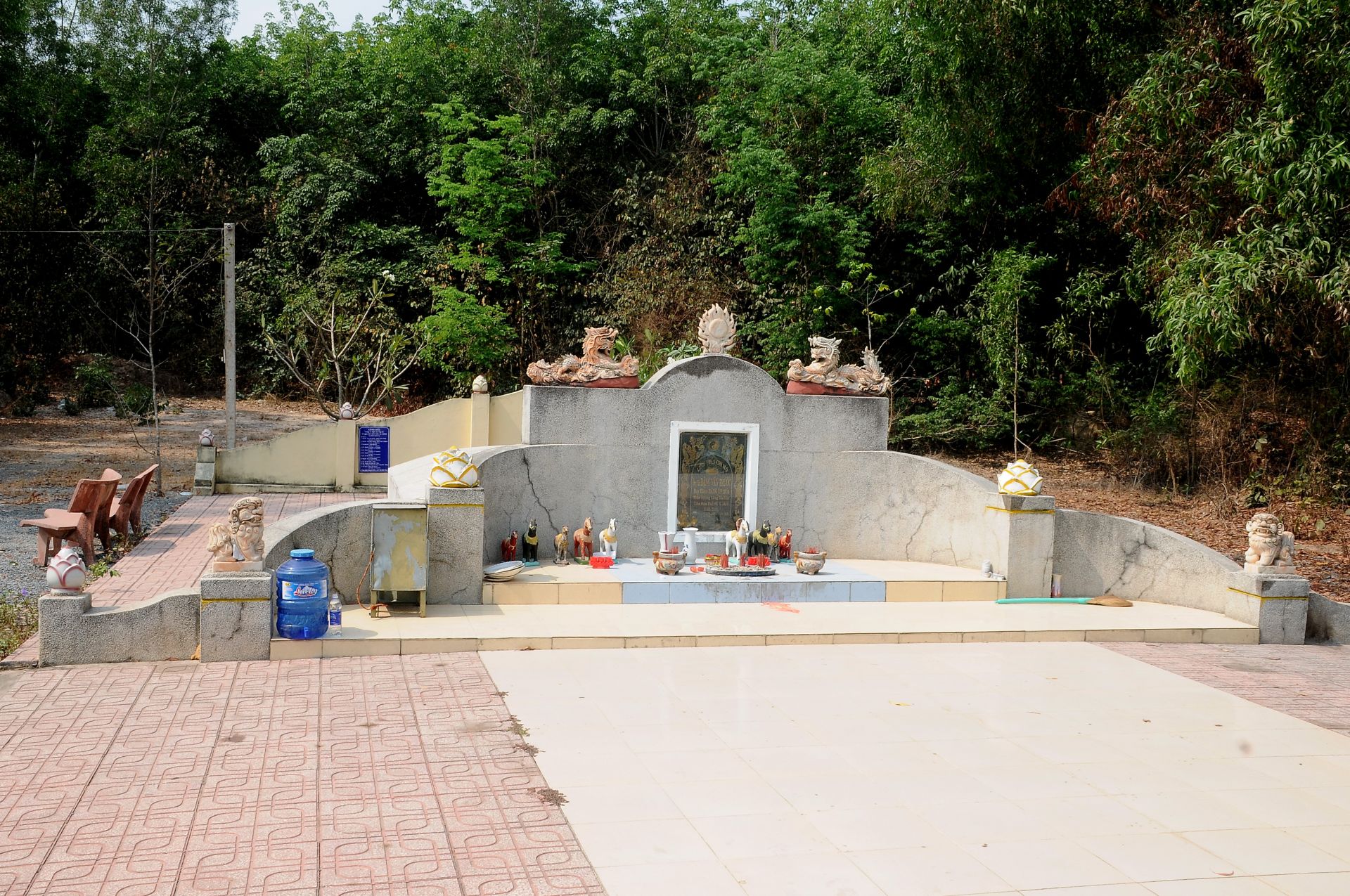
The tomb of Mr. Dang Van Truoc.
In the mid-18th century, there was also the Vo family, headed by Mr. Vo Van Oai, who is traditionally believed to have fought against invaders and protected civilians in the area of what is now Chau Thanh district and Tay Ninh city. After his death, he was revered by the people as the tutelary deity and worshipped at Thai Binh communal house (Tay Ninh city) and Thanh Dien communal house (Thanh Dien commune, Chau Thanh district).
In Thanh Dien commune, there are also the Do, Truong, Lam, and Nguyen clans… Therefore, currently, in Thanh Dien communal house, besides the patron deity of the Vo clan, the Do and Truong clans are worshipped as ancestors and later generations.
In reality, during the time of Tây Ninh's settlement, besides well-known families such as the Huỳnh Công Giản and Huỳnh Công Nghệ brothers, and the Đặng family in Trảng Bàng, many other families also joined hands to create the beautiful land of Tây Ninh we see today.
Ocean
Source




































































Comment (0)