Many women believe that simply freezing their eggs will give them peace of mind knowing they can have children at any age in the future.
- Why are more and more women in their 30s choosing to freeze their eggs?
- Common misconceptions about egg freezing
- Myth 1: Freezing eggs guarantees conception.
- Myth 2: You can wait until you're 45-50 to have children.
- Myth 3: Just stocking up on a few eggs is enough.
- What are the current costs involved in egg freezing?
- Who should consider freezing their eggs?
- When should this be done?
- Things to do before making a decision
- 1. Assess ovarian reserve
- 3. Preparing for reproductive health
In reality, egg freezing is not absolute "reproductive insurance" and does not guarantee pregnancy when needed.
The good news is that freezing eggs at the right age can help preserve fertility better than waiting until age 40 to think about becoming a mother.
The most important thing is to have a proper understanding of the success rate, actual costs, and limitations of this technology before making a decision.
Why are more and more women in their 30s choosing to freeze their eggs?
Over the past 10 years, egg freezing has become a trend that many women around the world are interested in.
Common reasons include:
- I haven't found a suitable life partner yet.
- I want to focus on developing my career.
- Not ready to be a mother yet.
- Concerns about declining fertility with age.
- Preparing for treatment of cancer or other conditions affecting reproductive function.
Between the ages of 30 and 35, many women are still in good health but begin to become more aware of their "biological clock." This leads many to consider egg freezing as a contingency plan for the future. However, this is also the time when the most misunderstandings arise. Eggs don't age in the freezer, but the body does. This is the most important point that many people overlook.
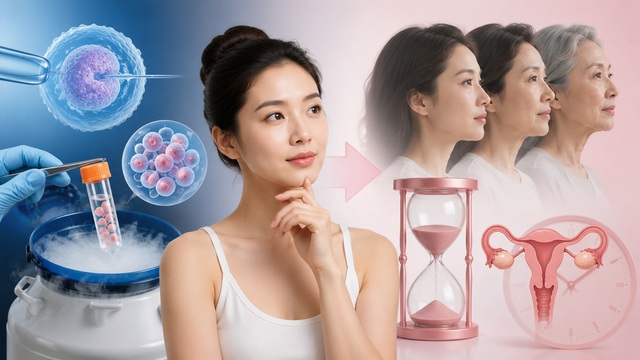
Egg freezing helps preserve the quality of eggs at the time of retrieval, but it cannot prevent the natural aging process of a woman's body.
When eggs are frozen using modern vitrification techniques, their quality is almost entirely preserved compared to the time they were harvested.
That means:
- Eggs frozen at age 30 still retain the "biological age" of a 30-year-old.
- Eggs frozen at age 38 still retain the "biological age" of 38.
In other words, the timing of egg retrieval is more important than the timing of egg use.
This is why fertility centers often consider a woman's age to be the most important factor in determining the effectiveness of egg freezing.
Common misconceptions about egg freezing
Myth 1: Freezing eggs guarantees conception.
The process of conceiving from frozen eggs involves several steps:



- Thaw.
- In-vitro fertilization (IVF).
- Embryo culture.
- Embryo transfer.
- The nest was successfully built.
- The pregnancy reached full term.
Each step has its own success rate. Not all frozen eggs will result in a healthy baby.
Myth 2: You can wait until you're 45-50 to have children.
Eggs can be preserved for a long time. But a woman's uterus, hormones, cardiovascular system, and overall health continue to age over time.
Pregnancy at an older age may increase the risk of:
- Gestational hypertension.
- Gestational diabetes.
- Premature birth.
- Obstetric complications.
Myth 3: Just stocking up on a few eggs is enough.
- Not all eggs survive thawing.
- Not all eggs are successfully fertilized.
- Not all embryos develop normally.
This is why doctors often advise on a target number of eggs rather than focusing on just one retrieval procedure.

Experts recommend that women undergo a thorough assessment of their ovarian reserve and receive comprehensive counseling before deciding to freeze their eggs.
What are the current costs involved in egg freezing?
Depending on the treatment facility, the cost may vary. Typically, it will include:
- Examination and testing to assess ovarian reserve.
- Ovarian stimulation drugs.
- Egg retrieval.
- Freeze eggs.
- Annual storage fee.
In Vietnam, the total cost for one cycle typically ranges from tens of millions to over 100 million VND, depending on the amount of medication used and the ovarian response.
There are also annual storage fees.
Who should consider freezing their eggs?
- The woman has no plans to have children in the next few years.
- I haven't found a suitable life partner yet.
- There is a risk of decreased ovarian reserve.
- She has a family history of early menopause.
- Preparing for cancer treatment.
- To preserve fertility while still young.
When should this be done?
| Age | Egg quality |
|---|---|
| Under 30 | Very good |
| 30-34 | Good |
| 35-37 | Start to decrease |
| 38-40 | Significant reduction |
| Over 40 | A sharp drop |
This doesn't mean women over 35 shouldn't freeze their eggs. However, the effectiveness in preserving fertility is generally higher when done earlier.
Things to do before making a decision



1. Assess ovarian reserve
What should be done:
- AMH.
- Ultrasound to count secondary ovarian follicles.
- Specialist examination for assisted reproductive technology
- How long do I want to postpone having a baby?
- Can I afford long-term storage?
- What can I expect from freezing my eggs?
3. Preparing for reproductive health
- Maintain a healthy weight.
- No smoking.
- Limit your alcohol consumption.
- Get enough sleep.
- Control underlying medical conditions.
Advice
Egg freezing is a tool to preserve fertility, not a guarantee of future pregnancies. Women should receive thorough counseling regarding age, ovarian reserve, expected egg retrieval volume, actual success rates, and long-term costs before making a decision. The ideal time to consider freezing eggs is usually when egg quality is still good, rather than waiting until fertility has significantly declined.
Egg freezing is becoming an increasingly popular option for modern women who want more control over their family planning. However, it is not a "guarantee" of future pregnancy.
Understanding the biological age of eggs, the actual success rates, costs, and limitations of the technique will help each individual make decisions that are appropriate for their personal circumstances and long-term reproductive goals.
Source: https://suckhoedoisong.vn/nhung-lam-tuong-ve-tru-dong-trung-169260615092945882.htm