

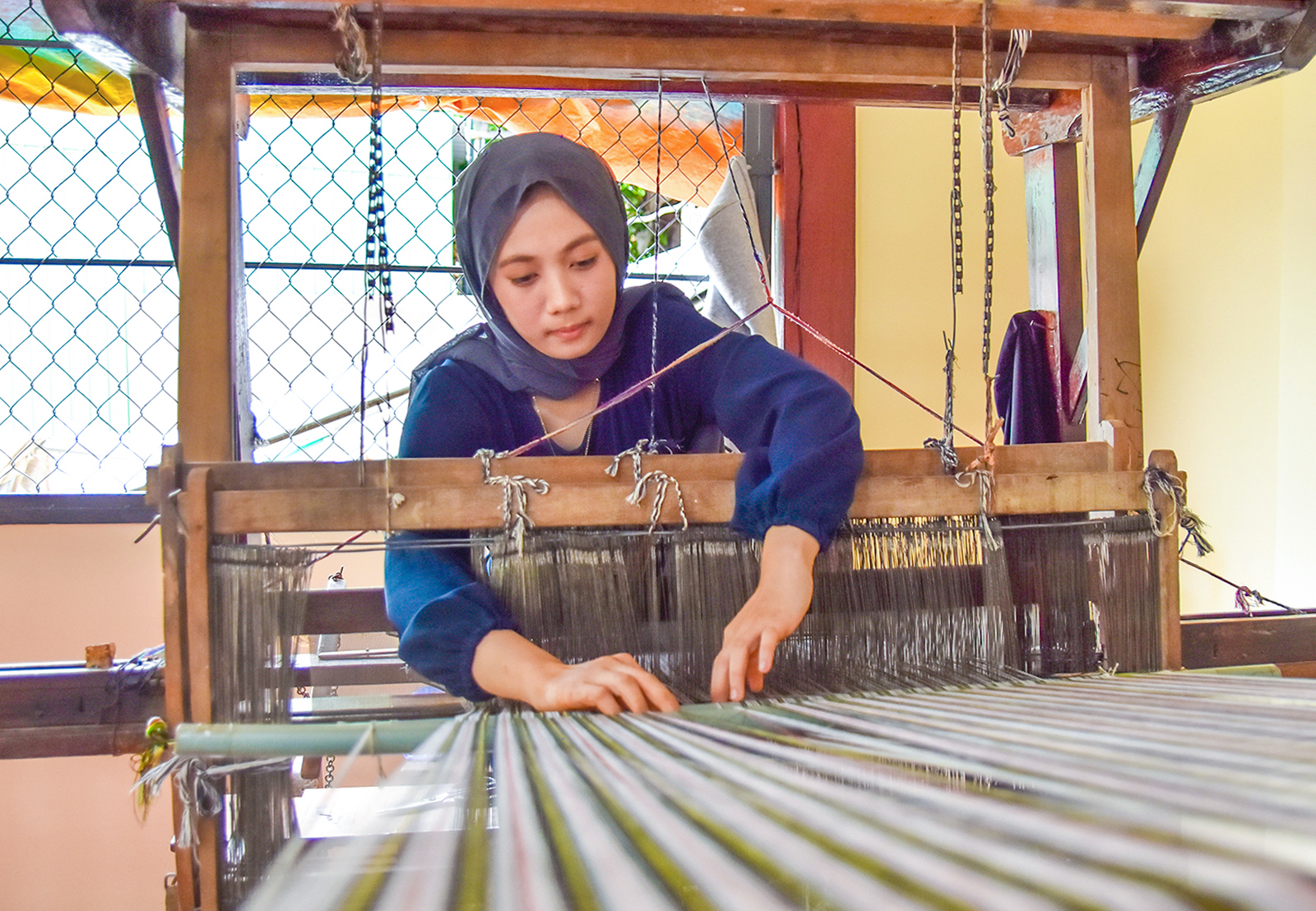
A Cham girl at the loom. Photo: THUY TIEN
As the year draws to a close, the brocade weaving village in Chau Phong commune bustles with the sounds of shuttles and the clicking of looms. Cham women showcase their embroidery and weaving skills, creating brocade fabrics with exquisite colors and patterns. According to many locals, the brocade weaving village in Chau Phong commune is the cradle of the Cham people's long-standing traditional weaving craft. Since the early 19th century, almost every Cham household has at least one loom, and weaving has become a skill that every Cham woman knows how to do.
What makes Chau Phong brocade unique is the meticulousness in every step, from spinning the yarn, dyeing, stretching the frame to weaving the finished product. No machinery is used; every operation is done manually by skilled hands, with perseverance and techniques passed down through generations. Unlike brocade from many other places, products from the Chau Phong brocade weaving village stand out with vibrant, warm colors such as red, orange, and yellow, harmoniously combined to create stylized, sophisticated patterns and motifs with deep spiritual meaning. The brocade products here are distinctive because they use dyeing techniques involving fruit peels, tree sap, and plants.
Cham ethnic brocade products are a frequent feature in the daily life of the Cham people. Sometimes they adopt new and beautiful patterns from other places and combine them with traditional patterns to create more innovative and diverse products. However, traditional elements remain a constant thread throughout their products. Therefore, the brocade weaving products from these villages are deeply rooted in Cham cultural identity, possessing both softness and sophistication, from color coordination to weaving techniques and pattern creation.
Mr. Mohamad, residing in Chau Phong commune, said: "Although the brocade of the Cham people is different from before, it still retains its traditional patterns. The main material used is industrial silk, and the colors are hand-dyed using natural materials such as tree sap, bark, and the fruit of the Mac Nua tree – a secret passed down through many generations in our Cham community."
Phu Quoc Island boasts stunning scenery and a distinctive traditional fish sauce making village. These fish sauce production facilities not only process the specialty product but also preserve traditional fish sauce-making techniques. According to many long-time residents of Phu Quoc, the fish sauce making profession originated from fishermen who couldn't consume all their anchovies, so they devised a method of preserving them by fermenting them with salt. Over time, the profession developed, producing renowned fish sauce factories.
When mentioning Phu Quoc fish sauce, many people think of the Khai Hoan brand, belonging to Khai Hoan Trading Joint Stock Company. This is a traditional fish sauce producer with over 40 years of history and development. Famous for its naturally fermented traditional fish sauce and geographically indicated fish sauce, Khai Hoan fish sauce is favored by consumers both domestically and internationally. Owning over 900 wooden fermentation vats, Khai Hoan Trading Joint Stock Company produces 5-6 million liters of fish sauce annually, and this production continues to increase each year. Each product is made from the essence of Phu Quoc island, a culmination of traditional values passed down from ancestors, combined with continuous research and improvement to protect consumer health.
The beauty of Phu Quoc's fish sauce making village also reflects the lifestyle and mindset of the local people. Fishermen set out to sea early in the morning to catch fresh fish; the selected fish are then thoroughly washed to remove impurities. The mixture of fish and salt is transferred into rows of dark brown, visually appealing wooden fermentation vats. After about 12-15 months, the fish sauce is continuously inspected and tested by experienced workers to ensure the health of consumers.
Finally, the fish sauce is carefully bottled to maintain its purity and natural delicious flavor. “The Phu Quoc fish sauce making village has existed for hundreds of years, representing the pride and cultural tradition of the local people, a refined art that transcends the sea to the dinner table,” shared Ms. Ho Kim Lien, President of the Phu Quoc Traditional Fish Sauce Association.
| An Giang province boasts numerous recognized traditional craft villages. These include the traditional fish sauce making village of Phu Quoc, the plastic chair weaving village of Vinh Phong commune, the Cham brocade weaving village of Chau Phong, the palm sugar production and processing village of Chau Lang (now Tri Ton commune), and the incense making craft of Binh Duc. Each craft village possesses its own unique beauty, but all share a common spirit of community solidarity, working together to preserve the cultural heritage passed down from their ancestors. |
Source: https://baoangiang.com.vn/nhung-lang-nghe-tram-nam-a474288.html


![OCOP during Tet season: [Part 3] Ultra-thin rice paper takes off.](/_next/image?url=https%3A%2F%2Fvphoto.vietnam.vn%2Fthumb%2F402x226%2Fvietnam%2Fresource%2FIMAGE%2F2026%2F01%2F28%2F1769562783429_004-194121_651-081010.jpeg&w=3840&q=75)


Comment (0)