

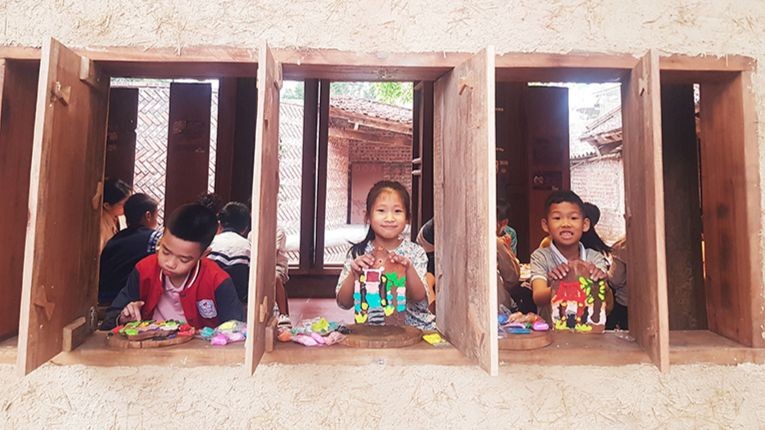
Children from Duong Lam village show off their drawings at "Doai Creative".
"Land of Two Kings" - just hearing the name - seems to encapsulate the very essence of the culture of the white-clouded Đoài region! However, Đường Lâm once faced the struggle between its traditional houses and the realities of daily life, land division, and household separation in the age of Industry 4.0.
And now, many new houses (but with their deep brown tiled roofs, harmonizing with the mossy charm of this typical Northern Vietnamese village) and even old houses that have been renovated and upgraded to withstand the ravages of time... are showing that Duong Lam is finding the right "path"...
Passing through the gate of Mong Phu village a short distance, one cannot help but be impressed by a rustic brick gate. A quarter of the circle of the well's base, made of laterite brick, has been built in an arched style by the owner to serve as the entrance to the house. "Surely everyone will have a feeling that is both strange and familiar. In the old days, every house in the village had a well, right? The old well bases (sometimes called 'well cloths') were built with arched bricks."
"I simply 'pulled' a corner of that well's base up to make a gate. That's how I bring people back to the old values of the village," architect Khuất Văn Thắng whispered, recounting his house. Opening that gate, one steps into a tranquil space with the green of trees, the brown of tiles and exposed bricks, and the timeless colors of old wooden doors and pillars.
I simply "pulled up" a corner of the well's base to make a gate. That's how I bring people back to the old values of the village.
Architect Khuat Van Thang
It's a two-story house. The wooden pillars and even a wooden gable are incorporated into the interior design, making one forget that the first floor has a concrete ceiling. Besides the workspace and reception area, the owner has dedicated two rooms on the first floor for friends and tourists to stay in as a homestay business. One also can't help but be impressed by the foundation of the house.
The winding wooden staircase leads up to the second floor, the family's living quarters. The entire second floor is made of wood, with a reddish-brown tiled roof. The staircase also has an interesting feature: a landing made from an inverted bamboo boat – a place where people can sit and enjoy the breeze.
After renting the old house for an extended period, architect Khuất Văn Thắng renovated it into a studio where he works, while also creating a tourist attraction in Đường Lâm. He named it NoK Studio (No stands for Number; K is the first letter of his surname, Khuất). Now, NoK Studio is a favorite destination for many tourists visiting the ancient village of Đường Lâm.
Khuat Van Thang is not from Duong Lam, but he is a son of the Doai region. The culture of the Doai region has permeated him since childhood. “Why did I choose Duong Lam and not somewhere else? It’s not simply an economic matter. If it were just for economic reasons, there are many other ways. There are many values of Doai culture that even the people of Duong Lam haven’t fully grasped.”
"I came here to create a space that fosters heritage, within the broader cultural flow of Duong Lam ancient village. The locals will then realize that people from other places still cherish and utilize the value of the ancient village. They will reflect on themselves and the cultural values they possess, and from there, be motivated to preserve and develop it. That's the message I want to convey to everyone. Next, I want to bring the beauty of the ancient village to the community of visitors and tourists."
Recently, architect Khuất Văn Thắng created another cultural space, also right at the entrance to Mông Phụ village, called “Đoài Creative”. He subtly modified an old tiled-roof house to create spaces with different functions serving cultural and artistic activities. Most uniquely, he recreated a historical feature that has almost disappeared. He removed the plaster and… plastered the walls with a mixture of mud and straw.
Of course, to ensure adhesion, he adds additives. In this space, Khuat Van Thang is organizing art classes for more than 20 children in the village. They will create artworks about their own village on the tiles, bricks, and old doors that he has collected. Similarly, for tourists, after experiencing Duong Lam, they will create their own artworks and can take them away.
To the right of the Mong Phu village communal house, there is also a house that was built a few years ago. The owner is Mrs. Quach Thi Thanh. If Khuat Duy Thang is an architect knowledgeable about culture, then Mrs. Thanh is just an ordinary villager like everyone else in this village. Her five-bay tiled-roof house is decorated in the traditional style. The central bay is for worship, with two sets of long benches for receiving guests on either side. Two separate rooms on either side of the house are for guests to stay overnight.
“I'm from Dong Sang village, and I moved to Mong Phu after getting married. Living in this ancient village, my husband and I both want a house built in the traditional style. Some people have asked why we don't build a modern house? Actually, the regulations in the ancient village don't prohibit building two-story houses; the authorities have suggested some new house designs that are suitable for the surrounding space. But my family only wants to build a house according to the traditional style of our ancestors.”
While recounting stories about her spacious five-room house, Mrs. Thanh enthusiastically introduced the dishes and beauty of the ancient village of Duong Lam: "If you come to Duong Lam and haven't tried roasted pork, rice cakes, or Mia chicken, then you haven't truly been to the ancient village. Those are the unique specialties of this land." Mrs. Thanh, being skilled in the kitchen, provides food and beverage services for tourists.
Although it's a new house, tourists really enjoy the quiet, traditional atmosphere. On some days, upon request, she even "demonstrates" making local specialties for guests to watch before they taste them. Ms. Thanh is very knowledgeable about old stories, so tourists feel free to ask her questions. Many people call her "the storyteller of ancient villages."
In 2022, despite the early part of the year still being affected by the Covid-19 pandemic, Duong Lam welcomed 340,000 visitors.
Duong Lam has now become a "tourist village". In 2022, despite the early part of the year still being affected by the Covid-19 pandemic, Duong Lam welcomed 340,000 visitors. Not only the family of Ms. Quach Thi Thanh, but dozens of other families also built new houses or renovated existing ones, but instead of "box-shaped" houses, they followed the traditional house style. Many families used their houses for business purposes, such as food and accommodation services, including Duong Lam Village homestay, Elephant House, Mami Retreat, and Duong Lam house…
Nguyen Trong An, Deputy Head of the Duong Lam Ancient Village Management Board, has a long-standing connection with the village. Wherever he goes, he is greeted with welcoming invitations from the locals. He is familiar with every house and alleyway. He shared:
"Change doesn't happen overnight; it's a process. Whenever a family wants to build or renovate their house, we go to their location to meet them, understand their needs, provide guidance, and encourage them if necessary. By being close to the people, we understand their thoughts and feelings."
As we ventured deeper into the winding alleys of the ancient village, Mr. Nguyen Trong An pointed out the newly built houses. Although not involved in business activities, the residents adhered to basic principles regarding roof tiles and building height. These new houses sprung up, but without disrupting the ancient, moss-covered architecture.
Duong Lam commune has approximately 1,000 traditional houses, including nearly 100 ancient houses, concentrated mostly in Mong Phu village. It proudly boasts the title of "land of two kings" – the birthplace of King Phung Hung and Ngo Quyen. In 2005, the ancient village of Duong Lam was recognized as a National Historical and Cultural Monument. Exactly 10 years ago (in 2013), Duong Lam became a hot topic when several households submitted petitions to the Hanoi city government requesting the return of its National Cultural Monument status, including one family forced to demolish part of their structure when constructing a multi-story house with a flat roof.
Although only a few households signed the petition, the event reflects a true story: the ancient village of Đường Lâm is torn between preserving its cultural heritage, architecture, and traditional houses, and developing in the context of the country's modernization. Under the moss-covered roofs, families continue to grow; children reach a certain age and need to leave home, requiring their own living space. Meanwhile, not every family benefits from tourism. Preserving the ancient village has never faced such challenges.
The obstacles were gradually removed. In 2013, the Hanoi People's Committee approved the plan for the preservation, restoration, and promotion of the value of the ancient village of Đường Lâm. Along with that, the Sơn Tây Town People's Committee published dozens of house designs, providing a basis for residents to build new houses or renovate existing ones.
However, that's only half the problem. The real challenge is preventing people from reluctantly complying. The Deputy Head of the Duong Lam Ancient Village Management Board added: "If we can't exploit the value of the ancient village, then preservation loses its meaning. The Son Tay town government is improving infrastructure, investing in the restoration of historical sites, and supporting the restoration of key ancient houses, thereby preserving the landscape of the ancient village; at the same time, strengthening promotional efforts."
The number of tourists visiting Duong Lam has been increasing year by year. The locals have gradually understood that disrupting the ancient village's atmosphere would lead to a loss of tourists and livelihoods, so there have been no construction violations for a long time. People building new houses or renovating now consciously follow the guidelines of the Duong Lam Ancient Village Management Board.”
...There are still challenges, especially in how to ensure that more people in the ancient village benefit from tourism. However, 10 years since some households demanded the return of the National Cultural Heritage title, many changes have taken place. Thanks to this, Duong Lam has been and will continue to be a place that encapsulates the most beautiful and quintessential aspects of the culture of the white-clouded Doai region.
Source link
![[Photo] Young people of the Dong Thap Border Guard actively participate in "March Border Month" activities.](https://vphoto.vietnam.vn/thumb/1200x675/vietnam/resource/IMAGE/2026/03/23/1774248483508_ndo_tl_dt3-jpg.webp)











































































Comment (0)