


These pages, imbued with the colors of time, reveal each pencil and charcoal stroke, evoking memories of a bygone era of the land and people the artist was once connected to. At the same time, they contain profound aesthetic value through the way the artist, a graduate of the Indochina Fine Arts School, class 12 (1938-1943), creates portrait sketches of his subjects.
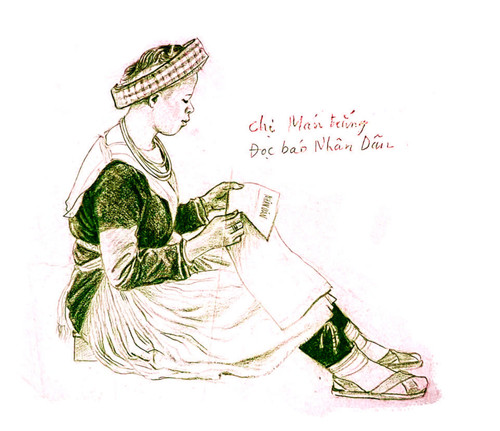
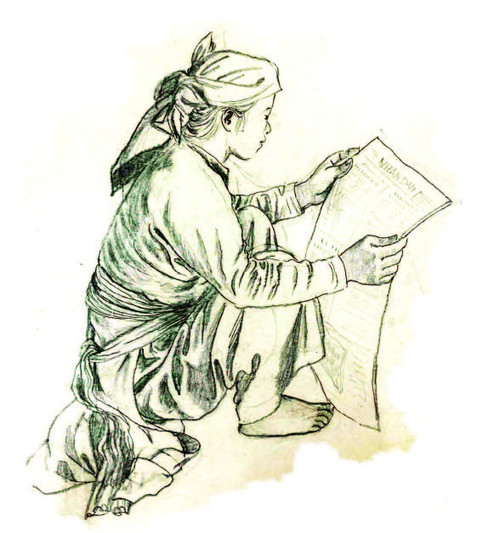
In both sketches, the artist chooses to observe the subject from an oblique angle, from left to right, at approximately 90 degrees. From this viewing position, the Nhân Dân newspaper is prominently depicted, pleasing to the viewer's eye. Following the subject's posture while reading the newspaper, the artist selects a suitable paper size to highlight the subject's content—the sketch of the subject reading the Party newspaper with its many layers of social meaning—while also emphasizing the subject's everyday, feminine beauty, with the clothing meticulously and subtly depicted.
In this vertical sketch, the figure is a Tay ethnic person, distinguished by the headscarf tied at the back of the head and the long, flowing robe. The varying shades of pencil strokes create light and shadow, giving the neatly tied headscarf its volume. The figure sits on a small platform, knees bent, body slightly leaning forward, in a completely relaxed posture. The waist and the flowing robe drape naturally and gracefully behind, defined by short, curved lines and long, slender strokes converging downwards to suggest the shape of the robe and the belt. The details of the robe, headscarf, and the slightly upright, rounded neckline, emphasized by the bolder pencil strokes, contribute to revealing the character of the figure's ethnic group.
The newspaper is held at eye level, hanging down completely, just touching the tips of the character's feet. Notably, besides the meticulously detailed " Nhan Dan" (People's Newspaper) logo, other details on the page, such as article boxes, images, headlines, and text, are all subtly rendered. The artist focuses on the light in the drawing, encompassing the character's shoulders, half of their face, and the newspaper itself, creating the impression of a beam of light shining from behind. The character's rough, sturdy hands, typical of a farmer, firmly grasp the newspaper, conveying their attentiveness to the subject and their act of reading.
In the second sketch, horizontally, the figure folds the newspaper while sitting with her legs slightly extended forward. The way the figure holds the newspaper shows that the artist's sketching is completely natural, without any hint of deliberate arrangement. The Nhân Dân newspaper is rendered in bold lines. The artist also notes above: "White Man reading Nhân Dân newspaper." "White Man" is a common term before 1975, referring to the H'Mông people. Here, the white pleated skirt and the round headscarf are important indicators. The artist pays close attention to the detailed and subtle depiction of the female figure's jewelry, including the necklace, the ring on her right hand, and the color gradient of the upper part of her dress, highlighting the differences in colors and decorative lines on the fabric, even though the artist only used pencil and charcoal in various shades. The light in the second sketch is also focused on the figure's face, looking down at the newspaper. Her hands held the newspaper gently, the corners of her mouth slightly curved upwards, as if she were smiling.
While reading the newspaper, both characters are impeccably dressed and presentable. This portrayal by the artist shows his respect for the newspaper and the characters' reading habits. Perhaps, while observing the characters, the artist simultaneously sensed their reverence for the newspaper, and quickly conveyed this through each brushstroke. The artist's choice of depicting ordinary people from the highlands reading the Nhan Dan newspaper also shows his concern for the level of awareness among the highlanders once they become proficient in Vietnamese.
These two simple, natural sketches by artist Van Binh evoke many other questions in the writer's mind, questions that perhaps only the artist himself can answer convincingly. Sadly, however, the artist passed away in 2004, more than 20 years before we had the chance to see these sketches.
Upon reviewing numerous historical art documents, we found only limited information about the artist during his time living in the mountains and among the people of the northern highlands. Before 1954, artist Van Binh participated in the revolution and worked in Military Region Four. After peace was restored, from 1955 onwards, he worked as a lecturer and in educational administration at the Vietnam Fine Arts School (now the Vietnam University of Fine Arts) until his retirement in 1979. This was undoubtedly a period when he undertook field trips for creative work or led students on internships in the northern mountainous regions. It was also a time when the Vietnamese language was increasingly popularized among ethnic minorities; and the Party and government paid increasing attention to the people's access to information and knowledge through reading and newspapers.
At the Vietnam Fine Arts Museum, in the lacquer painting section, there are three of his paintings: "Ha Long Bay" (90x120.5cm, 1955); "Bamboo and Banana" (66.8x100cm, 1958), depicting a scene of a village pond in the Northern Delta; and "Nam Na Village" (115.7x175.3cm, 1961), depicting the landscape of a pristine village in Than Uyen district, Lai Chau province at the time of creation.
According to Thang, his second son, Prime Minister Pham Van Dong personally invited artist Van Binh to create another lacquer painting of Ha Long Bay as a gift for Indonesian President Sukarno during his visit to Hanoi in 1959. This demonstrated the trust of the Party and State leaders in his meticulousness in creating works using traditional materials, as well as his creativity in painting depicting the beauty of his homeland. He was one of the artists awarded the first State Prize for Literature and Arts in 2001.
Regarding the lack of signatures and dates on the sketches, according to Thang, artist Van Binh didn't have this habit. Later, when someone expressed interest in buying his work and requested a signature and date, he would comply. Therefore, there are a few sketches in pencil, charcoal, or watercolor where his signature is in a different ink color; "at that time, he might just use whichever pen was convenient," Thang recalled.
A brief introduction to the author of the two sketches depicting ethnic minority people reading the Nhan Dan Newspaper is perhaps enough to draw us back to the beauty emanating from the authenticity, natural brushstrokes, and the artist's talent for capturing images, resulting in graceful and lively characters on the page. There, aesthetic and intellectual values are blended, and only through the artist's care and respect for these values, combined with talent and the subtlety in each brushstroke, can the message be fully conveyed.
(*) Over 100 sketches by the late artist Van Binh, including these two, are currently in a private collection in Hanoi.
Source: https://nhandan.vn/nhung-net-va-hinh-quy-gia-post947563.html

![[Image] A night of light, many layers of message](https://vphoto.vietnam.vn/thumb/1200x675/vietnam/resource/IMAGE/2026/03/10/1773158812907_hoa-nhac9-jpg.webp)






![[Image] A night of light, many layers of message](https://vphoto.vietnam.vn/thumb/402x226/vietnam/resource/IMAGE/2026/03/10/1773158812907_hoa-nhac9-jpg.webp)

















































Comment (0)