


The pristine, long stretches of sand at Bai Thit (Nui Chua National Park, Khanh Hoa), Cu Lao Cau (Hon Cau Marine Reserve, Lam Dong), or Hon Bay Canh (Con Dao National Park, Ho Chi Minh City) are not only breeding grounds for rare sea turtles, but also bear the footprints of tourists and volunteers who have learned to coexist with wildlife.
In recent years, ecotourism and educational tours linked to sea turtle conservation have redefined trips, moving beyond simply "observing" to "taking action," returning turtles to the ocean and bringing humans closer to nature.
A miraculous journey
In the early hours of a July night on Hon Bay Canh, one of the largest and most beautiful islands in Con Dao National Park, Nguyen Van Quoc Thai (born in 1997, from Tay Ninh province) witnessed for the first time a green sea turtle (also known as a hawksbill turtle) quietly emerging from the sea, searching for a flat spot on the sand, and beginning to dig a nest to lay its eggs.
Just a few meters away, Thai and his group of volunteers silently observed, feeling both nervous and joyful, as if they were participating in a sacred natural ritual. “Sea turtles are truly beautiful and mysterious creatures. Witnessing mother turtles coming ashore to lay their eggs after traveling thousands of kilometers across the ocean, I felt I needed to do something,” Thai shared excitedly after a nearly sleepless night watching over the turtles with the forest rangers of Hon Bay Canh.
In early 2025, after a friend shared information about a sea turtle conservation program jointly organized by the International Union for Conservation of Nature (IUCN) and Con Dao National Park, Quoc Thai registered and was fortunate enough to be selected. Along with about 20 other members, Thai participated in assisting mother turtles in giving birth at night, attaching identification tags to the turtles' shells to track their life cycle and reproductive frequency.
The group of young people not only gained knowledge about sea turtles but also learned about the marine ecosystem in Con Dao, as well as survival skills such as swimming, diving, and identifying venomous creatures.
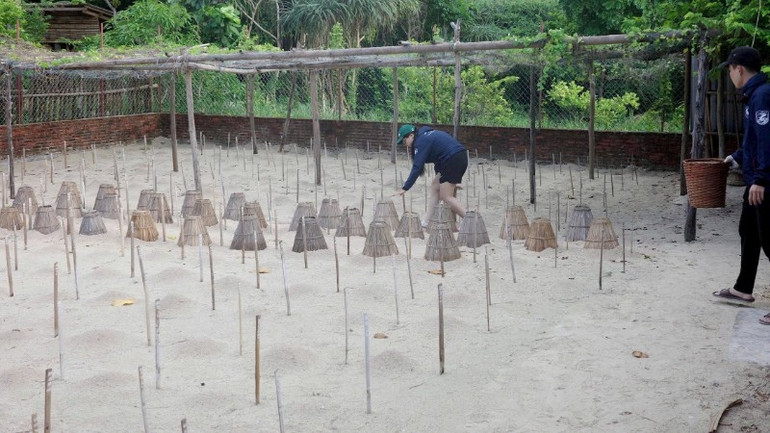
Meanwhile, at Cu Lao Cau, also known as Hon Cau Island (Hon Cau Marine Reserve, formerly part of Binh Thuan province, now part of Lam Dong province), 10 volunteers from Dong Nai, Ho Chi Minh City, and Hanoi recently had a meaningful one-week trip to support sea turtle conservation.
Ms. Nguyen Phuong Anh, an office worker from Hanoi, shared that although she hasn't had the chance to meet a mother turtle yet, she enjoys living amidst the beautiful natural surroundings. Every day, volunteers, tourists, and conservation staff walk around collecting trash and clearing obstacles on the turtle nesting grounds, gathering them for disposal. Despite the hard work and fatigue, this is an extremely important task to "welcome the mother turtle" during the nesting season, which lasts from approximately May to October each year.
Not far to the north, the turtle conservation program organized by the "My Family Loves Nature Vietnam" community in collaboration with Nui Chua National Park also attracts hundreds of parents and children every summer.
Le Nguyen Truc Linh (born in 2003, Ho Chi Minh City), a female student, recounted her first experience of watching turtles lay eggs: “On the fifth night, my patrol team encountered a mother turtle weighing about 90-100kg. Everyone was surprised because they had never seen such a large turtle before, but then watching it gently perform its maternal instincts, everyone was moved.” After the mother turtle finished laying her eggs, Linh and the group carefully moved the nest to an artificial incubation pit, aiming to increase the hatching rate and balance the sex of the hatchlings.
From Con Dao to Nui Chua and Hon Cau, the "white nights" of sea turtles are also the white nights of volunteers and tourists. They come not only to admire them but also to learn how to protect life – from attaching identification chips to mother turtles, picking up trash, cleaning ghost nets, to monitoring each nest, relocating them to safe places, documenting, caring for, and finally releasing the tiny baby turtles back into the vast blue ocean.
Besides protecting forest resources and maritime sovereignty, the members of the Forest Ranger Station also have the special task of conserving sea turtles, including coordinating and guiding tourist groups and volunteers participating in the procedures. The work is arduous and difficult, but everyone who does it does so with the desire to protect an important creature of the ocean, so that future generations can still see real turtles and not just in books.
Mr. Tran Dinh Dong, employee of Hon Bay Canh Forest Ranger Station
According to Mr. Tran Dinh Dong, a staff member of the Hon Bay Canh Forest Ranger Station, in addition to protecting forest resources and maritime sovereignty, the station's members also have the special task of conserving sea turtles, including coordinating and guiding tourist groups and volunteers participating in the procedures.
"The work is hard and difficult, but everyone who does it does it with the desire to protect an important creature of the ocean, so that future generations can still see real turtles and not just in books," Dong enthusiastically shared.
No longer isolated extracurricular activities, volunteer programs for sea turtles are becoming increasingly widespread and well-organized. National park officials and conservation organizations such as IUCN and WWF Vietnam recognize that sea turtle conservation is not only a scientific task but also an educational journey.
Spreading knowledge and responsibility
With 3,260km of coastline, Vietnam is home to 5 out of 7 species of sea turtles in the world, including green turtles (hawksbill turtles), hawksbill turtles, olive ridley turtles, olive ridley turtles, and leatherback turtles. Turtles have an amazing ability to navigate, able to return to their birthplace after decades, or travel thousands of kilometers to continue their species. Turtle eggs hatch after 45-55 days, however, the survival rate in the wild is only about 1 in 1,000. Therefore, turtle conservation not only involves creating a favorable environment for mother turtles to lay eggs but also protecting the nests and hatchlings, and helping the hatchlings reach the sea.
According to data from Con Dao National Park, approximately 500 mother turtles come ashore to lay eggs on 18 nesting beaches each year, and about 120,000 to 150,000 hatchlings are released back into the sea. Some adult turtles, tagged by conservationists and found in Indonesia, Malaysia, and even Florida (USA), have returned to the nesting beaches in Nui Chua National Park.
Tourism in these areas is also developing in an eco-friendly direction. According to Mr. Nguyen Khac Pho, Director of Con Dao National Park, in 2025, the National Park will officially organize 10 tours to experience the marine ecosystem and directly participate in sea turtle conservation, with flexible durations of 5, 7, or 10 days, all activities strictly adhering to conservation principles. The number of participants per tour is also limited, despite the considerable cost. However, with unique and deeply meaningful experiences, tourism involving watching sea turtles lay eggs and releasing baby turtles back into the sea has become a distinctive product here.
In 2025, the National Park will officially organize 10 tours to experience the marine ecosystem and directly participate in sea turtle conservation, with flexible durations of 5, 7, or 10 days, all activities strictly adhering to conservation principles. The number of participants per tour is also limited, despite the considerable cost. However, with its unique and deeply meaningful experiences, tourism involving watching sea turtles lay eggs and releasing hatchlings back into the sea has become a signature product of the park.
Mr. Nguyen Khac Pho, Director of Con Dao National Park
Having participated in a tour organized by Con Dao National Park to see mother turtles and their hatchlings, Ms. Le Thu Ha (Ho Chi Minh City) shared that not only children but also adults learn a lot from nature. After the trip, she and her daughter agreed to reduce their use of plastic in the family.
Over the past three years, the Nhon Hai and Nhon Ly beach areas (formerly in Binh Dinh province, now Gia Lai province) have recorded many individuals of the rare sea turtle species returning to lay eggs. Egg protection activities, carried out by community groups, have gradually formed, linked to tourism development, such as homestay services, guiding tourists to observe turtles, and snorkeling to see coral reefs.
The combination of tourism and sea turtle conservation in Con Dao, Nui Chua, and other coastal areas is a testament to a model that not only provides survival opportunities for thousands of baby turtles but also fosters a generation of environmentally responsible tourists. The stories of sea turtles, told through fragile nests, nights of guarding under the stars, and the massive amounts of plastic waste cleaned up, convey a vivid and profound message about respecting nature, requiring the contribution of the entire community, especially the younger generation.
Source: https://nhandan.vn/nhung-ngay-xanh-cung-rua-bien-post899601.html



























































































Comment (0)