

Since Mac Kinh Cung built the citadel on Ve Son mountain, Lang Son, once a desolate borderland, has become a noble land. For nearly 100 years, the Mac dynasty relied on the people of Lang Son, and this land accumulated the essence of the royal family. Layers of cultural sediment, accumulated over nearly half a millennium, imbue every inch of the land with the sacred spirit of the mountains and rivers.
One of those sacred landmarks is the system of ancient temples, where the Vietnamese people, from the dawn of time to the time they followed the Mạc dynasty's horses on their journeys across the land, through countless wars and battles, and finally to the peace and independence of today, have always placed a deep faith and reverence.
Therefore, when visiting Lang Son, pilgrims often follow the "traces of ancient carriages and horses" to find the shrines dedicated to the Mother Goddess and other saints, deities, and border heroes, as if seeking the essence of Vietnamese cultural history.
The Bac Le Temple (also known as the Mau Thuong Ngan Temple or Bac Le Temple) is an ancient temple nearly 500 years old located in Bac Le village, Tan Thanh commune, Huu Lung district. It is considered one of the eight most sacred temples in Vietnam. Legend says the temple was built around the 16th-17th centuries.
Bac Le Communal Temple.
Bac Le Temple is one of the three main places of worship for Mau Thuong Ngan in Lang Son, along with Dong Cuong Temple and Suoi Mo Temple. Based on ancient ceremonial texts, Bac Le Temple is where Mau Thuong Ngan manifested and provided spiritual assistance, Suoi Mo Temple is the sacred site where she practiced asceticism and cultivated her spiritual path, and Dong Cuong Temple is where she was born and resided. Besides worshipping Mau Thuong Ngan, the temple also worships Chau Be – a famous deity in the Four Palaces of the Goddesses. Therefore, when visiting Bac Le Temple, people must pray to Chau Be before entering to worship Mau Thuong Ngan.

The temple has stood majestically for five centuries beneath ancient trees, each brick and piece of wood covered in moss and lichen. Despite numerous upheavals and disturbances in this remote region, and several renovations, the local people have preserved the ancient statues made from jackfruit wood, and the intricately carved horizontal plaques and couplets, showcasing the high level of sculpting skill of the artisans of the past.
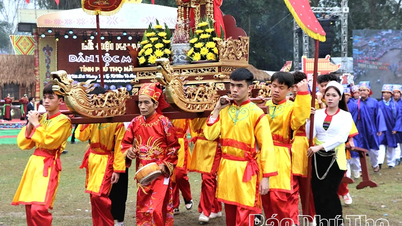
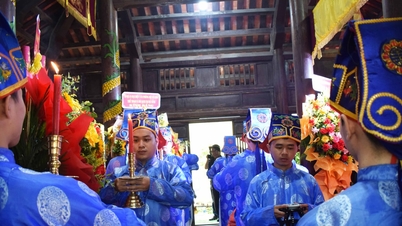
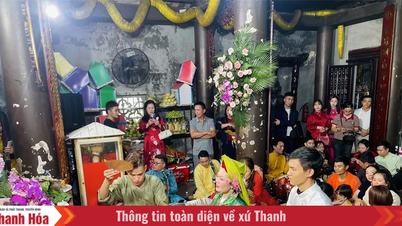
The main festival of Bac Le Temple is held on the 20th day of the 9th lunar month. The elaborate and grand ceremonies and processions demonstrate the people's reverence and preservation of the Mother Goddess tradition. Every year, tens of thousands of visitors from all over the country flock to Bac Le Temple on this special day.
From Lang Son city, traveling 13km north along National Highway 1A leads to the Dong Dang Mother Goddess Temple, an ancient temple nestled in the valley of the border town of the same name, surrounded by majestic mountains like a magnificent fortress wall.
Dong Dang Mother Goddess Temple.
The Dong Dang Mother Goddess Temple is a place of worship dedicated to Saint Mother Lieu Hanh - one of the Four Immortals in Vietnamese spiritual culture, along with Tan Vien Mountain Saint, Phu Dong Thien Vuong, and Chu Dong Tu.
The temple boasts a grand and exquisite architectural style, built in a tiered fashion, nestled against a rocky mountainside and overlooking the valley. Passing through the majestic triple-arched gate adorned with intricately carved dragons and phoenixes, one enters a spacious courtyard where dozens of ancient trees stand tall, their majestic presence casting shadows over a pair of solemn, respectful elephant statues.
The temple consists of five main worship halls. The innermost hall houses the Three Treasures, dedicated to the Buddha Cundi and the Bodhisattva Avalokiteshvara; the subsequent halls are dedicated to the Mother Goddess and other patron saints. Behind the temple is a stupa with sacred inner chambers, which are only opened on festival days.
Every year on the 10th day of the first lunar month, the spring festival of the ethnic groups of Lang Son province is solemnly celebrated at the Dong Dang Mother Goddess Temple. Here, visitors can immerse themselves in the sacred spiritual atmosphere of the Vietnamese, Tay, Nung, and Hoa communities, while also enjoying lively folk games and sports competitions. This is also a unique feature of the traditional festival, harmonizing religious and secular life, at this ancient temple in the border region.
Ky Cung Temple.
The Ky Cung and Ta Phu temples are both located in Lang Son city. Ky Cung Temple is situated at the left bank of the Ky Cung River, in Vinh Trai ward, while Ta Phu Temple is located in Ky Lua market street, in Hoang Van Thu ward. The connection between these two ancient temples stems from the legend of Than Cong Tai clearing the name of Quan Lon Tuan Tranh.
According to ancient legends, Quan Lớn Tuần Tranh was a high-ranking official during the Trần dynasty who rendered great service in repelling foreign invaders and pacifying the border, but was slandered by malicious individuals to the point of committing suicide to prove his innocence. Hundreds of years later, a high-ranking official during the Later Lê dynasty, Tả đô đốc Hán quận công Thân Công Tài, personally performed a ceremony to clear Quan Lớn Tuần Tranh's name.
Every year, in January, people choose an auspicious day to hold a procession carrying the incense burner of Mr. Tuan Tranh from Ky Cung Temple to Ta Phu Temple - where Than Cong Tai is worshipped - to express their gratitude. The Ky Cung - Ta Phu Temple Festival originated from this respectful ritual of gratitude.
Both Ky Cung and Ta Phu temples are situated in prime locations, within the bustling commercial center of Lang Son city. The traditional Ky Cung - Ta Phu temple festival usually takes place from the 22nd to the 27th of the first lunar month, also known as the Ky Lua Firecracker Festival, one of the most famous folk festivals in Lang Son.
On the 23rd and 24th, the festival features a firecracker-burning game. Whoever manages to grab the firecracker's head will receive good fortune and wealth in the new year. The vibrant and festive atmosphere of the temple festival in this ancient town in a remote region is a unique feature of springtime here.
The sacred temples of Lang Son are not only spiritual destinations for people in the region and throughout the country, but also tourist attractions that draw large numbers of visitors every year.
Source
![[Photo] Prime Minister Pham Minh Chinh receives the Chinese Ambassador to Vietnam](https://vphoto.vietnam.vn/thumb/1200x675/vietnam/resource/IMAGE/2026/04/05/1775397481797_ndo_br_dsc-5512-jpg.webp)






































Comment (0)