

Many Chinese women are prioritizing themselves, refusing to have children as desired by the government and their families.
Outside a shopping mall in Quanxiao County, Anhui Province, He Yanjing, a mother of two, said she received numerous calls from local authorities encouraging her to have a third child, but she refused. According to He, her son's kindergarten has halved its class size due to insufficient students.
Feng Chenchen, a friend of He and the mother of a three-year-old girl, said that relatives are pressuring her to have another son.
"Having one child is enough for me to fulfill my duty," Feng said. Having a second child is too expensive. She told relatives, "I can have another child if you give me 300,000 yuan" (US$41,000).
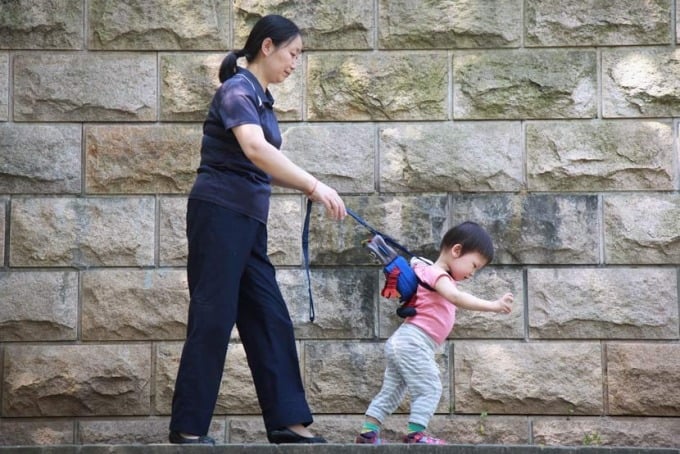
A mother and daughter in Nanjing, Jiangsu Province, on May 28, 2017. Photo: VCG
Young Chinese people, weary of slow economic growth and high unemployment rates, are seeking a lifestyle different from their parents' generation. Many women consider the traditional idea of getting married and having children to be outdated.
For Molly Chen, 28, caring for elderly family members and her work as an exhibition designer in Shenzhen leaves her no time for marriage and children. Chen simply wants to read books and watch pet videos in her free time.
Chen followed the story of Su Min, a retired woman who traveled alone across China to escape her exhausting marriage. Chen said that Su Min's story and the videos she posted online left a deep impression on her, highlighting that many men primarily marry women to act as nannies, caring for their husbands, children, and elderly parents.
Chen complained that she didn't even have time to take care of a pet. "I don't have time to look after anyone else besides my parents and I also have to work," Chen said.
In 2015, when Beijing lifted its 35-year-old one-child policy, officials predicted a population boom. However, reality defied expectations. Many newly built maternity wards closed after only a few years. Sales of baby products such as formula and diapers steadily declined. Businesses producing baby products are now shifting their focus to the elderly.
Newly built kindergartens are struggling to enroll enough students, and many have closed. In 2022, the number of kindergartens in China decreased by 2%, the first decline in 15 years.
Demographers and researchers predict that the number of births in China will fall below 9 million by 2023. The United Nations forecasts India will have 23 million births in 2023, while the US will have 3.7 million. India surpassed China to become the world's most populous country in 2023.
The one-child policy has led to a bleak demographic picture in China. There are fewer young people, including millions fewer women of childbearing age each year. They are also hesitant to marry and have children, accelerating the rate of population decline.
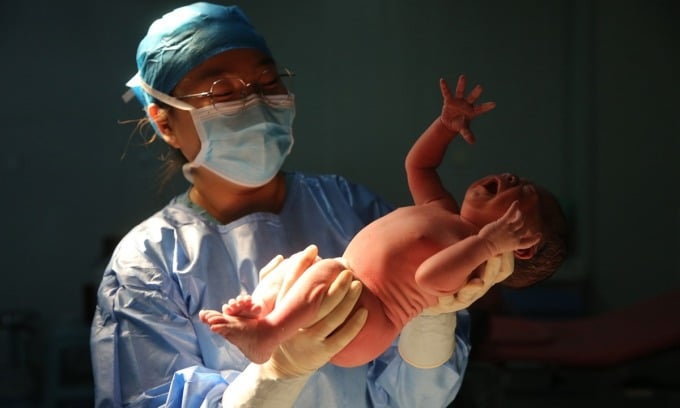
A nurse delivers a newborn baby at a hospital in Zhengzhou, Henan province, China, on January 1, 2022. Photo: VCG
In 2022, China recorded 6.8 million registered marriages, nearly half the 13 million in 2013. China's total fertility rate in 2022 was 1.09, approaching the target of one child per woman. In 2020, this figure was 1.30, significantly lower than the 2.1 needed to maintain a stable population.
China is implementing a series of measures to boost its birth rate, such as organizing matchmaking events and launching programs to encourage military families to have more children.
"Soldiers win battles. When it comes to having a second or third child and implementing the national policy on childbirth, we are leading the way," said Zeng Jian, an obstetrician at a military hospital in Tianjin, in 2022.
In August 2023, residents of Xi'an reported receiving a message from the city government on the Qixi Festival (Chinese Valentine's Day) that read, "Wishing you sweet love and marriage at the right age. May you continue the Chinese bloodline."
The message sparked outrage on social media. "Even my mother-in-law isn't urging me to have a second child," one person wrote. "I guess we're about to return to the era of arranged marriages," another commented.
Local governments also offer various incentives, such as cash bonuses for families having a second or third child. One county in Zhejiang province awarded $137 in cash to each couple who married before the age of 25. In 2021, the city of Luanzhou, Hebei province, required unmarried people to register for a government-funded dating initiative that used big data to find suitable partners across the city.
Changes in birth control policies have shifted women from having to hide the fact that they have more children to being pressured to have more. Ten years ago, Zhang had to hide the birth of her second child from the authorities. She quit her job for fear of being pressured to have an abortion. After giving birth in 2014, Zhang stayed with relatives for a year. Upon returning, local officials fined her and her husband $10,000 and forced her to have an IUD inserted, while also requiring her to have checkups every three months.
Months later, Beijing announced the abolition of the one-child policy. However, for a considerable period, local authorities continued to require Zhang to have her contraceptive device checked. Now, she is receiving messages encouraging her to have children.
"I wish they would just stop bothering us," she said, "and leave us ordinary people in peace."
Chinese authorities are tightening regulations on licensing clinics that perform birth control procedures. In 1991, during the strictest period of the one-child policy, China recorded 6 million tubal ligations and 2 million vasectomy procedures. In 2020, there were 190,000 tubal ligations and 2,600 vasectomy procedures. Some people complain that scheduling a vasectomy appointment is as difficult as winning the lottery.
The number of abortions decreased from 14 million in 1991 to under 9 million in 2020, and since then, China has stopped publishing data on vasectomy, tubal ligation, and abortions.
Sophy Ouyang, 40, decided not to marry or have children since she was in middle school. Ouyang studied computer science and is one of the few women in the field to pursue advanced studies and work as a software engineer in Canada.
Ouyang said that throughout her 20s, her family constantly pressured her to get married. Her mother often said that if she had known earlier that Ouyang didn't want to have children, she would have prevented her from pursuing graduate studies. Ouyang cut off contact with her family more than 10 years ago. She blocked her parents, aunts, uncles, and cousins on social media apps.
"If I let my guard down, they would take advantage of me." Ouyang still feels fortunate for her decision not to get married and have children, feeling "I avoided being shot."
Dai married at 26 and said she had to endure her husband's patriarchal attitude, especially during the pandemic, when they argued about household chores. She resolutely refused to have children despite pressure from both families.
Dai has filed for divorce. "If I didn't get a divorce, I would most likely have to have the child," Dai said.
Hong Hanh (According to WSJ, AFP )
Source link


![[Image] National Assembly discusses the implementation of the socio-economic development plan.](https://vphoto.vietnam.vn/thumb/1200x675/vietnam/resource/IMAGE/2026/04/20/1776696707422_ndo_br_img-20260420-185419-jpg.webp)
![[Photo] General Secretary and President To Lam meets with National Assembly delegates from ethnic minorities.](https://vphoto.vietnam.vn/thumb/1200x675/vietnam/resource/IMAGE/2026/04/20/1776696701056_a1-bnd-8331-3342-jpg.webp)
































































































Comment (0)