

Online savings accounts are a convenient and safe option. However, if not careful, customers can lose money due to avoidable mistakes.
Online savings deposits are a safe way to deposit money if customers choose a reputable bank and follow the bank's security guidelines.
To ensure user security and safety, banks have adopted many new technologies according to international standards, such as multi-factor authentication, biometric fingerprint/Face ID passwords, data encryption, etc. Therefore, the risk of errors when depositing savings is very rare; if it does occur, it is usually due to users' unsafe service usage habits.
Risks arising from user habits
To completely eliminate the risks when depositing savings online, users need to be aware of the following risks:
Accidentally deposited money into a fake bank account.
More and more banks are offering online savings services, but fake websites are also becoming more common. If customers carelessly click on a link sent via text message, or download an application from an unofficial source with an interface that looks exactly like a real bank's, their money could disappear.
If you've transferred money to a fake bank account, the chances of getting it back are very slim. Fraudsters can withdraw all your money in minutes without leaving a trace. Therefore, if you don't carefully check the website address, login link, or the origin of the application, the risk of losing money is always present.
Losing money due to forgetting interest rate conditions.
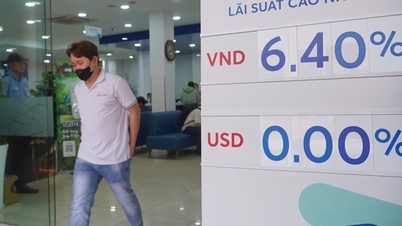
Online savings accounts offer the advantage of higher interest rates compared to in-person deposits, typically 0.1-0.5% per year. However, without carefully reading the terms and conditions, customers may lose interest or receive a lower-than-expected rate.
For example, a customer deposits money into a 6-month term savings account but withdraws it before maturity. Therefore, the customer will not receive the interest rate of a term savings account (approximately 3-6% per year) but will only receive the interest rate of a non-term savings account (approximately 0.5% per year).
Customers should carefully read the terms and conditions of online savings services before confirming account opening, including how interest rates are calculated, minimum deposit amount, conditions for early withdrawal, and the validity period of any promotions. If any information is unclear or not understood, contact the bank immediately for clarification.
Account security lapses
Online savings accounts offer faster transactions but also come with security risks. Sharing OTP codes, revealing login information, and using overly simple passwords can lead to account hijacking.
Many people are careless when logging into their bank accounts on public devices or insecure Wi-Fi networks. In such cases, fraudsters can steal information and carry out transactions without the account holder's knowledge.
Things to note when depositing savings online.
According to experts, before depositing money, carefully check the bank, secure your account securely, and read the terms and conditions regarding interest rates. A small oversight can cause years of accumulated savings to disappear in the blink of an eye.
For 100% security, instead of depositing money online, users can deposit savings at the counter and keep a physical passbook. Because once you have a paper passbook in hand, if the savings are lost, the fault lies entirely with the bank, so customers can request a refund from the bank.
If depositing savings online, customers can request the bank to confirm that online withdrawals are not permitted. They can also request the bank to freeze the account, only to unfreeze it when the account holder personally visits the branch to request it.
Additionally, joint savings accounts can be opened at the counter; however, when closing the account or withdrawing a portion, the signatures of both account holders are required.
For greater security regarding funds in their payment accounts, customers should register for biometric authentication. They can even request that the bank confirm that the account is only allowed to transfer a certain maximum amount, perhaps less than 10 million VND.
Things to do immediately when you lose money.
Banks advise that if savings are lost from an online savings account, customers should quickly contact the bank for assistance and provide evidence proving they have been scammed by:
Keep the original and print out a copy of all contact information with the scammer, such as SMS messages, social media messages, emails, letters, and call recordings (if any); create a statement/report detailing the entire timeline, the details of the events, and all the information you have about the scammer.
If there is a receipt or transaction document, customers must also keep the original and print out a copy to send to the bank.
Additionally, customers can request a printed transaction statement to prove any financial loss.
It is necessary to contact the bank via its hotline or customer service center as soon as possible after discovering the issue, within a maximum of 30 days from the date the incident occurred.
After receiving the information, the bank will conduct an investigation and retrieve the fraudulent transaction details. At this point, the customer needs to provide additional evidence and documents requested by the bank to assist in the investigation, such as copies of police reports, incident statements, etc.
After 30 days, if there is still no result, customers should contact the bank's hotline or customer service center to inquire about the complaint processing progress. Typically, banks will try to resolve the issue within 60 days, with a maximum of 90 days as stipulated in Article 512 of the 2015 Civil Procedure Code.
To ensure a smooth and quick complaint resolution process, clients can hire a lawyer to monitor the case, advise on optimal solutions, help clients store necessary documents/records, and communicate with the bank on their behalf.
In addition to reporting the incident to the bank, customers should also report it to the police so that the authorities can quickly create a case file and handle the matter.
Source: https://vietnamnet.vn/nhung-rui-ro-khi-gui-tiet-kiem-online-can-biet-de-tranh-2381022.html


































































































Comment (0)