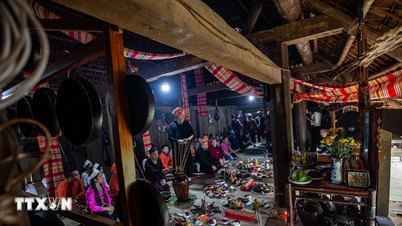
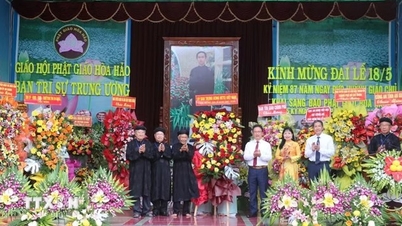
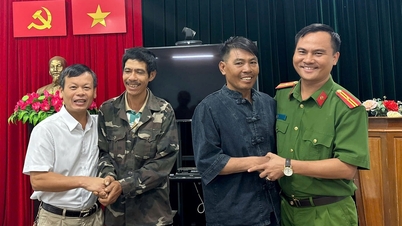
Village elders, hamlet chiefs, and respected community leaders are individuals chosen and honored by the local community and trusted by the people. They tirelessly go from street to street, house to house, mobilizing people to help each other develop the economy , alleviate poverty, eliminate outdated customs, preserve and promote the beautiful cultural identity of each ethnic group, participate in mediation, and effectively resolve all difficulties and conflicts within the community. They foster consensus, build united, peaceful, and prosperous villages, and ensure that every family enjoys a comfortable and happy life.
In particular, over the years, village elders, hamlet chiefs, and influential figures have served as "right-hand men," working alongside the military forces to ensure local security; as well as accompanying ethnic minority communities in socio-economic development and preserving long-standing traditional cultural values.

It is no coincidence that the motto "going door to door, knocking on every door, reaching out to every individual" is associated with the image of village elders, hamlet leaders, and community leaders. In areas with fragmented terrain and uneven levels of education, conveying policies cannot rely solely on administrative documents or loudspeakers; it requires firm handshakes, a warm cup of tea by the fire, and explanations in the language of the local people themselves.
According to Major General Van Ngoc Que, Deputy Head of the Political Department of the Border Guard, the northern region, especially the Northwest, has always held a particularly important strategic position in terms of national defense, security, and foreign relations. It is a melting pot of unique cultures and a place where many ethnic groups have lived together for generations. However, with its rugged terrain, difficult transportation, and the fact that hostile forces frequently exploit ethnic and religious issues to undermine the country, the task of protecting border sovereignty here has never been easy.
Currently, the northern provinces have over 8.8 million people belonging to ethnic minorities. This is also a region with a diverse range of beliefs and religions, including major religions such as Buddhism, Protestantism, and Catholicism, with a total of over 8.1 million followers, accounting for approximately 15.5% of the population.

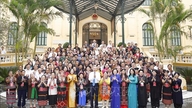

In this context, the role of community leaders, those who hold the "soul" of the village, becomes even more important.
"The Vietnam People's Army has always been deeply aware that one of the tasks in protecting national sovereignty is the particularly important contribution of the people of ethnic minorities in the northern region, notably the role of village elders, hamlet chiefs, influential figures, and religious leaders – the spiritual pillars of villages and hamlets; they serve as a bridge connecting the Party's will with the people's hearts, contributing their efforts to building a comprehensive national defense posture linked to a people's security posture, a solid posture for protecting the Fatherland," Major General Van Ngoc Que affirmed.

Meanwhile, Major General Be Hai Trieu, Director of the Department of Mass Mobilization, General Political Department of the Vietnam People's Army, stated: Throughout the past period, village elders, community leaders, influential figures, and religious leaders have actively and effectively accompanied the armed forces in maintaining security and order, ensuring that no family members have committed crimes... Through this, they have helped ethnic minorities and religious communities change their perceptions, actively engage in production, develop the economy, achieve sustainable poverty reduction, apply science and technology to production and livestock farming, and improve their material and spiritual lives.
Models that promote the role of village elders, hamlet chiefs, influential figures, and prominent religious leaders have truly become more in-depth and yielded practical results, such as: The model "Village elders and influential figures participating in building strong villages and hamlets" - where village elders act as "advisors" to local Party committees, offering sound advice on customs and the psychology of the people. The model "Living milestones - pillars of the village" - in which each citizen, each village elder, and each hamlet chief is a landmark of sovereignty, regularly patrolling and protecting the border with border guards. The model "Production teams staying in villages, working alongside village elders and hamlet chiefs" - combines the scientific knowledge of the military with the practical experience of influential figures to guide people in changing the structure of crops and livestock. The model "Reputable individuals take the lead in economic development and poverty reduction" - where reputable individuals not only speak but also act first, implementing the most effective methods of raising livestock and growing crops for others to observe and learn from.
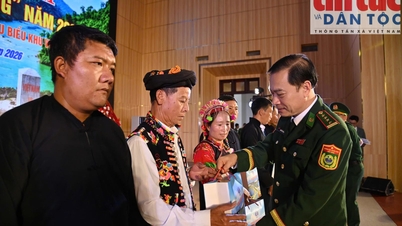
According to Major General Be Hai Trieu, in the past five years, in the northern provinces, military units have conducted nearly 200 training courses on national defense and security knowledge, with the participation of more than 17,000 people; more than 6,000 village elders, hamlet leaders, and community leaders have been honored; and nearly 2,000 concentrated propaganda sessions have been organized, contributing to raising awareness, strengthening trust, and fostering the affection of ethnic minorities and religious communities towards the Party, the State, and the military.
Through this, the local socio-economic development has progressed, national defense and security have been maintained, and local security and order have been stabilized; thousands of families have escaped poverty and risen to legitimate wealth; thousands of conflicts have been resolved, thousands of individuals have been reformed, and hundreds of complex incidents have been prevented early and from afar. These figures demonstrate the close coordination between the military and local Party committees and authorities, fostering the spirit of each village elder, hamlet chief, village head, influential person, and religious leader becoming a spiritual support for ethnic minorities, and a solid bridge between the Party, government, armed forces, and people.

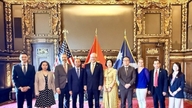

Furthermore, in building the grassroots political system and national unity through voter outreach by National Assembly and People's Council representatives at all levels and practical local activities, village elders, hamlet chiefs, influential figures, and religious leaders in the Northwest region have joined forces with the military to encourage, listen to, gather, and promptly reflect the legitimate aspirations and contributions of the people in the work of building the Party, government, and socio-political organizations.
Many reputable individuals, including retired officials, Party members, and village elders, have assumed positions such as Party branch secretaries, village heads, heads of the Fatherland Front, heads of mediation teams, and security team leaders, mobilizing people to participate in the activities of various organizations. Thanks to this, the political system in the northern provinces has been increasingly strengthened, the people's trust in the Party committees and government has been enhanced, and social consensus has been improved. They are the gatekeepers of peace, preventing early attempts to exploit ethnicity and religion to incite unrest and sabotage.
Source: https://baotintuc.vn/van-de-quan-tam/nhung-su-gia-noi-bien-cuong-20260702100026690.htm





















![[Image] Overview of the construction site for the underground station of metro line 5 at the Hanoi Ring Road 1 intersection.](https://vphoto.vietnam.vn/thumb/1200x675/vietnam/resource/IMAGE/2026/07/03/1783065595682_ndo_br_z7974930852369-100ca093c306e72675f1d3700966a86b-jpg.webp)