The writer Nguyen Trong Luan, on his way to revisit his old battlefield—he was a soldier who fought on Route 7 in 1975 (two of the soldiers who fought on the old Route 7, now Route 25, became writers: Khuat Quang Thuy and Nguyen Trong Luan)—called me and said that Suong Nguyet Minh had sent him a plastic bottle, he didn't know what it was, and he was about to receive it, asking for my address to bring it to him.
Sương Nguyệt Minh is a writer and a military colonel. He often compares himself to me, saying, "He's half Ninh Binh , I'm completely Ninh Binh." But he owes a debt to Ninh Binh and must remember to repay it. No one with a hometown can be away from it for so long without remembering it. Good heavens, how does he know I don't remember? I'll write about this talented writer, a true Ninh Binh native, on another occasion. Now, back to the... mossy rocks.
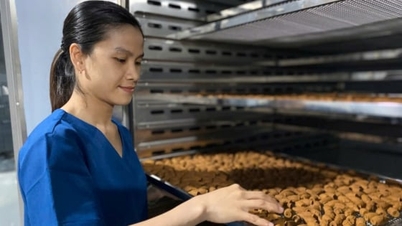
I got up and opened the door to welcome Mr. Nguyen Trong Luan. He arrived by taxi, clutching a large plastic jar, the kind usually used for something, repurposed to hold a gift from Mr. Suong Nguyet Minh. It contained dried moss. The following afternoon, I immediately prepared a grand feast for my friends. I boiled water to soak the moss until it softened. Fish sauce, lime, chili, and garlic, along with roasted peanuts, were mixed together to create a salad that would appeal even to the pickiest eaters.
Another half, making crab stew, the authentic Ninh Binh style, requires... crab, fermented rice paste, and tomatoes. My goodness, it caused such a commotion at my house that day. Now I can't eat it anymore. I heard dried moss is still available, but it's harder to find now than bird's nest soup. Nowadays, bird's nest soup is available almost everywhere, whereas in the past, it was a dish only the king could enjoy.
I remember about ten years ago, on a bitterly cold night just before Tet (Lunar New Year), it was me and the writer Suong Nguyet Minh from Ninh Binh, sitting at a restaurant owned by one of his nephews in Ninh Binh city. The nephew said, "What would you two like to eat? I'll cook it myself," and then the three of us would sit and eat.
I cautiously glanced at Mr. Minh, who said Mr. Hung should be prioritized. So, I boldly yet softly said: "Give me some sweet potato leaves with crab sauce, and some salad or crab and moss stew, please." Half an hour later, boiled sweet potato leaves with crab sauce were brought out, of course with "additives" like chicken, fried fish, pork trotters, and so on.
Then the old man and his grandson, rubbing their hands together, said: "Uncle, if you asked me to, I could find it now, but moss on the rocks is truly harder than rebuilding Mount Xẻ, Uncle. And it's true. Moss on the rocks is a great union, a magnificent union between rain and limestone, and it has to be ancient limestone. But now, Mount Xẻ is no more."
Other areas might still have limestone like Tam Coc Bich Dong, but where can you find "fairy tale limestone"? Besides, the rain is different now... I still remember those days when my grandmother used to wipe basins; after each rain, she would go and get some moss, which is this moss. It was still fresh and wriggling, then she'd dip it in hot water and eat it. On days when we went over, she'd buy two strings of crabs, which are rare now—crabs on strings, now they're sold in bunches or by the kilogram.
In the old days, there were about 5-6 crabs per string, two strings would have more than 10 crabs, and of course, the crabs for stringing had to be big. The string of crabs had two small bamboo sticks clamping the crab's shell, like the crab was carrying a ladder; the whole row of crabs carried those two bamboo sticks, which was very beautiful and convenient.
Regarding the crab stew that my grandmother used to cook, served in those small, flared bowls—those bowls with a narrow base—they're quite rare now. That dish, eaten with shredded water spinach, was simply amazing. That's how memories resurface, and when the opportunity arises, they demand it. And... disappointment, because now it's considered a high-end delicacy. That is, it's extremely rare, hopelessly rare. So, those who are addicted to memories, addicted to those rare, heaven-sent dishes, come up with ways. And one of those ways is to make dried moss. Apparently, it's not sold commercially; my writer friend had to ask his family to collect, dry, and send it to me, both to satisfy my longing for home and to fulfill my nostalgia. It's like now having sea worms all year round; in reality, it's also a rare delicacy, appearing only a few days a year. But now you can find it in restaurants anytime, of course, on one hand it's frozen sea worms, and on the other hand, not everyone has the discernment to tell the difference between sea worms and... pork omelet...


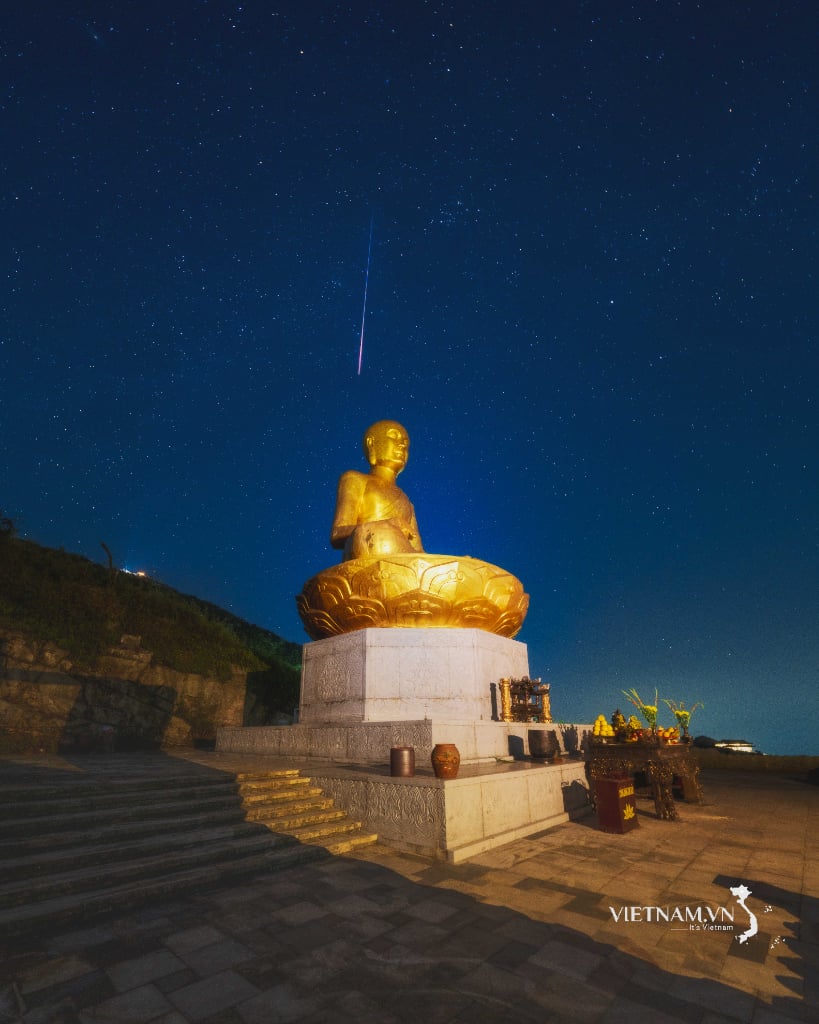
I arrived in Ninh Binh on the anniversary of King Le Dai Hanh's death. I was excited to finally have some descendants, but I was told that the Le family wasn't a direct lineage. However, that didn't diminish my pride. That evening, we went to light incense at the temples of King Dinh and King Le. I heard the organizing committee had to invite some women from some distant district to arrange the flowers. And indeed, the flower baskets and arrangements were very beautiful. The moonlight shining through the trees made the temple complex even more enchanting.
There are many anecdotes about the love triangle between King Dinh Tien Hoang, Lady Duong Van Nga, and General Le Hoan, who would later become King Le Dai Hành, whom I am respectfully offering incense to here. Some praise it, others criticize it.
But thinking about it, how many people are like Lady Dương Vân Nga? And General Lê Hoàn, the commander of the Ten Divisions, was clearly a talented general and a skilled king. Now, my maternal hometown of Hoa Lư is always proud to be the land of two kings. The phrase "temple of King Đinh and King Lê" is always mentioned affectionately and proudly by the people here. My mother was a very good cook, even though in her time, lard and MSG were things that even gold envied because they were more precious. That is, the conditions to showcase her skills were lacking, but with what was allocated during the subsidy period, she transformed makeshift meals into grand feasts.
The constant evacuations, carrying my siblings and all our belongings on a bicycle, and the endless lodgings in poorer homes—wherever we went, she always managed to find ingredients to create gourmet dishes that impressed us all. We later learned that she inherited this from her maternal grandfather, who was a foreman in the French kitchen.
And perhaps that's why, during the land reform, he was subjected to public denunciation, but after corrections, his social class was downgraded to lower middle peasant. During the most intense American bombing of Thanh Hoa, my parents transported my brother and me by bicycle from Thanh Hoa town to Da Gia village, where we stayed with my maternal aunt. This aunt was my maternal grandmother's younger sister and lived near her house. It turned out her house was only a few kilometers from Ninh Binh town, and Ninh Binh was also a bomb-ridden area, among the cities and towns in North Vietnam that were destroyed at that time: Hanoi , Hai Phong, Phu Ly, Ninh Binh, Thanh Hoa, Vinh…
And indeed, a few months after returning, I witnessed a horrific bombing raid on the Thien Ton cave area. Anyone in Thanh Hoa at that time knew about the two historic days of April 3rd and 4th. My mother's factory was also named the 3-4 Match Factory, so some people jokingly said that it took 34 matches to light. Nowadays, we use high-quality matches, so I don't remember the details from back then, but it's true that sometimes it took 10 matches to light.
Everything is done by hand, from dragging the wood up from the Ma River, sawing it into sections, splitting it into pieces, then making matchsticks, arranging each matchstick individually in a tray, and… using your hands to dip the entire tray into the chemical solution. The match heads are huge or two or three matchsticks are stuck together because they are manually dipped into the solution; sometimes, when lit, a spark of fire burns your hand.
To save fuel, they would only apply phosphorus to one side of the matchbox. They would even make a matchbox out of paper, as large as a cigarette pack, stuff matches inside, and place a small piece of phosphorus-coated matchstick on a piece of cardboard (about the size of two fingers) on top. Sometimes, there would be plenty of matches left, but the phosphorus would be gone. Then they would strike the match against anything rough, and surprisingly, it would still light a fire.
What we kids loved most was stealing gunpowder to make firecrackers, which exploded all day long, and many of us got burned or had our clothes caught fire...
April 3rd was the day American planes first attacked North Vietnam. And Ms. Hang and Ms. Tuyen appeared in this battle as members of the Nam Ngan and Ham Rong self-defense forces. At that time, Nam Ngan was a coal port, where coal barges docked to supply energy to Thanh Hoa town, especially the Ham Rong Thermal Power Plant. Back then, the very fact that the plant stood proudly, albeit crooked and battered, was a source of pride for the people of Thanh Hoa and a significant challenge to the US Air Force…
My mother was the Deputy Director of the 3/4 Match Factory. Later, when we had money, my siblings and I would invite her out to eat, choosing restaurants serving rice in clay pots, all Northern Vietnamese dishes, so she wouldn't miss her hometown so much. She said, "We went to work in the revolution to escape from eating rice in clay pots and drinking water in bottles, but now, for you guys, rice in clay pots and water in bottles has become a specialty."
We went out for rice cooked in a clay pot, everyone drank beer, but she drank bottled water. I blurted out, "Mom, this bottle of water costs as much as half a liter of gasoline!" Later, when she saw that I paid 25,000 dong for the rice in the clay pot (at that time), 20,000 dong for the plate of water spinach, and 100,000 dong for the plate of fried perch, she was shocked!
Now she lies beside my father in the sand dunes of The Chi Tay village, Thua Thien Hue, and every time I return for my mother's death anniversary, I am moved to tears because she was so cherished by her husband's Van family, who lined up in their traditional long dresses and headscarves to light incense for my mother, the quiet woman from Ninh Binh who stayed by her husband's side in a land she only came to know 18 years after getting married...
Source: https://baoninhbinh.org.vn/ninh-binh-ky-uc-me-ky-2-999588.html


![[Image] Ho Chi Minh City: Ma Lang area, Chicken-Rice Market about to change its appearance](https://vphoto.vietnam.vn/thumb/1200x675/vietnam/resource/IMAGE/2026/06/25/1782377698627_ndo_br_m1-jpg.webp)
![[Image] Schools organize meetings and introduce teaching models to students admitted to grade 10.](https://vphoto.vietnam.vn/thumb/1200x675/vietnam/resource/IMAGE/2026/06/25/1782368077271_ndo_br_z7970052192242-1ec8daeb77a6eed1a4e9f58c564ddd3e-jpg.webp)

![[Photo] General Secretary and President To Lam receives Palestinian Ambassador Saadi Salama](https://vphoto.vietnam.vn/thumb/1200x675/vietnam/resource/IMAGE/2026/06/25/1782365384740_a1-bnd-9423-8322-jpg.webp)