

This is Hon Chuoi Island, located in Song Doc Town, Tran Van Thoi District ( Ca Mau Province ), approximately 32 km west of the mainland, with an area of about 7 km² . Currently, the island has only one self-governing community with over 40 households and 130 inhabitants. The people mainly earn their living by raising grouper in cages, fishing, and small-scale trading.
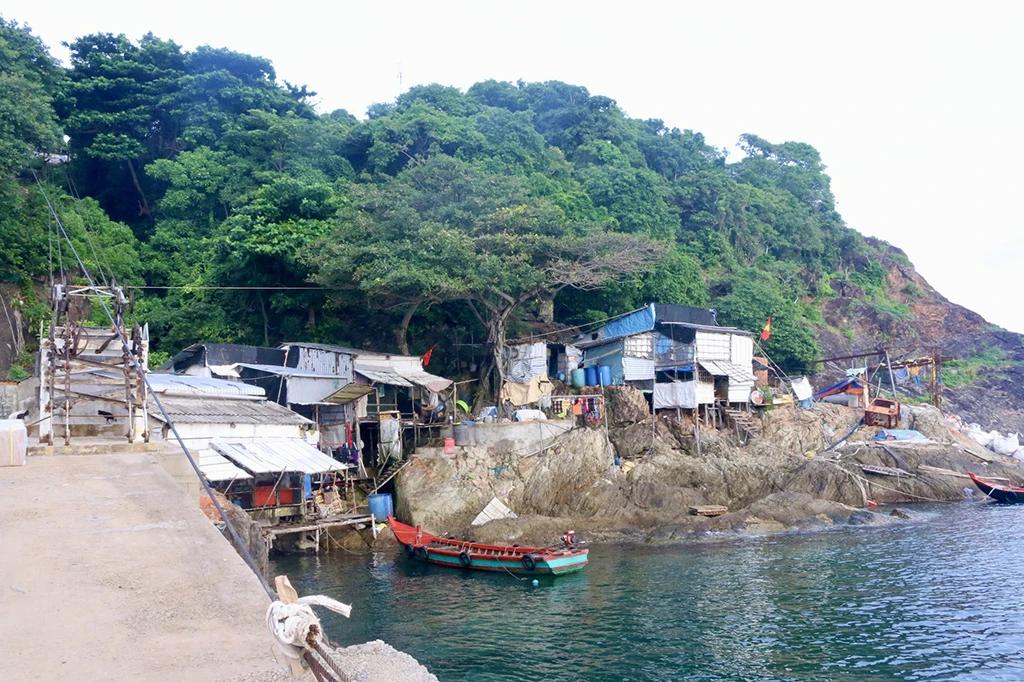
The people here build their houses clinging to the cliffs on Hon Chuoi Island. They move their houses twice a year due to the monsoon winds.
Previously, Hon Chuoi Island was known as the "five no's" island: no electricity, no roads, no schools, no clinics, and no clean water. Over time, the lives of the residents have improved, with the introduction of solar power, water tanks, and more; but one thing remains unchanged: the harsh climate. The island has two distinct wind seasons: the northeast monsoon (dry season), which runs from November to April, so residents move from Ganh Chuong to Ganh Nam around October; and the southwest monsoon (rainy season), which runs from June to September, so residents move back to Ganh Chuong around May.
The islanders are both residents and "lords of the island." Mrs. Nguyen Thi Thom (80 years old, originally from Cai Doi Vam, Phu Tan District, Ca Mau Province), who has lived on Hon Chuoi Island for 50 years, recounted: "When we first came to the island, the country was not yet unified, there were only a few scattered houses, people lived high up on the hills, cut down trees, built temporary houses, and planted beans, sugarcane, jackfruit, bananas... When harvesting, we loaded our farm produce onto small boats, transported it to the shore to sell, and then from the shore we bought rice to transport back. It was very hard, we lacked everything. Now things are better."
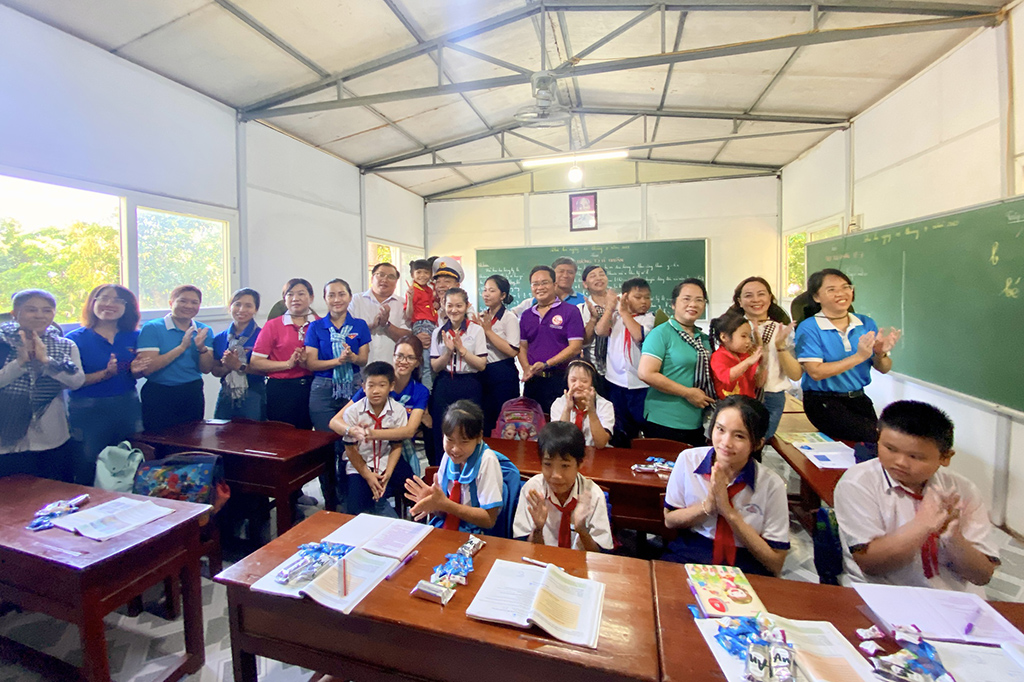
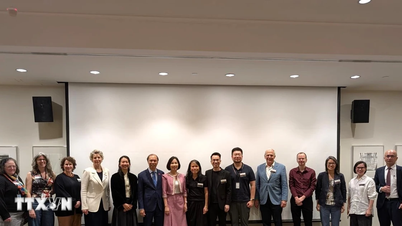
Delegates from the working group took a commemorative photo with the students at Hon Chuoi.
Mrs. Thom has six children; four live on the island, and two have moved to the mainland. When asked if she intended to return to the mainland, she said, "No, life is fine now."
Having lived on Hon Chuoi Island for nearly 30 years, Mr. Le Van Phuong, head of the self-governing community group, recounted how the island used to be scarce in fresh water, and residents struggled to carry water in containers while waiting for fresh water to flow out of the caves... He said: "Now that we have a water source, the economy is somewhat more stable."
Mr. Phuong is currently the head of the cooperative on Hon Chuoi Island, working with residents to raise grouper in cages. After harvesting, the fish are brought to Song Doc town and then transported to Ho Chi Minh City or neighboring provinces for sale.
He assessed that cage fish farming brings high profits to the people, but now they also face many difficulties regarding fish fry sources, feed prices, etc. "Previously, the cooperative had 12 members, now only 8 remain. I hope the government will invest and support the residents of Hon Chuoi more. Furthermore, it could support projects for young entrepreneurs in this island region. This is a youth island!", he shared.
When asked if he had ever felt too overwhelmed by the difficulties on the island and wanted to move ashore, Mr. Phuong shook his head: "I already have a basic house here. It's quiet here, and the security is good. The people are used to moving from one place to another; in the old days, each time we moved, we built a new house, but now everyone has two houses."
When asked what his wishes were for the island, Mr. Phuong immediately said that he wanted his children and grandchildren to have a good life and career. "They want to know about the sea and islands, and to see the blue sky. To achieve that, we must be determined to build the youth island according to the initial plan," he said.
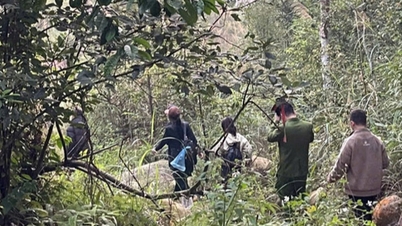
There are children on Hon Chuoi Island, but there is no school system for them to study. A staircase carved through the forest leads up the hill to Radar Station 615. On the way, before reaching the radar station, I saw a charity school run by the Hon Chuoi Border Guard Post. The locals said I had climbed more than 300 steps. Every day, the children on the island, from grades 1 to 7, climb this steep slope to get to school. If you ask any child, "Where do you study, and who are your teachers?", they will all immediately answer, "It's Mr. Phuc's charity school."
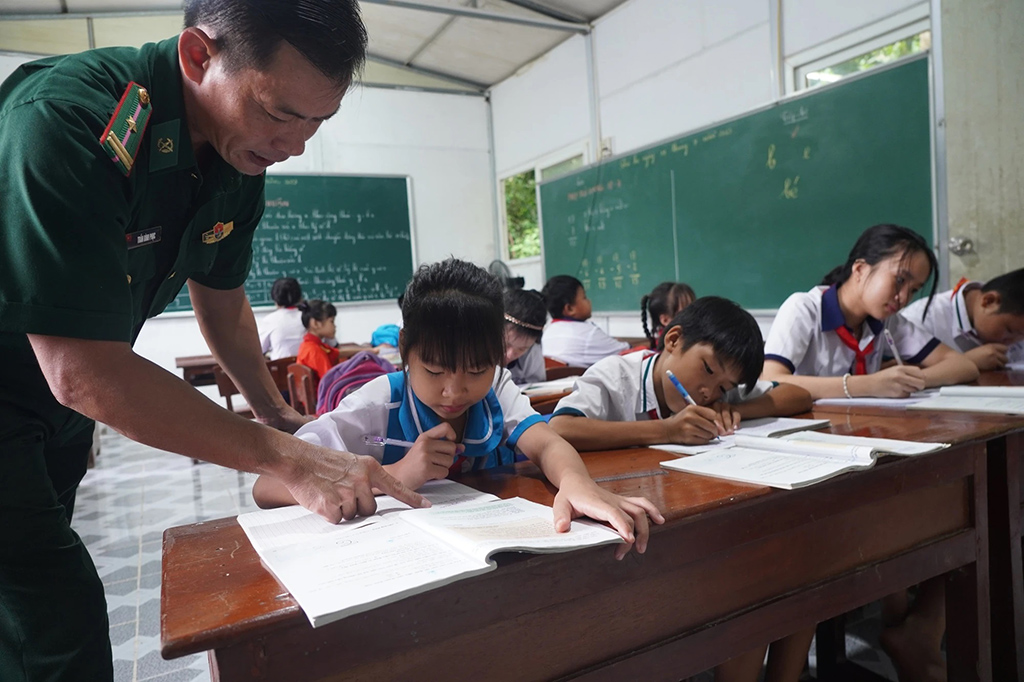
Teacher Tran Binh Phuc has been teaching in charity classes for 14 years.
This charity class in Hon Chuoi has been recognized as a school within the education system of Song Doc town.
Young Nguyen Tan Luc innocently recounted how much fun school was, especially arriving early each morning to meet his friends and wait for the teacher to come to class. Meanwhile, Nguyen Thi Tuyet Nhi, a 7th-grade student, proudly stated that she had been taught by Mr. Phuc from childhood to adulthood.
Major Tran Binh Phuc, Deputy Team Leader of the Community Mobilization Team at Hon Chuoi Border Guard Post, who has been teaching for 14 years, said: "When I first came to the island, I saw that the children had no education, they didn't know how to read or write. I asked the leadership to let me teach them for about a month, and if that wasn't allowed, then so be it. In the end, I've been with the class ever since."
For 14 years, Mr. Phuc has been called for transfers many times, but he always asked to stay. When asked the biggest reason for his persistence in teaching, Mr. Phuc said: "Just two words: love. The children are so deprived; it's the same wherever I go for work. I begged them to let me work here. I've grown fond of teaching them, and the people here also love me with special affection."
The teacher, wearing a military uniform, proudly stated that some of his students have graduated from university, found jobs, and most importantly, none of his students from Hon Chuoi have fallen into social vices. However, Teacher Phuc remained humble: "Here, we have a class with many different grade levels. I say 'teach,' but initially, I was just teaching without any prior experience. I had never stood at a podium or held a piece of chalk before, so when I took on the task, I spent every night talking to myself, practicing gradually. I also prepared lesson plans, learned from teachers on the mainland, and researched and strived to teach in a way that would ensure the students understood the most basic knowledge so they wouldn't feel lost when they went to the mainland to continue their studies."
"Have you encountered any difficulties during your teaching career?" I asked. Teacher Phuc replied, "There have been many difficulties, related to family, life, and circumstances. But I am a soldier, and I know how to overcome these challenges to manage things and complete my duties. For me, teaching is a duty, a political responsibility. And the word 'duty,' when placed on the shoulders of a soldier, is something very sacred. I have a wish to stay here until retirement, and if I have the means after retirement, I would like to build a house here permanently."
"Does your family support what you do?" I asked further. Mr. Phuc replied, "My wife is a pharmacist, and I have two children. The older one is in university, and the younger one is in kindergarten. When I visit home, the younger one clings to me, so I have to sneak back to the island. My wife and children are used to me traveling a lot, and I often call home."
( to be continued)
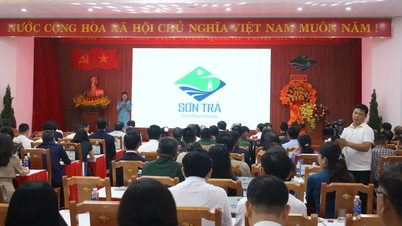
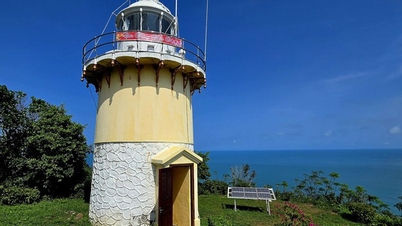
The Ho Chi Minh City delegation also visited and presented gifts to poor households and military units stationed on Hon Chuoi Island, such as Radar Station 615 (551st Regiment), Border Guard Post 704, and the lighthouse station. Residents on the island said that the relationship between the military and civilians is like that of fish and water, with the units helping to clean up the island and assisting residents in transporting their belongings when moving.
Captain Phung Sy Chuong, Head of Radar Station 615, said that the unit is maintaining two community outreach models: "Each unit is associated with a charitable address" and the "Drop of Compassion" model. In 2022 and the first nine months of 2023, they supported disadvantaged families with more than 400 kg of rice and 50 m³ of fresh water.
Source link
![[Photo] National Assembly Chairman Tran Thanh Man working with the Standing Committee of the National Assembly's Delegation Affairs Committee.](https://vphoto.vietnam.vn/thumb/1200x675/vietnam/resource/IMAGE/2026/05/20/1779294340023_ndo_br_1-1691-jpg.webp)
![[Photo] General Secretary and President To Lam works with the Party Committee of the Ministry of Health on the work of Vietnamese traditional medicine.](https://vphoto.vietnam.vn/thumb/1200x675/vietnam/resource/IMAGE/2026/05/20/1779294323718_a1-bnd-2978-3319-jpg.webp)
![[Image] "Journey of Hope" promotes the organ and tissue donation movement in Vietnam.](https://vphoto.vietnam.vn/thumb/1200x675/vietnam/resource/IMAGE/2026/05/20/1779294400833_1-8910-jpg.webp)























































Comment (0)