

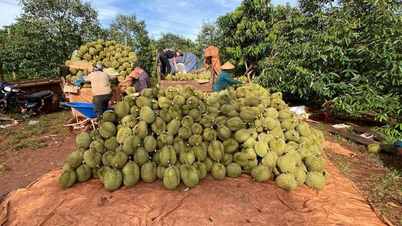
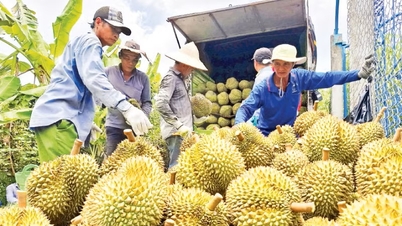
Currently, it is the peak durian harvest season in the Central Highlands. Many traders from various localities are flocking here to buy the fruit. Many durian growers are also enthusiastic about this crop, which is being called the "billion-dollar" crop.
| Nearly 1.4 trillion VND invested in salinity control for durian-growing regions; durian exports estimated to reach over 500 million USD. |
A good harvest, good prices.
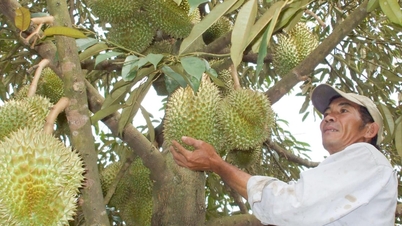
Unlike the past, when durian harvests were often accompanied by low prices, durian is now experiencing both a bumper crop and high prices, contributing to increased agricultural product value and farmers' income. Mr. Chau Van Han, residing in Ia Bang commune, Chu Prong district ( Gia Lai province), said that his family's durian orchard this year yielded a good harvest and high quality fruit, attracting traders who came to purchase it at 80,000 VND/kg. With this price and a yield of approximately 35 tons, after deducting all expenses, his family earned a profit of about 2.5 billion VND.
It's safe to say that durian growers in the Central Highlands have never experienced such a bountiful harvest and high prices. Besides the good harvest and high prices, the news that durian crops in Thailand are failing this year due to weather conditions has further fueled the confidence of many farmers in the Central Highlands, promising another successful harvest with billions of dong in profits. In fact, in recent years, many durian growers in the Central Highlands and Central Vietnam have made huge profits from durian cultivation. Therefore, many farming households are now competing to plant this "billion-dong" crop, hoping to change their lives for the better.
Due to high profits, the area planted with durian in the Central Highlands, as well as throughout the country, is increasing rapidly. In recent years, the area planted with durian in various localities has continuously increased, from nearly 32,000 hectares in 2015 to over 151,000 hectares in 2023. Durian production has also increased year by year, reaching nearly 1.2 million tons in 2023, while in 2015 it was only about 366,000 tons. Consequently, the value of durian exports increased from 29.2 million USD in 2016 to 420 million USD in 2022 and reached nearly 2.3 billion USD in 2023.
In Dak Lak, the area planted with durian is skyrocketing. From a situation where people planted durian haphazardly, by 2023 Dak Lak had risen to lead the country in terms of planting scale with over 32,780 hectares. With purchase prices at the farm ranging from 70,000 to 90,000 VND/kg, it is estimated that each hectare of durian cultivation yields 1-1.2 billion VND, after deducting costs, growers pocket approximately 700-800 million VND/ha… In neighboring Gia Lai, there are also nearly 6,000 hectares of durian. Of that, the area for commercial production accounts for about half, concentrated in districts such as Chu Prong, Ia Grai, Dak Doa, Chu Se, and Chu Puh. Gia Lai has also established 16 durian growing area codes and is developing durian as a strategic agricultural product.
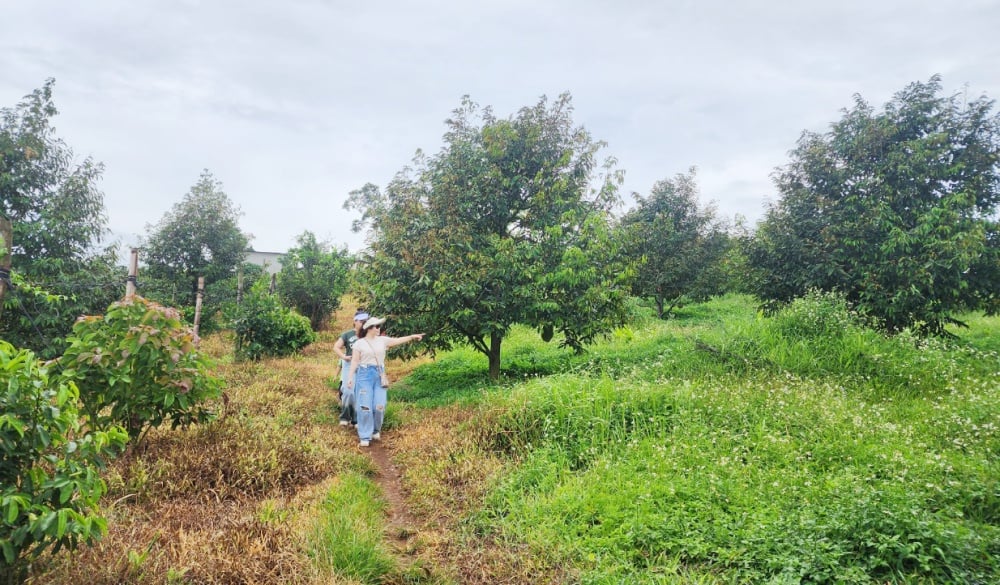 |
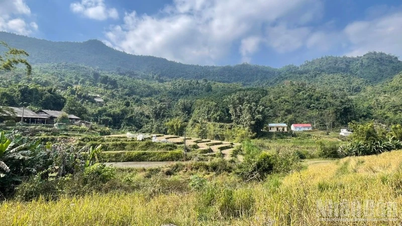
| The area under durian cultivation is expanding rapidly in many localities. |
We need to develop in a stable direction.
However, the rapid, uncontrolled, and unplanned expansion of durian cultivation poses many unpredictable risks, especially the lack of sustainability, which is causing concern. Even in the Central Highlands, many agricultural products have experienced booms, similar to the current durian boom. However, this has subsequently led many families into hardship and poverty. A prime example is pepper, where soaring prices led many farmers in the Central Highlands to abandon coffee and cashew cultivation. When pepper prices plummeted, farmers cut down their pepper plants, even falling into debt after investing heavily. Similarly, many farmers in the Central Highlands provinces also suffered greatly from the rapid expansion of rubber, often dubbed "white gold," due to the uncontrolled cultivation of this industrial crop.
Returning to durian, although it is currently at its peak, if the situation is not well controlled, durian could follow the same path as other agricultural products. The current rapid and unplanned increase in durian cultivation area will lead to oversupply and surplus production; some growing regions may be unsuitable or lack reliable irrigation, resulting in losses in yield and quality, and potentially disrupting the planning of other crops.
In fact, recently, some durian export shipments have received warnings from importing countries, leading to the temporary suspension of the use of codes for units with shipments infested with mealybugs (a plant quarantine pest in China). Besides that, there are also issues of fraud, theft of planting area codes; bidding wars; premature price fixing, and contract breaches... According to a representative of the Dak Lak Department of Agriculture and Rural Development, in reality, the scale of durian production in the locality is still small and fragmented, lacking large-scale raw material areas, and farmers lack technical skills and a professional approach to commodity production. In particular, there is currently no truly close link between orchard owners, cooperatives, and businesses.
Mr. Le Anh Trung, Vice Chairman of the Dak Lak Durian Association, frankly shared that the durian market in Vietnam in general and Dak Lak in particular is currently unregulated. Therefore, the current occurrences of "breaking contracts," price dumping, chaotic competition in orchards, and loss of reputation in export markets are understandable.
Meanwhile, the market for durian products remains dependent on traders. The main market for Vietnamese durian is China – a rather volatile market. Furthermore, in China, Vietnamese durian faces fierce competition from rivals, especially from Thailand.
To develop durian cultivation sustainably and avoid risks, local authorities and relevant agencies need to encourage people to participate in supply chain linkages, while also calling on businesses and cooperatives to collaborate with farmers in planting, processing, and consuming durian, and to find ways to export it through official channels to various markets. In the long term, state management agencies need to work alongside and implement more policies linked to the supply chain activities of businesses, cooperatives, and farmers, acting as an effective "bridge" between all parties. In the short term, it is necessary to strengthen communication and advise farmers to carefully consider and be cautious when expanding durian cultivation areas, avoiding uncontrolled expansion that could have long-term consequences. Farmers, on their part, need to adhere to cultivation techniques according to VietGAP, GlobalGAP, and organic standards, meeting the increasingly high demands of the market, especially demanding export markets, instead of being overly dependent on a single main market as is currently the case.
Source: https://thoibaonganhang.vn/noi-lo-chung-ve-sau-rieng-153532.html



























































Comment (0)