

Although North Korea's missile launch on May 31st failed, it has caused great concern in South Korea, the United States, and Japan regarding Pyongyang's future intentions.
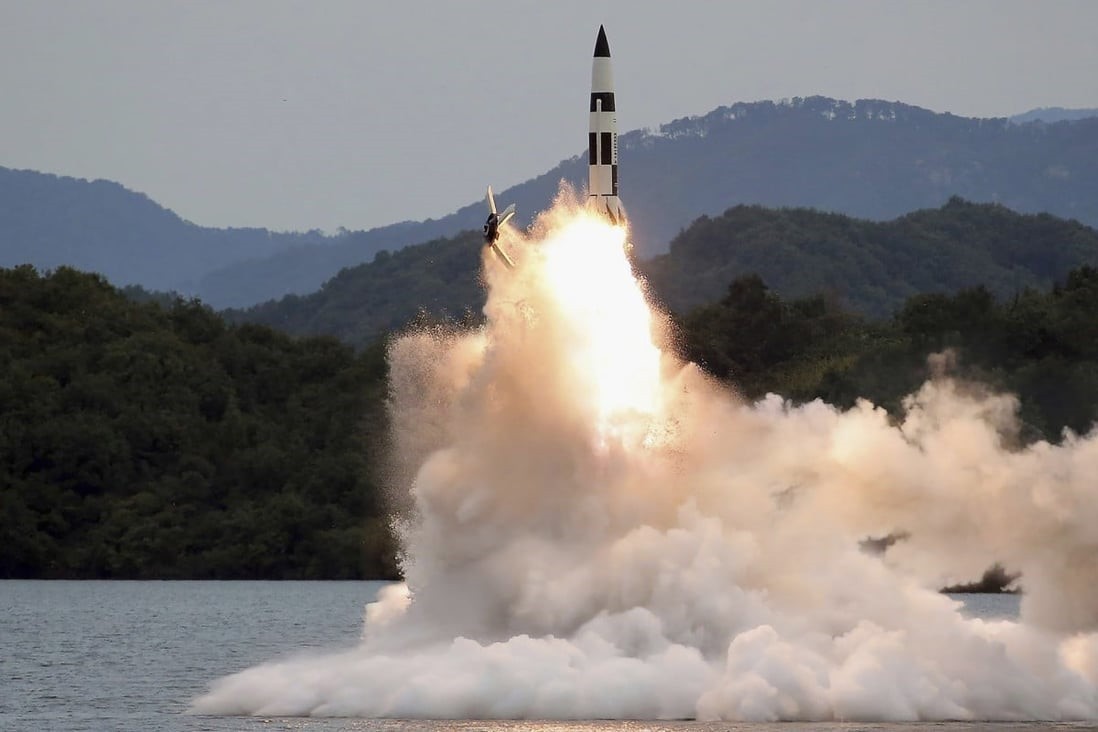 |
| Image of a North Korean missile launch. (Source: AP) |
On May 31, North Korea launched a "space-launching vehicle," but the launch failed and the missile fell into the sea.
According to a North Korean official, the new "Chollima-1" missile, carrying the "Malligyong-1" military reconnaissance satellite, fell into the sea due to "an abnormal start-up of the second-stage engine."
The North Korean state news agency ( KCNA ) said the country plans to conduct a second launch as soon as possible.
Seoul's Joint Chiefs of Staff (JCS) said they detected the launch from Tongchang-ri off North Korea's west coast at 6:29 a.m., and the missile fell into the sea about 200 kilometers west of South Korea's Eocheong Island after flying over the border island of Baengnyeong.
The South Korean military has recovered a fragment of this North Korean missile. It is a cylindrical object believed to have been used to connect the first and second stages of the missile. Observers suggest that such a component could shed light on the missile's construction and North Korea's technological advancements.
North Korea informed Japan and the International Maritime Organization of its plan to launch a satellite earlier this week, between May 31 and June 11, despite criticism that the activity would violate United Nations Security Council (UNSC) resolutions prohibiting any launches using ballistic missile technology.
The missile launch marks North Korea's first provocative act since it test-fired the Hwasong-18 intercontinental ballistic missile on April 13.
Failure, why?
According to KCNA , the launch failure was due to "the low reliability and stability of the new engine system applied to the rocket and the unstable nature of the fuel used."
KCNA mentioned that the missile flew "normally" until the first stage separated, indicating defects stemming from the second-stage propulsion system and rocket fuel – crucial elements for launching the satellite into orbit.
Chang Young-keun, a rocket expert at Korea Aerospace University, said the second-stage engine may have failed during ignition and combustion after the first stage separated.
Analysts say this North Korean missile is believed to be equipped with a Paektusan liquid-fuel engine modeled after the Soviet-made RD-250 twin-engine system.
Its first and second stages can carry a twin-chamber Paektusan engine with 160 tons of thrust and a single-chamber engine, while the third stage can be equipped with two small liquid-fuel engines. The operation of these engines requires liquid fuel as well as an oxidizer. In particular, the requirement to store liquid oxygen at extremely low temperatures could be a challenge for North Korea.
It remains unclear whether North Korea will adhere to its stated plan to rectify any flaws and conduct another space rocket launch "as soon as possible."
On May 30, Ri Pyong-chol, Vice Chairman of the Central Military Commission of the Workers' Party of North Korea, emphasized the need to secure reconnaissance capabilities before officially announcing plans to launch missiles.
In a statement from KCNA , Ri said the spy satellite is "indispensable for tracking, monitoring, distinguishing, controlling, and responding to dangerous military actions in real time" by the U.S. and South Korea.
International community reaction
Following North Korea's latest missile launch, the South Korean President's Office convened an emergency meeting of the National Security Council's Standing Committee, condemning the launch as a "serious provocation" that threatens peace on the Korean Peninsula in particular and the world in general.
Ahead of the launch, South Korea issued a "strong" warning that it would make Pyongyang "pay a heavy price" if it went ahead with the launch.
Immediately after launch, the Japanese government issued a warning urging residents in southern Okinawa to seek shelter, but this order was lifted about 35 minutes later after confirming that the missile was unlikely to fall on national territory.
Japanese Prime Minister Kishida Fumio told reporters in Tokyo that the government was gathering and analyzing information about the launch and there were no reports of damage from the projectile.
Japanese Chief Cabinet Secretary Hirokazu Matsuno said at a press conference that Tokyo had sent a protest note to Pyongyang regarding the launch, adding that whether the launched object was a satellite-carrying rocket was still "under analysis".
Japanese Defense Minister Yasukazu Hamada told reporters that the Japan Self-Defense Forces will remain vigilant and ready to intercept as long as the designated launch window has not closed.
The White House said the U.S. condemned North Korea's missile launch, noting that President Joe Biden and his security team are coordinating a situational assessment with allies and partners.
The top nuclear envoys of South Korea, the United States, and Japan held trilateral phone calls and also "strongly condemned" the launch, stressing that it could not be justified in any way, according to Seoul's Foreign Ministry.
In a separate statement, the U.S. Indo-Pacific Command stressed its "ironclad" security commitment to South Korea and Japan, and said it would continue to monitor the situation.
A spokesperson for the UN Secretary-General said in a statement that Secretary-General Antonio Guterres "strongly" condemned the launch, reiterating his call for Pyongyang to cease such actions and "swiftly" resume dialogue for peace.
Is Pyongyang just the first step?
After admitting to an unusually swift failure, North Korea announced it would conduct a second launch once it knew what had happened. This suggests that North Korean leader Kim Jong Un remains determined to expand his arsenal and put further pressure on Washington and Seoul while diplomacy remains stalled.
A North Korean satellite launch violates UN Security Council resolutions prohibiting the country from conducting any launches based on ballistic technology.
Observers believe that North Korea's previous satellite launches have helped improve its long-range missile technology. Recent long-range missile tests by North Korea demonstrate the ability to reach the entire US mainland, but outside experts say North Korea still has some work to do to develop a fully functional nuclear missile.
Recent commercial satellite imagery of North Korea's Sohae launch center shows ongoing construction activity, suggesting the country may be planning to launch more than one satellite. North Korea has stated it will test “various surveillance means” to monitor the movements of the U.S. and its allies in real time.
According to Lee Choon Geun, an honorary researcher at the Korea Institute for Science and Technology Policy, with 3-5 spy satellites, North Korea could build a space-based surveillance system that would allow it to monitor the Korean Peninsula in near real time.
This satellite is one of several high-tech weapons systems that Chairman Kim Jong Un has publicly stated he will introduce. Other weapons on his wish list include multiple-warhead missiles, nuclear submarines, solid-fuel intercontinental ballistic missiles, and hypersonic missiles.
During a visit to the space agency in mid-May, Chairman Kim Jong Un emphasized the strategic importance of a spy satellite in the confrontation between North Korea and the United States and South Korea.
Source


![[Photo] Prime Minister Pham Minh Chinh receives the Chinese Ambassador to Vietnam](https://vphoto.vietnam.vn/thumb/1200x675/vietnam/resource/IMAGE/2026/04/05/1775397481797_ndo_br_dsc-5512-jpg.webp)

















































































![[INFOGRAPHICS] Exploiting children's personal images for profit can result in fines of up to 50 million VND.](https://vphoto.vietnam.vn/thumb/402x226/vietnam/resource/IMAGE/2026/04/06/1775442200854_1775442148.webp)
























Comment (0)