

Joining her in the conversation were renowned experts and researchers from across the country. One of them was historian Le Nguyen, who translated and introduced the work "The Tay Son Rebellion" by American scholar George Dutton. In addition, Dr. Phan Thu Van – a lecturer at Ho Chi Minh City University of Education – also provided an interesting analysis of the works from the perspective of human nature and national identity.
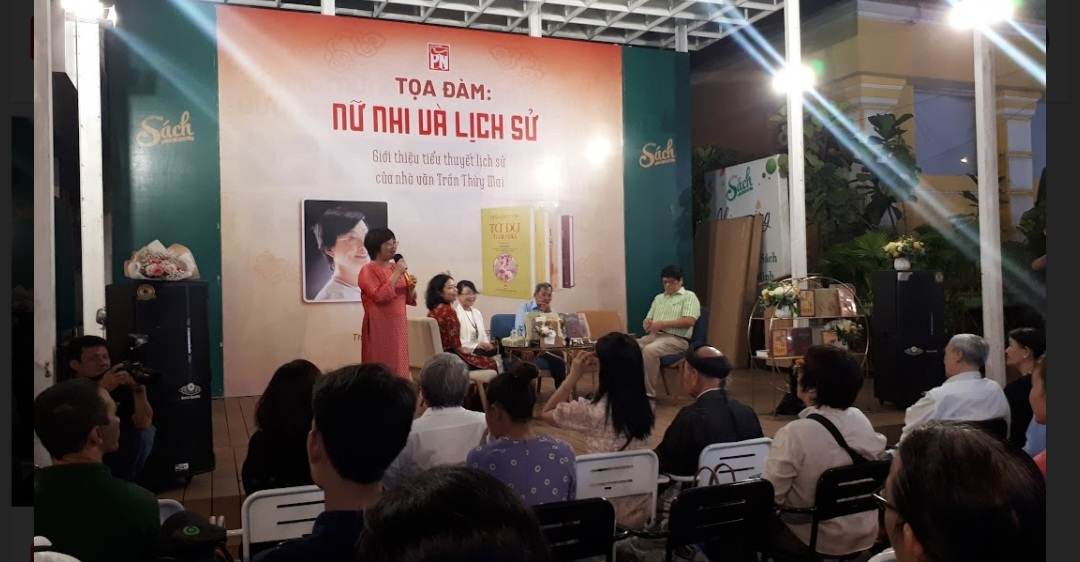
"History tells us what people did, while historical novels tell us how people saw things," shared writer Tran Thuy Mai.
My connection with historical novels
As one of the most impressive short story writers in Vietnamese literature, author Tran Thuy Mai shared that when she was younger and writing short stories, she mainly wrote whatever she liked, but coincidentally, stories about love were popular with readers. And because love is a very important human theme, she was very happy that her stories were appreciated by readers.
Living far from her homeland in San Francisco, USA, a sense of nostalgia led her to reconnect with history. As a Vietnamese person, wherever you go, you are always connected to the glorious years of your ancestors. This connection was formed during her 15 years working at Thuan Hoa Publishing House, where she read and edited major historical works such as Dai Nam Thuc Luc and Dai Nam Liet Truyen … Through these experiences, she inadvertently came into contact with historical sources.
The biggest challenge for authors writing historical novels is writing a story whose ending everyone already knows; therefore, the writer must conduct in-depth research and offer fresh interpretations.
Writer Tran Thuy Mai also shared that during that period, when reading history books, she found many things that needed reflection, and questioned whether those facts were accurate. This became the foundation for her personal shift. She also acknowledged that "the most difficult thing for authors writing historical novels is writing a story whose ending everyone knows, so the writer must conduct in-depth research and offer new interpretations."
When asked if she primarily wrote about the Nguyen dynasty because she was born and raised in Hue , she shared that people cannot be separated from the cradle of their birth, but it's not because she's from Hue that she writes about history.
Her writing was driven by the fact that Hue was the capital of Vietnam in the 18th and 19th centuries, so the story of Hue is the story of the entire nation. For example, the fall of the capital is still a shared event for the people of Hue on May 23rd every year, when they still offer prayers along the riverbank. It also marks the day our nation lost its sovereignty to the French army.
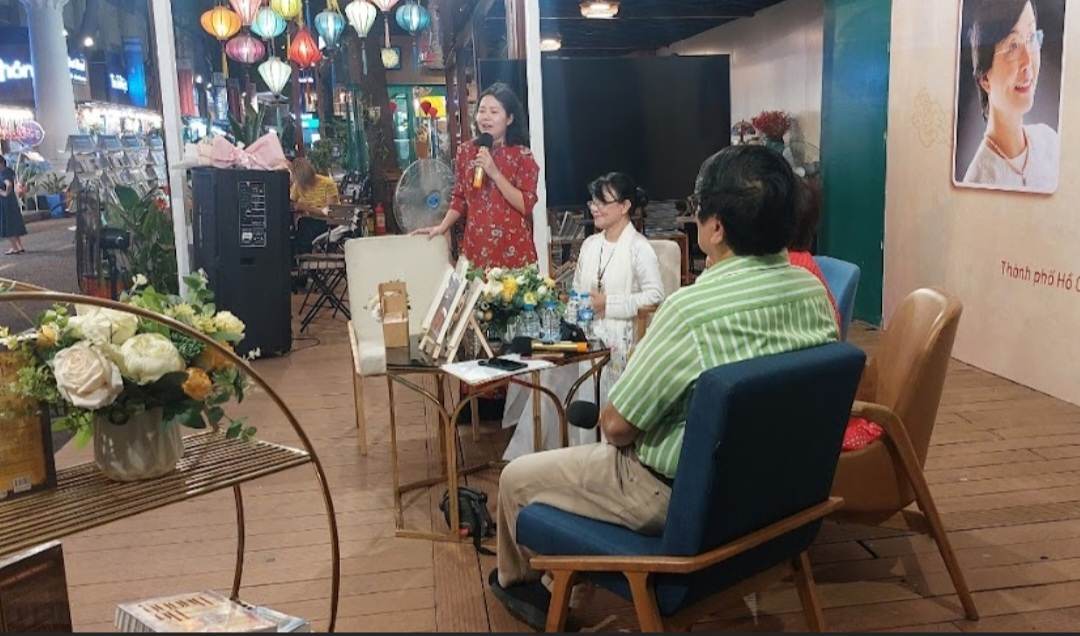
Writer Tran Thuy Mai (in white shirt) believes that historical novels consist of two parts: the historical framework and the creative elements filling in the gaps.
History or fiction?
This was also a topic of interest for the audience and readers at the sharing session. According to researcher Le Nguyen, even historical novels always require three main pillars: accuracy, honesty, and objectivity. So, is there a boundary between the two genres? He believes that between different historical events, there are always gaps that haven't been recorded, and this is the "fertile ground" for writers to use fictional techniques, thereby making historical transitions smoother.
Writer Tran Thuy Mai also believes that historical novels consist of two parts: the historical framework and the creative elements within the gaps. According to her, the framework must be very fixed, and we cannot alter the course of events or the characters' personalities. However, it is within these "gaps" and "spaces" that writers also have the opportunity to add their own creative touches.
History tells us what people did, while historical fiction tells us how people saw things.
She shared that during the writing process, she mainly relied on the Đại Nam Thực Lục to follow the linear flow of historical events. This is a detailed and very complete book about the Nguyễn dynasty, but more importantly, the historians of this period were very objective, standing independently without distorting the facts themselves. In addition, she also supplemented the facts in the Đại Nam Liệt Truyện by detailing the lives of officials such as Nguyễn Tri Phương and Phan Thanh Giản…
Regarding the lifestyle of that period, she primarily used the Đại Nam Hội Điển Sử Lệ (Great History of Vietnam), as well as other works written by French authors. In addition, she incorporated a wealth of folklore, including anecdotes and folk tales about Empress Từ Dụ and Tôn Thất Thuyết, creating interesting additions not previously recorded in historical texts. She also acknowledged that while the anecdotes might not be entirely accurate, they contributed to the novel's appeal.
Furthermore, the battle at Ky Hoa Fortress, or the issues of Annam and France – friend or foe?... were also explored by her using historical records compiled by foreign historians. Speaking about the gap between the two genres, writer Tran Thuy Mai said: "History tells us what people did, while historical novels tell us how people saw things."
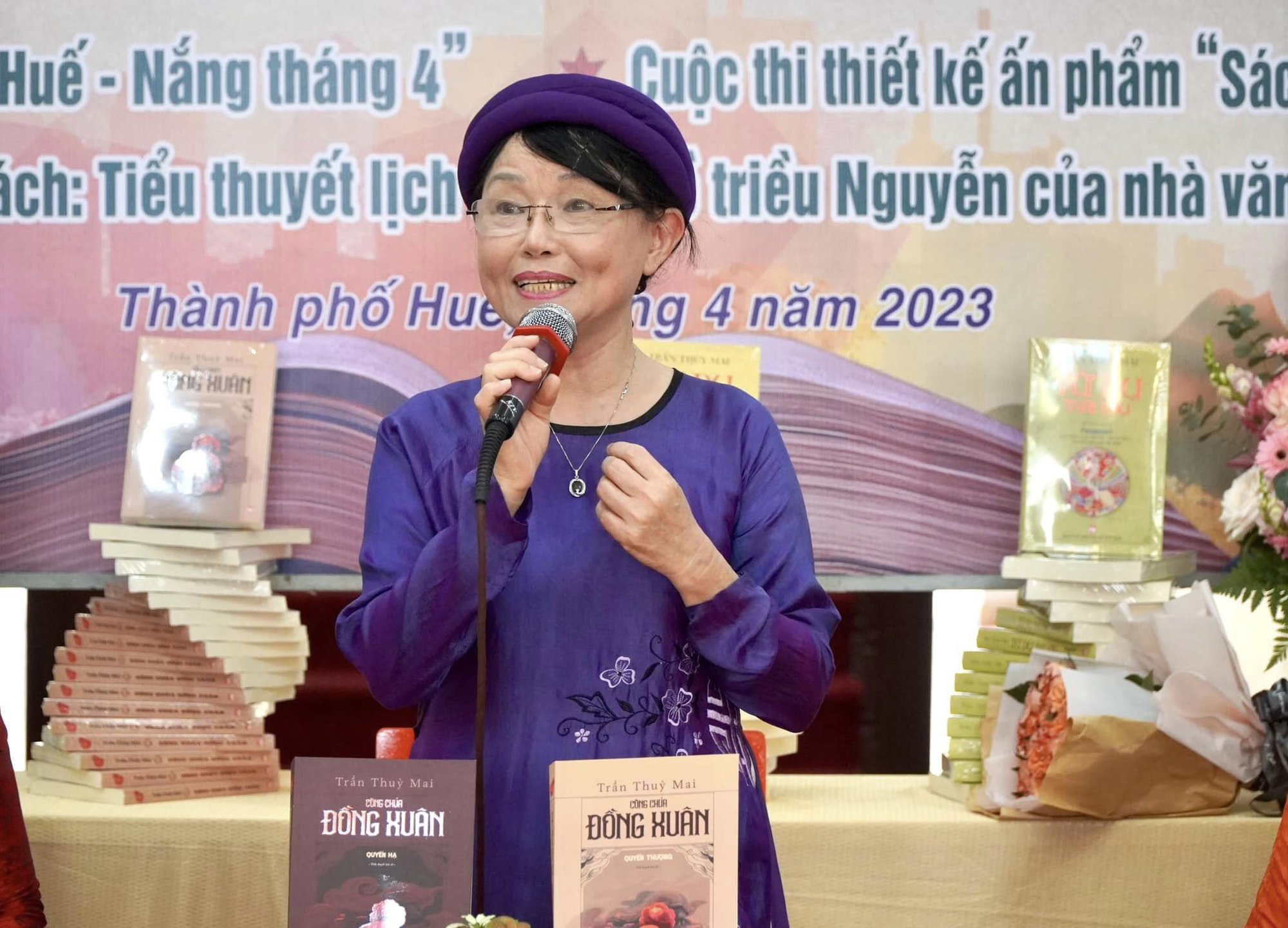
Writer Tran Thuy Mai interacts with readers in Hue.
The role of women
According to writer Tran Thuy Mai, the majority of characters in historical novels and films are still women. This is because, in this field, "men make history," but when women appear, artistic stories with historical significance are born.
We can see this in figures like Empress Y Lan and Duong Van Nga… They are prominent figures who have been used to create stories, films, and scripts. Like the cyclical nature of yin and yang, this combination makes stories more interesting, while in a period dominated by men, these figures served as historical sources for learning.
As a famous historical novelist once said, "When I read, I am entertained; when I am entertained, I learn the most." Therefore, in her work on Empress Dowager Từ Dụ , author Trần Thùy Mai intended to achieve this. She found a harmonious balance between the imperial harem – the world of women – and the royal court – the world of men. This also resulted in many interesting and little-known details.
Dr. Phan Thu Vân also agrees that male writers tend to focus more on issues of dynastic rise and fall, right and wrong, justice and injustice… primarily on ideological conflicts, between Confucianism and Buddhism, East and West… While with Tran Thuy Mai, she has raised completely different issues compared to her predecessors, where the most prominent feature is emotion and generational divides.
Ms. Vân also shared that when choosing the Nguyễn Dynasty as the subject, the tumultuous nature of its history always compelled further exploration. Each dynasty had different characteristics and different interpretations, influencing subsequent dynasties. A dynasty can pass in the blink of an eye. Therefore, writer Trần Thùy Mai paid close attention to creating child characters, showing us as if we were just born, and a small part of the historical narrative.
And is there another option for our nation through novels? Starting from the humanity in the characters and lives depicted in novels, we can easily see it gradually transforming into national identity, as the fates of the characters are guided by the prominence of a particular era. And that is the primary role of historical novels, where the upheavals of a dynasty and a period are vividly revealed through the fates and circumstances of the characters.
Source link
![[Photo] National Assembly Chairman Tran Thanh Man attends the policy seminar to promote Vietnam-Türkiye cooperation.](https://vphoto.vietnam.vn/thumb/1200x675/vietnam/resource/IMAGE/2026/04/16/1776351415367_vna-potal-chu-tich-quoc-hoi-tran-thanh-man-du-toa-dam-chinh-sach-thuc-day-hop-tac-viet-nam-tho-nhi-ky-8705791-jpg.webp)















![[Image] Bridges and roads connecting the eastern part of Ho Chi Minh City](https://vphoto.vietnam.vn/thumb/1200x675/vietnam/resource/IMAGE/2026/04/16/1776328595108_ndo_br_bh-vt5-jpg.webp)




















![[Infographic] Details of the Hanoi-Quang Ninh High-Speed Railway Project](https://vphoto.vietnam.vn/thumb/402x226/vietnam/resource/IMAGE/2026/04/16/1776338188424_anh-man-hinh-2026-04-16-luc-18-16-10.png)

![[Photo] National Assembly Chairman Tran Thanh Man meets with the Speaker of the Georgian Parliament](https://vphoto.vietnam.vn/thumb/402x226/vietnam/resource/IMAGE/2026/04/16/1776338494029_anh-man-hinh-2026-04-16-luc-18-21-21.png)














Comment (0)