

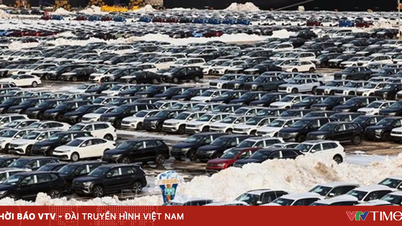
In a report submitted to the Department of Local Industry and Trade ( Ministry of Industry and Trade ), the Department of Industry and Trade of Vinh Phuc province stated that Toyota Vietnam Company - a large FDI enterprise in the locality - saw its production in the first quarter of 2023 decrease by 37%, equivalent to a reduction of 2,802 vehicles compared to the first quarter of 2022. Sales decreased by 24%, equivalent to a reduction of 1,760 vehicles, while inventory increased by 347%, equivalent to an increase of 1,931 vehicles.
During a meeting with a delegation from the Ministry of Industry and Trade earlier this week, the leaders of Vinh Phuc province requested the Ministry of Industry and Trade to propose to the Government the issuance of policies to develop the automobile and motorcycle industries.
For the time being, consideration should be given to further reducing the vehicle registration fee for domestically produced and assembled cars to stimulate domestic consumption and production.
Citing the example of the automobile factory located in the area, Thanh Cong Group Joint Stock Company, the Ninh Binh Provincial People's Committee, in a document sent to the Government and ministries, also reflected that Thanh Cong's automobile production and sales have suffered a significant decline: In January 2023, sales volume reached only nearly 3,000 vehicles, a decrease of 4,939 vehicles (equivalent to 62.5%) compared to January 2021 and a decrease of more than 3,700 vehicles (equivalent to 55.8%) compared to January 2022.
Therefore, Ninh Binh province has proposed to the Government and relevant ministries and agencies solutions to support automobile manufacturing businesses. These include a solution to reduce the vehicle registration fee by 50% for domestically produced and assembled cars for a suitable period.
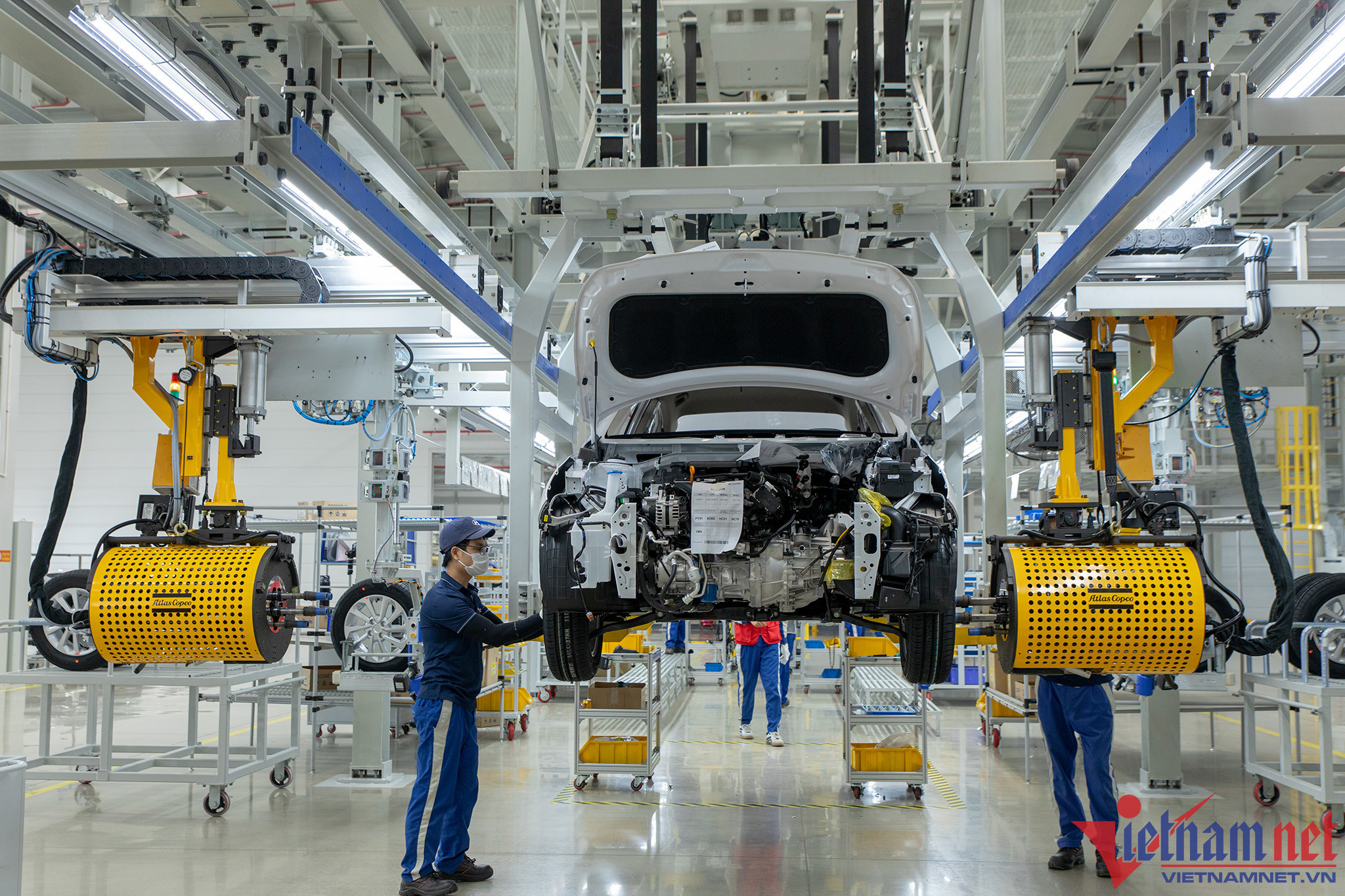
Previously, the Vietnam Automobile Manufacturers Association (VAMA) and several other associations had proposed postponing the payment of special consumption tax for 2023 and reducing the registration fee by 50% for domestically produced and assembled vehicles.
The reason is that from the end of the fourth quarter of 2022, the automotive market was affected by rising bank interest rates and low credit limits. Sales across the entire market in January 2023 decreased by as much as 60% compared to December 2022 and were only 54% compared to the same period in 2022.
According to VAMA statistics, the cumulative sales volume of member brands in the first quarter of 2023 all experienced significant declines. Specifically, Thaco KIA only achieved 8,600 units, a decrease of 49%; Mitsubishi decreased by 21%; Suzuki by 29%; Mazda by 25%; and Toyota Vietnam by 37%... compared to the same period last year.
Similarly, the Vietnam Association of Mechanical Engineering Enterprises (VAMI) also highlighted the reality of declining vehicle sales, leading to a drop in orders for supporting industries and the mechanical engineering sector. In the short term, if purchasing power does not improve and the market does not recover, to alleviate inventory pressure, manufacturers will find it difficult to maintain stable production levels and will be forced to reduce capacity and workforce.
In a document sent to the Ministry of Finance on April 25th, the Ministry of Industry and Trade stated that, overall for the first three months of 2023, total market sales reached 77,090 vehicles, a decrease of 31% compared to the same period in 2022.
Therefore, the Ministry of Industry and Trade believes that continuing to apply the policy of supporting the reduction of registration fees for domestically produced and assembled automobiles for an appropriate period is necessary and consistent with the general spirit, contributing to stimulating consumer demand for domestically produced and assembled automobiles, and supporting automobile businesses and distributors in selling their existing inventory.
According to the Ministry of Industry and Trade, consideration could be given to extending the application period of this policy until the end of 2023.
However, the Ministry of Finance, in contrast, argues that further reducing the vehicle registration fee by 50% for domestically produced and assembled cars would negatively impact the fulfillment of international commitments, such as those under the WTO agreement.
Furthermore, in a document sent to the Prime Minister on April 28th, the Ministry of Finance noted that continuing to reduce the vehicle registration fee for domestically produced and assembled cars, in addition to reducing state budget revenue, would also have a certain impact on the 2023 budget balance of many localities.
Based on the above analysis, the Ministry of Finance is submitting to the Prime Minister a proposal to postpone the 50% reduction in vehicle registration tax for domestically produced and assembled automobiles.
In the event that the Prime Minister decides to implement a policy to reduce the vehicle registration tax rate for domestically produced and assembled automobiles, the Ministry of Finance proposes considering one of two options.
Option 1: Reduce the vehicle registration tax rate by 50% for domestically manufactured and assembled automobiles. This option would reduce state budget revenue by approximately 8,000-9,000 billion VND (implemented in the first 6 months of 2022, the revenue reduction due to policy adjustments is 8,727 billion VND).
Option 2: Reduce the vehicle registration tax by 50% for both domestically produced and assembled cars and imported cars. This option would reduce state budget revenue by approximately 15-16 trillion VND.
Statistics show that vehicle registration tax revenue accounts for approximately 70% of total vehicle registration tax revenue (total vehicle registration tax revenue in 2021 was VND 27,318 billion, accounting for 72% of total vehicle registration tax revenue, and in 2022 it was VND 32,398 billion, accounting for 68% of total vehicle registration tax revenue).
Source
![[Image] Shipbuilders exposed to steel and record-breaking heat.](https://vphoto.vietnam.vn/thumb/1200x675/vietnam/resource/IMAGE/2026/06/04/1780545781745_ndo_br_img-5402-4683-jpg.webp)
















































![[Video] Sunset at Lap An Lagoon – Where the sun sets over the fishing nets](https://vphoto.vietnam.vn/thumb/1200x675/vietnam/resource/IMAGE/2026/05/31/1780192137701_beach-landscape-sea-water-nature-grass-745871-pxhere-com.jpeg)





























Comment (0)