Many people buying gifts for parents, elderly people, or those suffering from joint pain often choose boxes labeled "Omega 3-6-9" instead of "Omega-3," thinking that the more types of omega fatty acids, the better.
- Omega-6 and Omega-9: Are we really deficient?
- Omega-6/Omega-3 Ratio: Why is Imbalance the Problem?
- Taking Omega 3-6-9 supplements while suffering from arthritis: Why might this be the wrong approach?
- Quick comparison table: Omega-3 and Omega 3-6-9
- Why are Omega 3-6-9 supplements selling so well?
- What should I buy?
- Who needs to ask a doctor before taking this?
It sounds logical: 3, 6, and 9 must be more comprehensive than just 3 alone. But the truth is, your body may not be deficient in omega-6, and you certainly don't need to supplement with omega-9 in pill form.
If the goal is to fight inflammation, support cardiovascular health, lower triglycerides, or alleviate joint pain, the most important thing to consider is usually the EPA and DHA in Omega-3s, not a fancy-sounding multivitamin supplement that adds fats already abundant in the modern diet.
Omega-6 and Omega-9: Are we really deficient?
To understand why Omega 3-6-9 is often misunderstood, it's necessary to separate each type.
Omega-3s include essential fatty acids such as EPA and DHA, commonly found in fatty fish, fish oil, and krill oil. This group is frequently discussed due to its association with cardiovascular health, blood lipids, inflammatory responses, brain function, and eye health. Many people eat little seafood, so they may need to increase their omega-3 intake through food or appropriate supplements.
Omega-6 is also an essential fatty acid. The body needs omega-6 for immunity, skin, hormones, and many other biological functions. The problem is that modern people often already consume plenty of omega-6 from soybean oil, sunflower oil, corn oil, fried foods, processed foods, snacks, and fast food. Therefore, most consumers are not deficient in omega-6 to the point of needing to buy supplements.
Omega-9 is different. It's a monounsaturated fat found in olive oil, avocados, and some nuts. The body can also synthesize omega-9 on its own, so it's not considered an essential fat in the sense that it needs to be supplemented with pills.
In short: omega-3 deficiency is fairly common; omega-6 and omega-9 deficiency to the point of needing supplements is uncommon.
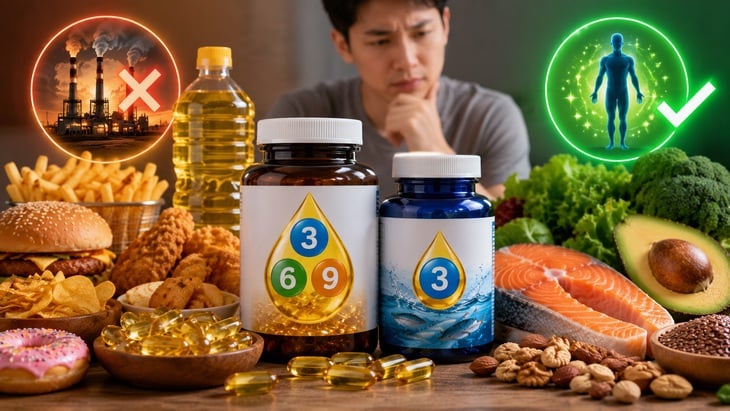
Omega 3-6-9 sounds comprehensive, but it's not always necessary, especially since modern diets already provide plenty of omega-6 from cooking oils and processed foods.
Omega-6/Omega-3 Ratio: Why is Imbalance the Problem?
The body needs both omega-3 and omega-6. But balance is key.
Omega-3 and omega-6 are both involved in metabolic pathways that produce signaling molecules related to inflammation, blood clotting, immunity, and vascular responses. When there is too much omega-6 and too little omega-3, the biological balance may tilt toward a state of simmering inflammation.
Some nutritional literature often mentions an ideal omega-6/omega-3 ratio that is much lower than what is recommended in a modern diet. In reality, for people who consume a lot of processed oils, fried foods, snacks, and fast food but little fatty fish, this ratio can be pushed up very high.



Interestingly, many people suffering from joint pain, hormonal acne, abdominal obesity, fatty liver disease, and dyslipidemia continue to buy Omega 3-6-9 supplements hoping to "fight inflammation." But these capsules don't just contain Omega-3; they also contain Omega-6 and Omega-9. If your diet already has an excess of Omega-6, supplementing may not serve the intended purpose.
Taking Omega 3-6-9 supplements while suffering from arthritis: Why might this be the wrong approach?
People with joint pain often turn to fish oil because they've heard that omega-3s help reduce inflammation. This approach has some merit in some cases, especially when patients are getting enough EPA/DHA and adhering to their primary treatment.
But if you're buying Omega 3-6-9, you need to ask yourself: "Am I getting more omega-3, or am I buying more omega-6, which I already have in excess in my diet?"
If the goal is to support the inflammatory response, consumers should be aware of:
- EPA content per capsule.
- DHA content per capsule.
- Total EPA + DHA per day.
- Has the product undergone independent testing?
- Does the oil have a rancid smell, a strong fishy odor, or a bitter taste?
- Are you currently taking anticoagulants, cardiovascular medications, or do you have any underlying medical conditions?
An Omega 3-6-9 capsule with large lettering on the front but without clearly stating EPA/DHA may not help you know how much active omega-3 you're actually consuming.
Quick comparison table: Omega-3 and Omega 3-6-9
| Criteria | Pure Omega-3 | Omega 3-6-9 |
|---|---|---|
| Main ingredients | EPA, DHA, or ALA | A blend of omega-3, omega-6, and omega-9 fatty acids. |
| Suitable for whom? | People who eat little fish need to increase their EPA/DHA intake. | People who lack diverse fats rarely need them in pill form. |
| Anti-inflammatory goals | Focus more on getting enough EPA/DHA. | Adding omega-6s unnecessarily may be less effective. |
| People with joint pain | Clearly, EPA/DHA should be prioritized. | Not the first choice. |
| How to read labels | See EPA/DHA information per capsule | Easily deceived by the phrase "3-6-9 comprehensive" |
| Actual value | Depending on the quality and dosage of EPA/DHA | Sounds appealing, but not necessarily better. |
Why are Omega 3-6-9 supplements selling so well?
There are three reasons.
- Firstly, the name sounds "comprehensive." Buyers feel like they are choosing a more complete product.
- Secondly, when buying gifts for the elderly, people often prioritize large boxes, attractive labels, and numerous ingredients. Few people bother to check the back of the box for EPA/DHA information.
- Thirdly, consumers often lump all types of "omegas" into one supplement group. But in nutrition, more isn't always better. The right type, the right dose, and the right needs are what truly matter.
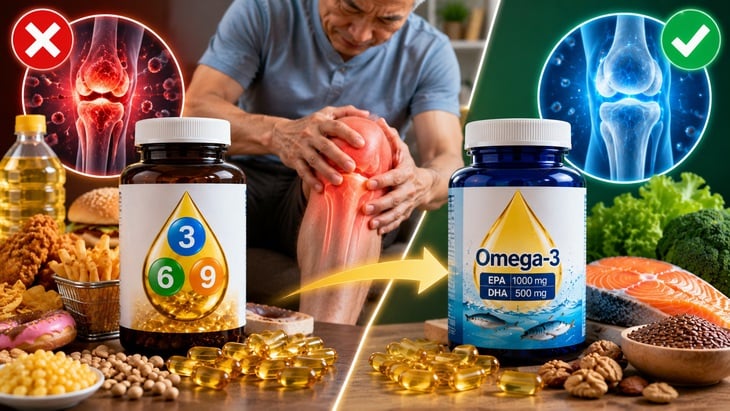
People with joint pain or those seeking anti-inflammatory support should prioritize Omega-3 products with clearly stated EPA/DHA content rather than choosing based on the "3-6-9" label.
What should I buy?
If the goal is to support cardiovascular health, blood lipid levels, brain function, or the inflammatory response, consumers should prioritize Omega-3 products with clearly stated EPA/DHA.
Consider these:
- Pure Omega-3 fish oil.
- Krill oil is a good option if you're on a budget and not allergic to seafood.
- Eat fatty fish twice a week if possible.
- Supplement your diet with flax seeds, chia seeds, and walnuts as plant-based sources of ALA.
When buying supplements, please read:



- What is the EPA content in mg/tablet?
- How many mg of DHA are in each tablet?
- Total EPA + DHA per serving.
- Oil form: triglyceride, re-esterified triglyceride, phospholipid or ethyl ester.
- Are tests for heavy metals, oxidation, and purity conducted?
- Is the bottle too big? Will it last too long?
- The oil had a strong, pungent, bitter, rancid smell.
Who needs to ask a doctor before taking this?
Fish oil should not be considered a harmless health supplement.
You should consult a doctor if you:
- Currently taking anticoagulants or aspirin at therapeutic doses.
- There is a blood clotting disorder.
- Upcoming surgery, need to have a major tooth extracted.
- Currently undergoing treatment for cardiovascular disease.
- He has severe liver and kidney disease.
- Allergy to fish and seafood.
- Pregnant or breastfeeding.
- They want to use a high dose to lower triglycerides.
People with arthritis should not stop taking their prescribed medication just to take omega-3s. Supplements are only supportive and do not replace medical treatment.
When choosing a fat supplement, don't buy based on the feeling that "more ingredients are better." For most modern people, the problem is often a deficiency in active omega-3s from EPA/DHA, while omega-6 is already abundant in the diet and omega-9 can be synthesized by the body. If the goal is to fight inflammation or support joint pain, choose an Omega-3 product with clearly stated EPA/DHA content, good quality testing, and use the correct dosage as advised by your healthcare provider if you have underlying conditions.
Omega 3-6-9 sounds comprehensive, but it's not always the smart choice. For people who eat a lot of processed oils, fast food, fried foods, and little fatty fish, what's often needed isn't to take extra omega-6, but rather to increase omega-3 and reduce unhealthy sources of fat. If you're buying a gift for parents, elderly people, or someone with arthritis, don't just look at the front of the product. Flip the label, read the EPA/DHA information, and choose what their body is truly lacking.
Source: https://suckhoedoisong.vn/omega-3-6-9-co-chac-tot-hon-omega-3-169260619130838812.htm