

Each time we met him, we were surprised again and again. It's hard to believe that a former prisoner of Con Dao, tortured by the enemy and having several ribs broken, could live so long and be so clear-minded. Even more admirable is that, throughout his revolutionary life, he left his mark with many bold and famous ideas and actions.
Having grown up during the preparations for the August 1945 General Uprising in his hometown of Kim Thanh, Hai Duong (now Hai Phong City), in addition to his dedicated efforts in his work, he also self-studied to become proficient in Chinese characters and fluent in French and English.
Having lived through nearly a century, experiencing the historical periods of the country, veteran revolutionary Doan Duy Thanh's recollections hold countless profound memories. As someone "in the thick of it all," and a high-ranking official from the period before the 1986 reforms, he shared with us that what he remembers most vividly is the image of the people suffering from hunger and hardship.
Comrade Doan Duy Thanh recounted: “Before the reforms, people were very hungry. When I was a leader in Hai Phong, I was deeply troubled to see so many poor people gathering in front of the city Party committee and People's Committee offices to beg for food. Once, I went to Hoa Nghia commune, Kien Thuy district, and saw three young children lying starving on their beds. When I asked the commune secretary and chairman why they let the situation be like that, they gave evasive answers, saying it was because the fields were unproductive, and then they blamed the farmers for abandoning their fields and being lazy... I told my driver to go home and get rice to cook for the children immediately. The commune officials were so scared that they quickly asked for rice from the cooperative's warehouse to help the people starve.”
In that context, Hai Phong pioneered the household contract system, allocating land to farmers, which provided the practical basis for the Party Central Committee to issue Directive 100 on product contracting to groups and individual workers (Contract 100) in early 1981. Seven years later, the Politburo of the 6th Party Congress issued Resolution 10 on reforming agricultural management (Contract 10), creating a breakthrough in agricultural productivity and output. Along with Vinh Phuc in the preceding period, Hai Phong was one of the leading places to realize the policy of "contract management in agricultural production," thanks in large part to the decisive and bold "breaking the rules" of Comrade Doan Duy Thanh.
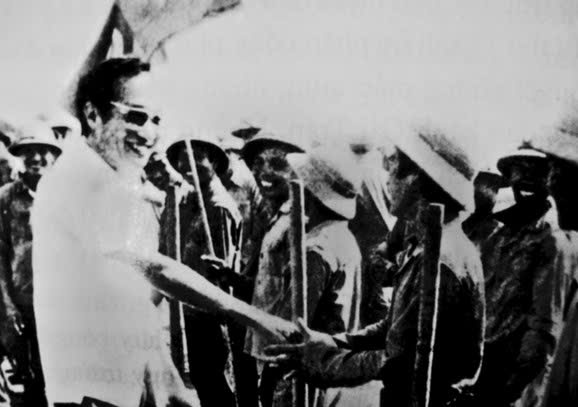 |
| Hai Phong City Party Secretary Doan Duy Thanh visits the Cai Trap canal excavation site in 1984. (Photo reproduced) |
He recounted: “I had been thinking about the household contract system and the allocation of land to farmers for a long time. After the criticism of Vinh Phuc's contract farming model, I still went to the province to meet with the Provincial Party Secretary Kim Ngoc to learn more. In the late 1970s and early 1980s, the food situation in Hai Phong, as well as the whole country, was extremely tense. I was very concerned that in the rice granaries, with two harvests a year, interspersed with one crop of other vegetables, why was there still persistent hunger? Initially, I thought that if we used plowing machines and new varieties of seeds... surely productivity would increase. But then, despite investments in plowing machines, science and technology, new varieties, fertilizers, and pesticides... productivity still declined. I remembered that when I was a child, my family in Hai Duong could get 100 kg/sao (a unit of land measurement) with normal plowing, but now we can't even get 40 kg/sao. What is the root cause of this?”
With that concern in mind, Comrade Doan Duy Thanh (Chairman of the People's Committee of Hai Phong City, later Secretary of the Hai Phong City Party Committee) decided to personally lead a working group (on some trips he went alone) to inspect all the suburban districts of Hai Phong.
When we spoke with him at his home on Doi Can Street (Hanoi), he had a private space where he kept his notes from that period. Therefore, even though decades have passed, when asked, the memories marking those pivotal moments still vividly return to his mind.
Accordingly, a typical example of the "eve of reform" was Phuc Le commune in Thuy Nguyen district. "Through inspection, we found that the commune reported that cooperative meetings were regularly attended by 100% of members. A single drumbeat for a Party committee meeting would result in 100% of Party members being present. However, labor productivity was very erratic, and daily wages were not high. Members only worked quickly to finish their cooperative tasks, while focusing their efforts on farming (5%) and fishing in the river and sea, or engaging in petty trading. The cooperative economy only provided 20% of their family's living expenses, so they had to rely mainly on outside work. Many communes at that time suffered from severe food shortages...", he recounted.
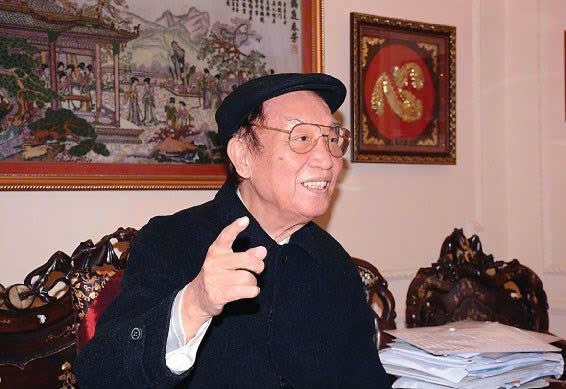 |
Comrade Doan Duy Thanh speaks with reporters. Photo: BICH TRANG |
Recognizing that the root of the problem lay in management, only a change in agricultural management could bring about a turnaround, Chairman Doan Duy Thanh reported the issue to Provincial Party Secretary Bui Quang Tao, who agreed and supported the proposal. The two key officials exchanged views numerous times and drafted a resolution on "production contracting" in agriculture.
However, according to Comrade Doan Duy Thanh, at that time, the "contracting" system was still a taboo subject. The Hai Phong City Party Committee held many meetings but still failed to reach a high level of consensus. Secretary Bui Quang Tao and Comrade Doan Duy Thanh advocated that, along with campaigning to create internal consensus, one district should issue a resolution first to gather opinions from the grassroots, after which the City Party Committee would issue the official resolution. Do Son District was chosen as the pilot district.
“This district issued its resolution 32 days before the Standing Committee of the Hai Phong City Party Committee issued Resolution 24 on agricultural contracting in August 1980. The Party's will aligned with the people's aspirations and was quickly realized in daily life. The people enthusiastically embraced it and worked diligently on their 'fields.' When I visited the grassroots on the 30th and 1st day of Tet (Lunar New Year), I still saw people working in the fields. This had never happened before. As a result, productivity increased significantly; previously, the annual yield was only 3.5 to 3.8 tons of rice per hectare, but in the very first year of contracting, it increased to 4.5 to 5 tons of rice per hectare. In the following years, Hai Phong's agriculture developed very rapidly. Food production, including non-agricultural sectors, became almost self-sufficient. There was no longer the annual need to go to the central government to request rice and noodles. Hundreds of delegations from the central government and localities across the country flocked to Hai Phong to visit and learn. Hai Phong became a model for economic development.” "The most dynamic economy in the country...", Comrade Doan Duy Thanh smiled proudly as he mentioned the groundbreaking figures that paved the way for the innovative development of Hai Phong Port City.
In a conversation with us during his lifetime, former Vice Chairman of the Council of Ministers Doan Duy Thanh stated that, to achieve those groundbreaking successes, besides the high level of unity among key leaders and greater internal consensus, another crucial factor was that Hai Phong had secured the support of key leaders of the Party and State. He personally went to the home of General Secretary Le Duan and reported for three hours on the current state of agriculture, farmers, and Hai Phong's "contract farming" policy. The General Secretary listened very carefully and agreed. Prime Minister Pham Van Dong also expressed his agreement. He also reported to Chairman Truong Chinh two or three times.
“To provide convincing evidence, I reported to Comrade Truong Chinh to visit the grassroots level and provide specific, practical data on the lives of the people and civil servants. Finally, when we sought his final opinion on product-based contracts in agriculture in Hai Phong, he agreed. I am very pleased that our policy has been successful in practice, contributing to the achievements of the reform process in the following years. I believe that any change or reform that originates from the people, is driven by the people, and is for the people will surely succeed. All difficulties will be overcome, and the future will be brighter if we truly listen to the voice of the people,” Comrade Doan Duy Thanh affirmed.
Source: https://www.qdnd.vn/chinh-tri/tiep-lua-truyen-thong/ong-xe-rao-o-hai-phong-1025721
![[Photo] General Secretary and President To Lam visits and delivers a policy speech at Tsinghua University.](https://vphoto.vietnam.vn/thumb/1200x675/vietnam/resource/IMAGE/2026/04/14/1776164592318_vna-potal-tong-bi-thu-chu-tich-nuoc-tham-va-phat-bieu-chinh-sach-tai-dai-hoc-thanh-hoa-trung-quoc-8700658-5437-jpg.webp)
![[Photo] General Secretary and President To Lam and his wife begin their state visit to China.](https://vphoto.vietnam.vn/thumb/1200x675/vietnam/resource/IMAGE/2026/04/14/1776133794926_z7723148772587-ffefa3c4b1e54e100de1554593a862c6-jpg.webp)
![[Image] Expediting land clearance at Alley 310 Nghi Tam to facilitate the construction of Tu Lien Bridge](https://vphoto.vietnam.vn/thumb/1200x675/vietnam/resource/IMAGE/2026/04/14/1776160406551_ndo_br_z7724148990408-9e5d4777e3c4504998b4286178b2e66e-jpg.webp)










![[Photo] General Secretary and President To Lam receives Slovak Prime Minister Robert Fico](https://vphoto.vietnam.vn/thumb/1200x675/vietnam/resource/IMAGE/2026/04/13/1776080592076_a1-bnd-8227-6002-jpg.webp)



































Comment (0)