 |
To understand why Japanese football is so highly praised, you sometimes don't need to look at overly complicated plays. Just a few short videos are enough to reveal the essence of how this team operates.
The value of those without a ball
The core isn't the passing. The core is the movement of the players who don't have the ball.
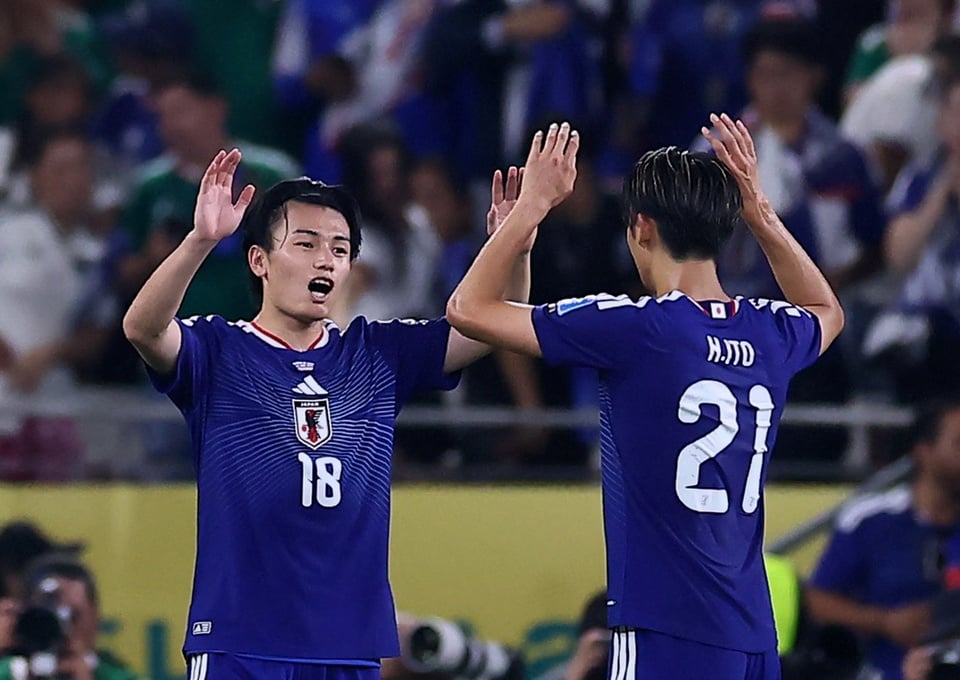
In the situation leading to the opening goal in the 4-0 victory against Tunisia on June 21st, the noteworthy aspect wasn't solely the player in possession (Keito Nakamura). In front of Nakamura, two teammates without the ball accelerated towards the goal. One drew the opposing defense along with him, while the other created space.
But the final goal was scored by a fourth player (Daichi Kamada).
That detail highlights the danger posed by Japan. They don't attack with the solitary efforts of a single individual. They create multiple movements simultaneously, disrupting the opposing defense in terms of vision, distance, and position.
When multiple players move together, defenders lose track of the main threat. According to one source, they may overlook others. By dropping deep, they lose control of the space. By pressing forward, they leave gaps behind.
In modern football, the player with the ball is usually the center of attention. But with Japan, it's the players without the ball who tire out the most. They don't just run for the sake of running. They run to draw defenders, open up space, create options, and force the defense to make decisions in a very short amount of time.



Just one moment of hesitation, and the opponent could pay the price.
When the whole team sees the same picture
The third goal in the second half followed the same logic.
From the midfield, the Japanese players advanced in unison. They created opportunities on both flanks, in the center, and in the spaces in front of the defense. The ball didn't need to reach its final destination, but the opposing defense had to constantly shift.
The danger lies in the fact that Japan doesn't create opportunities through a single run. They create multiple options simultaneously. The player with the ball is therefore not isolated. He always has someone to pass to, space to exploit, and teammates to support him from various directions.
This style of football cannot be developed overnight. It requires practiced movements, an understanding of space, speed of transitions, and organizational skills so that the whole team can see the overall picture.
A single player making a good run can create opportunities. But multiple players making runs at the right time, in the right direction, and with the right purpose create an attacking structure that is difficult to control. That's what Japan is doing well.
Therefore, when talking about Japanese football, one shouldn't just look at the fact that they have good players. More importantly, they have a team that knows how to create opportunities for each other.
The difference is enormous.



A team with talented individuals might thrive on fleeting moments. But a team where many players understand each other's movement, know how to exploit space, and serve a common vision will create more sustainable strength.
There's no need to praise Japan in an absolute way. But what they do well deserves recognition.
In those situations, the player without the ball is even more dangerous than the player with the ball. And that's why Japan is increasingly becoming a team that opponents have to be wary of.
Source: https://znews.vn/pha-bong-boc-tach-suc-manh-cua-nhat-ban-post1662087.html