

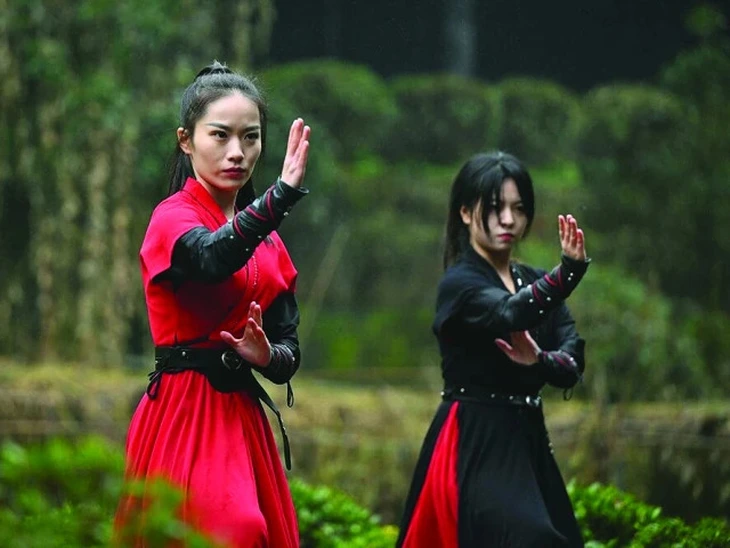
The Emei martial arts school is often mistakenly thought to be for women only - Photo: EM
Controversial origins
"During the late Southern Song Dynasty and early Yuan Dynasty, Guo Xiang, daughter of Guo Jing and Huang Rong, founded the Emei martial arts school on Mount Emei in Sichuan Province. This school has been passed down through generations to women and is one of the largest martial arts schools in Central China."
That's what readers of Jin Yong's novels know by heart. But the reality is quite different from what the great Hong Kong writer created.
According to widely circulated documents in the field of Chinese martial arts research, the Emei school is named after the mountain of the same name in Sichuan province.
Some folklore suggests that this school of thought originated during the Ming Dynasty, founded by a female Taoist priestess named Chu Xiu Ying.
This information is confirmed in the work "Chronicle of Chinese Martial Arts" by scholar Wang Delin, a reputable document on the history of Chinese martial arts.
Another legend suggests that the founder of the Emei sect was a Taoist named Situ Bai, who lived from the Qin dynasty to the Eastern Han dynasty.
According to this legend, Situ Bai was the first to create martial arts forms that mimicked the white apes of Mount Emei - which later developed into the signature martial art of the school.
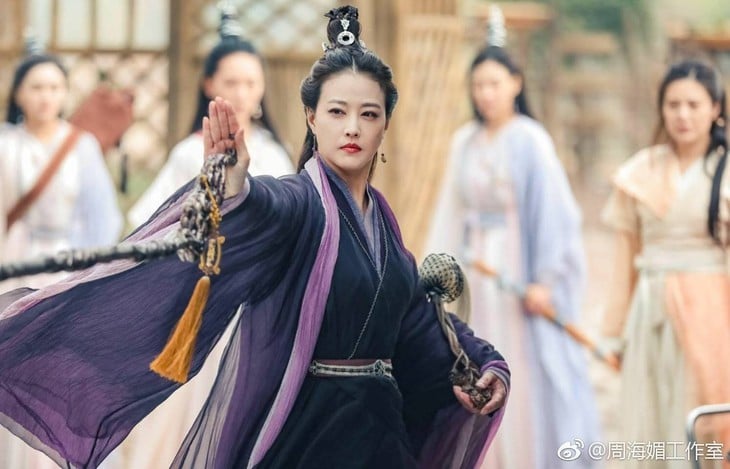
In Jin Yong's novels, the Emei sect is closely associated with women - Photo: PT
Because both accounts date back thousands of years, neither is officially recognized as the true "founder" of the Emei sect.
Therefore, Kim Dung had even more opportunities to create more information through his masterful writing.
In the novel "The Heaven Sword and Dragon Saber," Jin Yong portrays the Emei Sect as a "symbol of feminism," the only sect among the six major sects that places women at its center.
For a long time, Chinese historians have assessed this innovative aspect of Jin Yong's work as merely a way to create balance in his novels. The Shaolin and Wudang schools have no female characters, so a martial arts school of comparable stature is needed to counter them.
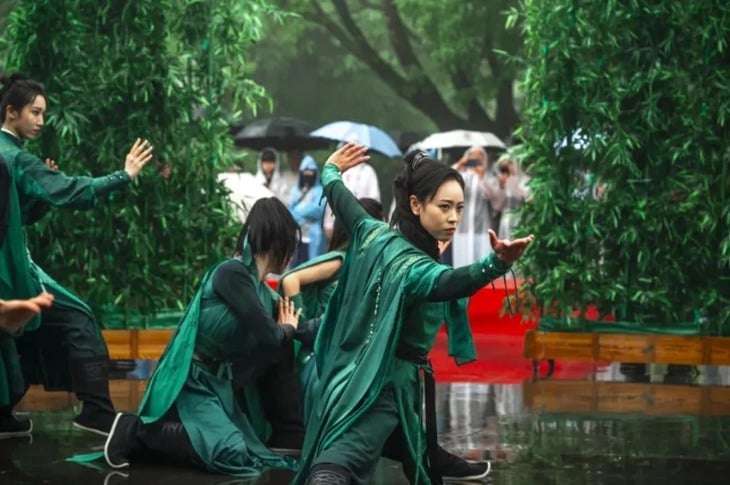
The "Emei Kung Fu Girls" group attracted a large audience to their performance - Photo: XN
Kim Dung's creativity is not without basis. In his work, scholar Wang Delin acknowledges that the fighting techniques of the Emei sect prioritize grace, agility, and skill, making them very suitable for women.
The unique martial arts style of Emei
Emei martial arts emphasize speed, utilize flexible footwork, and focus on short, low strikes and pressure point attacks.
Some Emei martial arts forms mimic animals such as butterflies, snakes, and toads, creating a fluid yet dangerous effect. Unlike Shaolin or Hung Gar, which focus on brute strength, Emei combines internal and external martial arts, emphasizing balance and grace.
The Emei sect's signature weapon, the Emei Hairpin, is inspired by the traditional Chinese hairpin.
However, this does not mean that Emei martial arts are only suitable for women. Many modern Emei branches have male disciples who have achieved high levels of proficiency.
In traditional martial arts tournaments, Emei forms are often performed by both men and women, without gender distinction. And the proportion of men generally remains overwhelming.
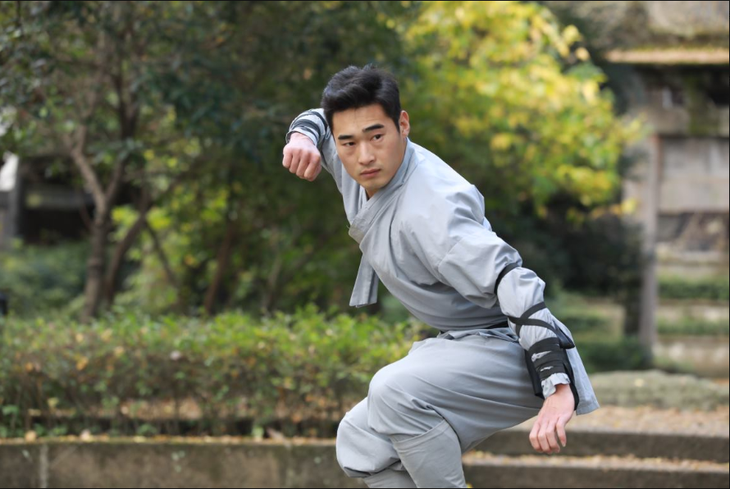
Many men today are studying Emei martial arts - Photo: XN
In recent years, a group of female martial artists called "Emei Kung Fu Girls" has emerged on Chinese and international social media. They have gained attention for performing Emei Kung Fu forms in a style that combines tradition with artistic expression.
This group of martial arts students actually originated from the Emei martial arts training centers. They gained considerable fame with their attractive appearance, costumes reminiscent of "female warriors" from novels, and eye-catching performance videos .
"Emei Kung Fu Girls" have performed in France and Japan, and attracted large crowds to the events they held on Mount Emei.
The emergence of this group helps to recreate the image of female warriors in novels, and further enhances the recognition of women in traditional Chinese martial arts.
However, the truth is that Emei includes both men and women. And although Emei martial arts emphasize dexterity, overall, martial arts training is still more geared towards men.
Source: https://tuoitre.vn/phai-nga-mi-co-thuc-su-danh-cho-nu-gioi-20250826222654708.htm



![[Photo] “Red Journey” 2026: Vietnamese Youth Continue Building the Bridge of Friendship Between Vietnam and China](https://vphoto.vietnam.vn/thumb/1200x675/vietnam/resource/IMAGE/2026/04/20/1776629730866_4055880775670638308-9618-4200-jpg.webp)

![[Photo] “Red Journey” 2026: Vietnamese Youth Continue Building the Bridge of Friendship Between Vietnam and China](https://vphoto.vietnam.vn/thumb/402x226/vietnam/resource/IMAGE/2026/04/20/1776629730866_4055880775670638308-9618-4200-jpg.webp)












































































Comment (0)