

For the 2025-2026 Winter-Spring rice crop, the provincial agricultural sector plans to sow rice in four concentrated phases. At this time, the weather conditions are becoming increasingly complex, creating a favorable environment for pests and diseases to develop and cause damage. Therefore, relevant agencies and farmers are proactively implementing pest and disease control measures to protect rice fields, contributing to increased productivity and economic efficiency.
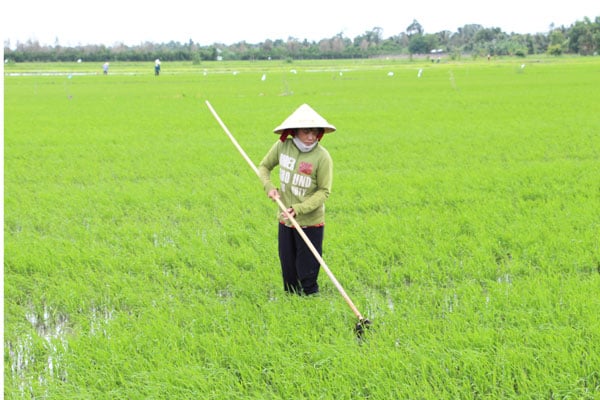 |
| Farmers are actively tending to their winter-spring rice crop. |
For this Winter-Spring rice crop, the province plans to sow over 105,000 hectares, striving for a yield of approximately 6.7 tons/ha, thereby providing a total production of over 703,000 tons of rice. Of this, two large-scale sowing periods will take place: period 3 (53,875 hectares, from November 14th to December 16th) and period 4 (41,930 hectares, from December 24th, 2025 to January 10th, 2026), distributed across localities in the province.
Observations in the fields show that this season, farmers have increased the use of certified seeds, focusing on varieties with wide adaptability and good domestic and export potential such as OM5451, OM18, Dai Thom 8, ST24, ST25…
To ensure the best results for the winter-spring rice crop, after harvesting the autumn-winter rice crop, Mr. Truong Van Diep (Tan Long Hoi commune) lets the land rest for about two months. Even with favorable weather and good drainage, to ensure the winter-spring rice crop thrives, Mr. Diep meticulously prepares the land and digs deep drainage ditches.
“For this crop, I used the OM18 rice variety along with Dai Thom 8. For the past few years, I've been sowing 12-13kg of seeds, the rice panicles are long, the harvest is better, and the cost of fertilizer and pesticides is lower,” Mr. Diep said.
Mr. Le Quang Trung (Tan Long Hoi commune), who sowed 3 acres of Dai Thom 8 rice variety, said that he regularly visits his fields, closely monitors pest and disease outbreaks, applies balanced fertilizer, and regulates water properly to help the rice grow healthily, minimize lodging, and prevent pest and disease damage. Because his field is near an orchard, there are more rats, so he has proactively taken measures to control them. He hopes for a good harvest and good prices this season.
According to the Department of Agriculture and Environment, the sowing of the Winter-Spring rice crop is expected to be completed around the 25th of November (lunar calendar). To ensure a successful Winter-Spring rice crop, the agricultural sector advises farmers to adhere to the planting schedule, focus on appropriate timing, and continue to sow seeds simultaneously and intensively in each region and field.
When planting, it is necessary to have contingency plans and flexibility to respond to unusual flood and tidal surge situations, paying particular attention to forecasts on migratory pests and dangerous weather conditions.
For areas preparing for planting, after harvesting the autumn-winter rice crop, the fields need to be thoroughly cleaned of weeds, rice stubble, and wild grass around the field edges. The fields should be plowed and harrowed thoroughly, and a minimum 14-day quarantine period must be ensured.
In addition, it is necessary to closely monitor the situation of planthoppers attracted to light traps, plant seeds in a concentrated manner, and avoid planthopper infestations in specific areas and fields within the locality in order to minimize damage from brown planthoppers, yellow dwarf disease, and leaf curl disease.
The area infested with rice weeds is increasing rapidly with each rice crop. Farmers are advised to thoroughly prepare the land before planting to avoid losses to the yield of the upcoming Winter-Spring rice crop.
In addition, farmers need to monitor and detect early signs of pests such as golden apple snails and thrips. Due to the often rainy weather combined with high tides, golden apple snails thrive and can damage newly planted rice, especially in low-lying, waterlogged areas where control measures are not proactively implemented.
Note the presence and damage caused by rats. Farmers should implement large-scale, community-based rat extermination measures. Prioritize the use of mechanical traps and biological rat poisons.
Farmers are advised to adhere to the "four correct principles": using the right pesticide, the right dosage, at the right time, and in the right way when spraying. They should also collect and dispose of pesticide packaging in designated areas after use to minimize environmental pollution.
Besides using rice varieties with wide adaptability and good domestic and export potential, farmers are advised to use rice varieties that are resistant to salinity, drought, and acidity in areas at risk of saltwater intrusion and late-season drought to minimize losses.
Most improved short-day varieties such as OM6976, OM5451, OM9921, OM5621, OM6677, ST5... can tolerate moderate to high salinity levels (from 2-3‰).
Mr. Nguyen Thanh Binh, Head of the Crop Production and Plant Protection Sub-Department (Department of Agriculture and Environment), said: Farmers need to implement good production techniques, integrated pest management, reduce seed usage, focus on applying water-saving irrigation solutions; sustainable farming and green growth; and apply mechanization to production to improve productivity, quality, lower production costs, and enhance rice production efficiency…
In the coming period, the sub-department will continue to monitor weather developments and saltwater intrusion, strengthen pest and disease forecasting, and promptly inform farmers; and organize training and guidance on safe and effective farming techniques.
Text and photos: NGUYEN KHANG
Source: https://baovinhlong.com.vn/kinh-te/nong-nghiep/202512/phong-tru-sau-benh-tren-lua-dong-xuan-5544527/





















































![[Photo] Closing Ceremony of the 15th Conference of the Central Committee of the 13th Party Congress](https://vphoto.vietnam.vn/thumb/402x226/vietnam/resource/IMAGE/2025/12/23/1766462841764_a1-bnd-3731-1647-jpg.webp)






















Comment (0)