

60 Years of Hue's Glorious Enamel Culture
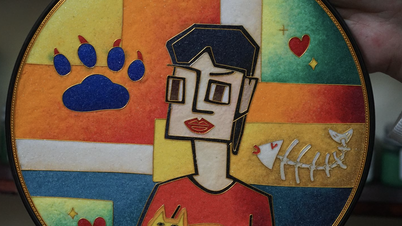
According to Hue cultural researchers, Hue's enamelware art originated in 1827 during the Nguyen Dynasty and flourished under the reigns of Emperor Minh Mang (1820-1841), Emperor Thieu Tri (1841-1847), and Emperor Tu Duc (1848-1883). Enamelware consists of copper pieces coated with multicolored enamel, which are not only aesthetically pleasing but also possess high mechanical, chemical, and physical durability, with high resistance to impact and corrosion from the environment and climate.
After the period of "four months, three kings" (*), cloisonné enamelware gradually declined and completely disappeared during the reign of Emperor Đồng Khánh (1885-1889).
Although it only existed for 60 years, "Hue enamelware represents a pioneering direction in Vietnamese painting" and managed to create a special mark through household items, interior decorations, and artifacts. Enamelware was favored by officials and nobles of the time, used for exterior decoration in the architectural structures of the imperial palace.
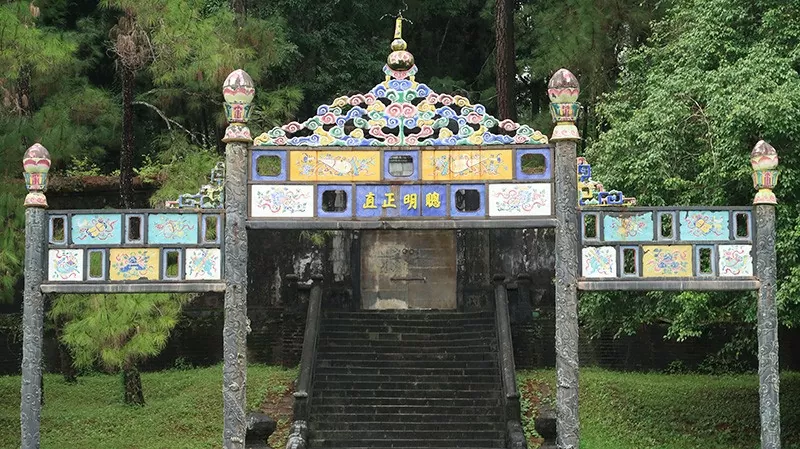 |
| Hue enamelware decorations in front of the tomb of Emperor Minh Mang. |
Reviving Hue's Enamelware after 200 years of being lost.
After approximately 200 years of existence, many cloisonné enamel decorative elements on the Hue imperial palace architecture are gradually deteriorating and falling into disrepair. Not wanting the hallmarks of Hue cloisonné enamel to completely disappear from Vietnam, many research groups and individuals have been working diligently to explore and restore this craft, aiming to serve the restoration and preservation of historical sites as well as to conserve this ancient art form.
Particularly after December 11, 1993, when the Hue Imperial Citadel Complex was officially inscribed on the UNESCO World Heritage list, the restoration of cloisonné enamelware received even more attention from the government and academics.
It all started with Dr. Nguyen Nhan Duc, a pharmacist whose connection to cloisonné enamelware stemmed from his visits to China: "During my trips to China, visiting many palaces, I never saw cloisonné enamelware used for exterior decoration. Meanwhile, in Hue, cloisonné enamelware for exterior decoration was very common. So I plunged into research."
Throughout this research process, with the advice of the Hue Imperial City Relics Conservation Center, he completed the restoration and decoration of the flat enamel panels, enamel reliefs, and enamel sculptures at Thien Mu Pagoda, the two ceremonial gates at Trung Dao Bridge, the two main gates behind Thai Hoa Palace, etc., making a significant contribution to the revival of Hue's enamel art.
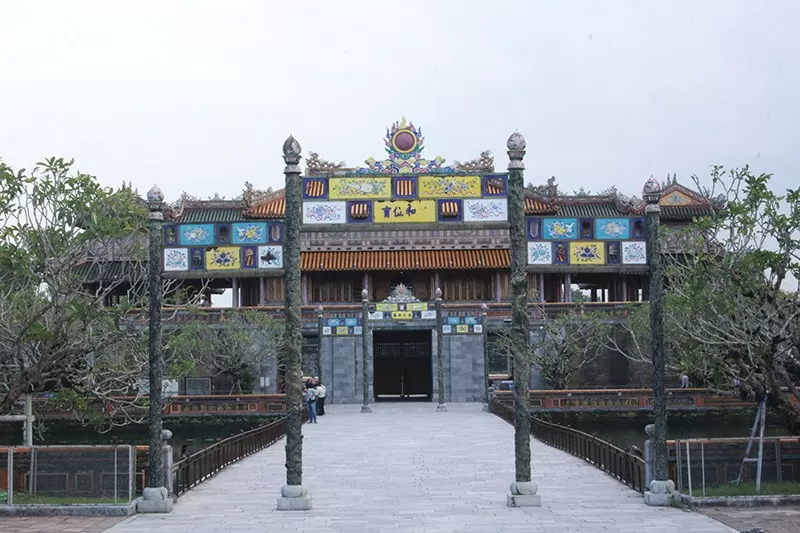 |
| The restoration of the enamelware on the ceremonial gate at Trung Dao Bridge, Hue Imperial Citadel, has been completed – a result of the work of Dr. Nguyen Nhan Duc and his colleagues. |
Sharing the same concerns, Master Do Huu Triet, Director of Thai Hung Co., Ltd. (Hue), has also successfully restored many cloisonné enamel items on important imperial relics in Hue. One of the projects that strongly marks the return of Hue cloisonné enamel is a pair of cloisonné enamel lamps, costing approximately 2.5 billion VND, currently located in Tu Tuong Park next to the Perfume River, completed by 100 workers of Thai Hung Clove Company.
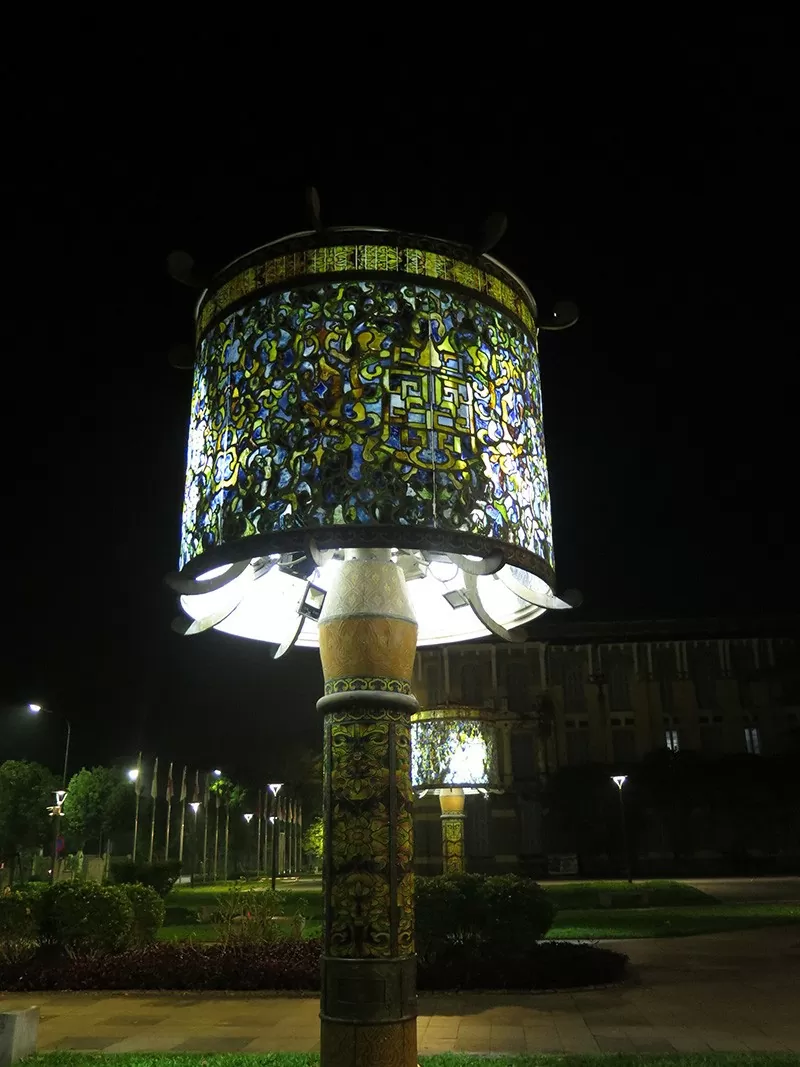 |
| Master Do Huu Triet restored and rebuilt two cloisonné enamel lamps at a cost of approximately 2.5 billion VND and donated them to the city of Hue, where they are placed in Tu Tuong Park. |
Visiting the Hue Enamelware production and exhibition facility of Master Do Huu Triet at 66 Chi Lang Street, Hue City, our group of International Communication students from the Academy of Journalism and Communication had the opportunity to admire over 100 Hue enamelware pieces on display, including souvenirs and products used in architecture and construction. Here, Mr. Triet shared with heartfelt emotion: "I always believe that Hue enamelware will surely be revived. Future generations will have the chance to be captivated by the historical beauty and rich national identity of Hue enamelware, just like the enamelware artisans of Hue."
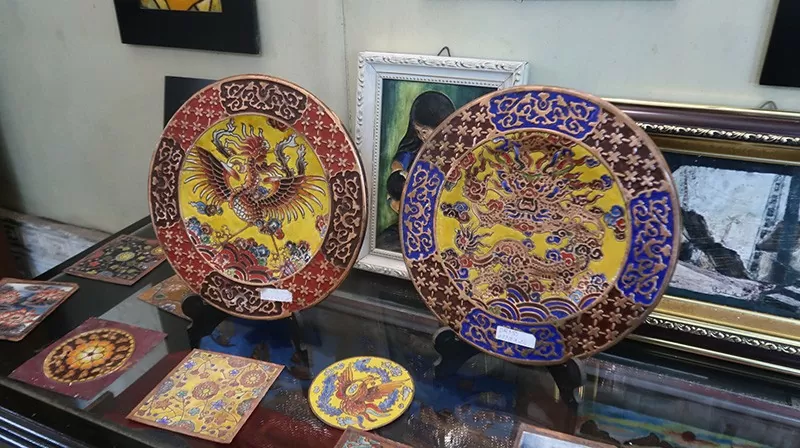 |
| Souvenirs featuring Hue's French enamelware techniques are displayed at Thai Hung Co., Ltd. (66 Chi Lang Street, Hue City). |
The next valuable stop on the Hue enamel restoration journey is the Hue Royal Antiquities Museum. This museum houses and displays nearly 100 artifacts related to enamel from the Nguyen Dynasty, including household items, ceremonial objects, and souvenirs used in the royal palace.
Sharing with our group of students, Mr. Nguyen The Son, Deputy Director of the Museum, emphasized: “All artifacts related to cloisonné enamel that are unearthed will be brought to the museum for cleaning, restoration, and display. Therefore, the number of 100 artifacts is a relatively large number and will continue to increase. The museum has a dedicated research team specializing in restoring and preserving cloisonné enamel in the architecture of palaces and tombs, as cloisonné enamel has been one of the city's key restoration techniques for the past few decades.”
Not only are Hue enamelware displayed in museums in Vietnam, but it is also present in several major museums in Europe such as the Berlin Ethnographic Museum (Germany), the Munich Ethnographic Museum (Germany), the Rennes Museum of Fine Arts (France),… and even in the collections of some antique collectors around the world. This is a great source of pride, urging Vietnamese artisans and researchers to urgently and further promote the research and preservation of this national craft.
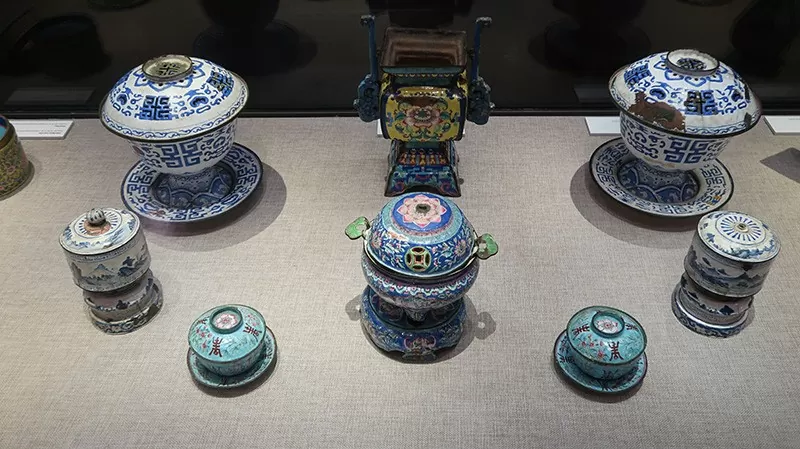 |
| Enamel artifacts used in royal court ceremonies are displayed at the Hue Royal Antiquities Museum for visitors to see. |
Mr. Nguyen The Son emphasized: "Enamelware will only truly return to its golden age when it serves the needs of everyone for use and appreciation; and this requires the joint efforts and unity of an entire generation working to restore and preserve Hue's enamelware art. The State creates conditions for preservation, artisans and groups delve into research and restoration of Hue enamelware products; while young people, the media, and the press carry out propaganda and promotion so that not only the people of Hue, but all Vietnamese people know, are proud of, and have the opportunity to recognize and experience this unique enamelware craftsmanship."
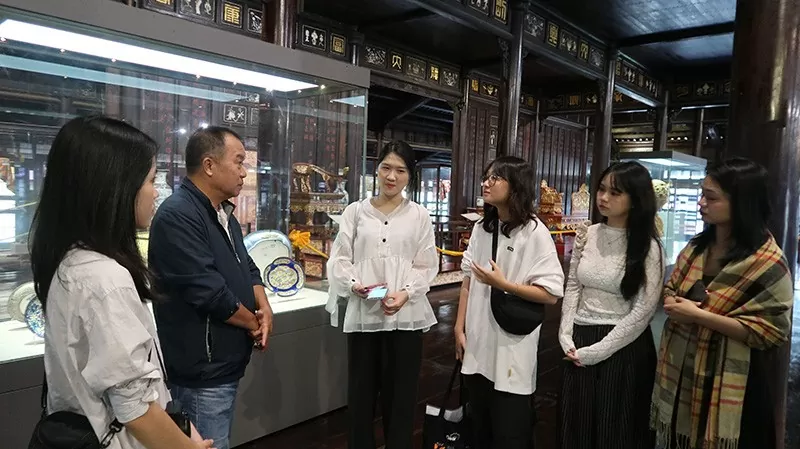 |
| Nguyen The Son, Deputy Director of the Hue Royal Antiquities Museum, shared with a group of students from the Academy of Journalism his aspiration to preserve and develop Hue's enamelware. |
——–
(*) This was the darkest period in the history of the Nguyen Dynasty. After Emperor Duc Duc was deposed, within just four months, the two powerful officials Ton That Thuyet and Nguyen Van Tuong installed and then deposed two more emperors: Emperor Hiep Hoa and Emperor Kien Phuc.
Image source: Taken by a group of students from the International Communication Department, Academy of Journalism and Communication, who are also the authors of this article.
![[Image] The appearance of the Bien Hoa-Vung Tau expressway before its opening.](https://vphoto.vietnam.vn/thumb/1200x675/vietnam/resource/IMAGE/2026/03/25/1774430324663_ndo_br_2-resize-6064-jpg.webp)






































































Comment (0)