

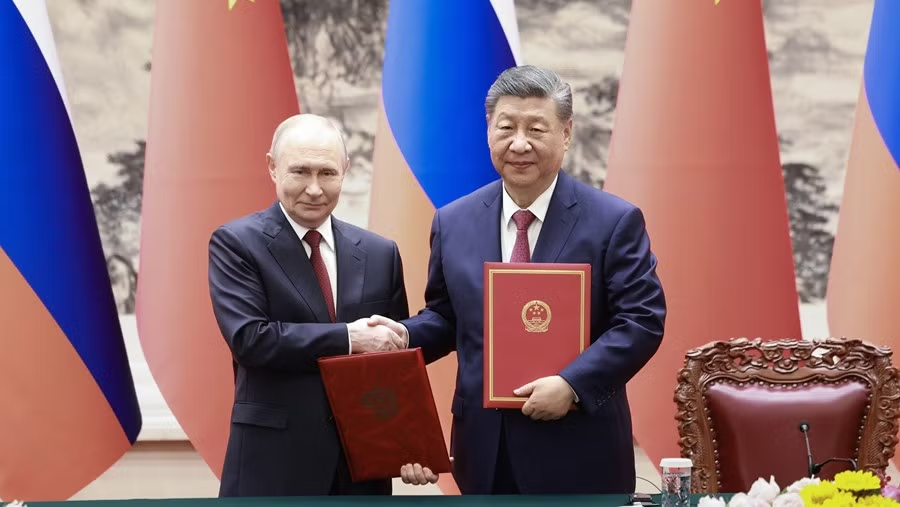
After President Putin boarded his plane to leave Beijing, concluding his visit, Li Yongquan, Director of the Academic Committee of the Eurasian Institute for Social Development Studies under the Development Research Center of the State Council of China, shared his thoughts on the significance of the visit, the new meaning of bilateral relations, and the role of the two Joint Declarations in bilateral relations and cooperation between the two countries on international issues.
Regarding the significance of the visit for bilateral relations, Mr. Li Yongquan stated that the international community is very interested in President Putin's visit, because it is not just a routine visit, but also a special one.
It's called a regular visit because China and Russia have established an annual meeting mechanism, whereby the leaders of the two countries meet once a year in a different country. Last year, President Xi Jinping visited Russia and attended the 80th anniversary of Victory Day in the Great Patriotic War. This year, President Putin is visiting China again. Meanwhile, this visit is also considered special, as the leaders of the two countries need to discuss many bilateral, regional, and international issues in the context of a volatile global situation.
This year marks the 25th anniversary of the signing of the Treaty of Friendship and Neighborhood Cooperation between China and Russia. Since its signing, bilateral relations have seen a significant leap forward. This is a crucial time for the two countries to decide whether to extend the treaty, as it is an important legal document and the institutional foundation for friendly neighborly relations and comprehensive strategic cooperation between the two countries.
Analyzing the new content of bilateral relations, according to Li Yongquan, China-Russia relations have continuously developed to new heights since 1992, and can be called a relationship that progresses with the times, as it is adjusted and developed based on the needs of both countries and the international situation.
2026 marks the first year of China's 15th Five-Year Plan implementation, a crucial period for Russia's development. The two countries have many issues requiring consensus regarding strategic development alignment and sectoral strategic integration. Therefore, many members of the Russian government and leading business representatives are accompanying President Putin on this visit to China. China-Russia relations are entering a new, faster, and more substantive phase of development. The "new" aspect here refers to the changes in the global situation and the new era for practical cooperation between the two countries.
Finally, we will assess the role of two important documents: the China-Russia Joint Statement on Further Enhancing Comprehensive Strategic Coordination and Deepening Friendly Neighborly Cooperation, and the China-Russia Joint Statement on Leading a Multipolar World and a New Type of Great Power Relations.
The first document concerns strengthening bilateral relations. According to Mr. Li Yongquan, there are no political issues that need to be resolved in the relationship between the two countries. Political trust between the two countries is at a high level, and bilateral relations are at their highest point in history. The current scale of trade has far exceeded that of the time when the two sides signed the Treaty of Friendly Neighborly Cooperation 25 years ago and the time when the Strategic Partnership was established 30 years ago.
Now, at this crucial juncture, the China-Russia Joint Statement on further strengthening comprehensive strategic coordination and deepening friendly neighborly cooperation will serve as a guideline for the two countries to further deepen their comprehensive strategic cooperative partnership in the new era.
The second document concerns global strategic cooperation. Li Yongquan argued that international relations are currently undergoing significant changes as the world enters a transitional phase. While the unipolar world order has ended, a multipolar world has yet to fully emerge. This transitional period will inevitably bring about many conflicts, clashes, and even potential wars. Therefore, China and Russia play a crucial role in addressing these threats and challenges, as well as promoting multilateralism.
Therefore, the core meaning of the China-Russia Joint Statement on Leading a Multipolar World and a New Type of Great Power Relations is how the two countries will strengthen cooperation in building a multipolar world. From the perspective of bilateral relations, coordination in regional forums, and cooperation on global issues, cooperation remains an effective method for maintaining international stability and world peace. And the China-Russia relationship remains a stabilizing factor in international relations, contributing to the promotion of a multipolar world order.
Source: https://nhandan.vn/quan-he-trung-quoc-nga-tien-cung-thoi-dai-post963777.html























































































Comment (0)