
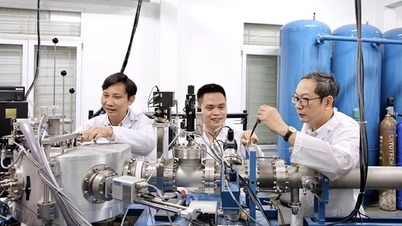
Research is being conducted at the Institute of Chemistry to find potential cancer-inhibiting compounds from naturally occurring xanthone frameworks. (Photo: VAN NGA)
Cancer significantly impacts public health, making the need for effective, safe, and sustainable treatment solutions increasingly urgent. Integrating artificial intelligence (AI), high-performance computing, and experimental validation is opening up efficient approaches in the design of xanthone derivatives for targeted cancer therapy.
Computer-aided drug design (CADD) is becoming a significant trend in modern pharmaceutical chemistry. In Vietnam, the integration of AI and high-performance computing with experimental methods is opening up new approaches to exploiting natural compounds. In this study, xanthone frameworks were selected as a promising source material, with a research process oriented from simulation to experimental verification.
Alongside traditional treatments, the trend in modern drug development is shifting strongly towards targeted drug design, combined with advanced computational technologies to shorten research time and improve efficiency. In this trend, naturally derived compounds, especially xanthones, are attracting attention due to their diverse biological potential, including anticancer activity. However, the effective exploitation of these compounds remains limited if relying solely on traditional experimental methods, which are time-consuming and costly.
Associate Professor, Dr. Pham Minh Quan and his colleagues at the Institute of Chemistry (Vietnam Academy of Science and Technology) have implemented the project "Research on using computational simulation combined with experimental methods to search for potential cancer cell inhibitory compounds from naturally derived xanthone framework compounds". This project aims to build an integrated research process in which modern computational methods such as AI, molecular simulation, and high-performance computing are used in combination with experimental verification, contributing to opening up a new approach in drug research and development in Vietnam.
Associate Professor, Dr. Pham Minh Quan stated that the research team has built a database of xanthone compounds, including both compounds with existing experimental data and those used for virtual screening. Based on this, a machine learning model was developed and trained to predict the potential interactions of compounds with cancer-related biological targets, thereby quickly generating a shortlist of potential compounds that inhibit the protein under study. Combining published experimental data with computational models provides clearer guidance for the screening process, rather than relying on the traditional "trial-and-error" approach.
Simultaneously, the pharmacokinetic parameters and "drug-likeness" index of the compounds are also predicted using specialized computational tools. This ensures that not only are compounds with high potential to inhibit the target protein selected, but also that essential criteria for drug development such as absorption, distribution, and safety are met. This is a crucial step in improving the reliability of the computational predictions and further narrowing down the list to identify potential precursor compounds before moving to the experimental phase.
A highlight of the research is the application of deep learning models in designing novel derivatives from identified lead compounds. Instead of simply "searching," the research took a crucial step by "designing" new derivatives based on the structures of lead compounds with the goal of improving activity. This approach clearly demonstrates the role of AI not only in data analysis but also in creating new structural compounds, a direction gaining global attention in the field of drug design.
Notably, with the list of potential derivatives obtained from the simulation process, the study proceeded with the semi-synthesis of these derivatives based on gambogic acid – a xanthone compound abundant in the resin of the Coptis chinensis plant. Two main groups of derivatives, esters (11 compounds) and amides (8 compounds), were synthesized with high efficiency, and the synthesis process was also developed and published.
The obtained derivatives were evaluated for their biological activity on cancer cell lines; the two most promising compounds were further tested in animal models to determine their tumor-inhibiting potential, while acute and subchronic toxicity assessments were conducted to ensure safety. The results showed that many derivatives exhibited significant antitumor activity, consistent with simulation predictions; methyl gamgogate and morpholinyl gambogamide stood out with their superior tumor-inhibiting efficacy.
However, according to Associate Professor Dr. Pham Minh Quan, the implementation of integrated research still faces many challenges. First, there are limitations in input data for machine learning models due to a lack of high-quality experimental data sources, affecting predictive reliability. In addition, effective integration between interdisciplinary research groups, including chemistry, biology, bioinformatics, and data science, requires close coordination in both expertise and workflow.
Based on these initial results, the research team plans to expand the application of the CADD model to other groups of natural compounds in the future, while diversifying therapeutic targets and contributing to improved research and development of drugs.
HIEU LIEN NGA
Source: https://nhandan.vn/tich-hop-ai-dieu-tri-ung-thu-post964425.html


![[Image] Close-up view of the interchange connecting the two expressways and Long Thanh Airport.](https://vphoto.vietnam.vn/thumb/1200x675/vietnam/resource/IMAGE/2026/05/25/1779703378210_ndo_br_z7863716673926-224453a31600126cce10622af6290afd-4549-jpg.webp)


![[Image] Hanoi's urban life under the challenge of a "scorching hot" environment](https://vphoto.vietnam.vn/thumb/1200x675/vietnam/resource/IMAGE/2026/05/25/1779706979265_nang-nong-t5-2026-minh-duy-7-4636-jpg.webp)


















































































Comment (0)