


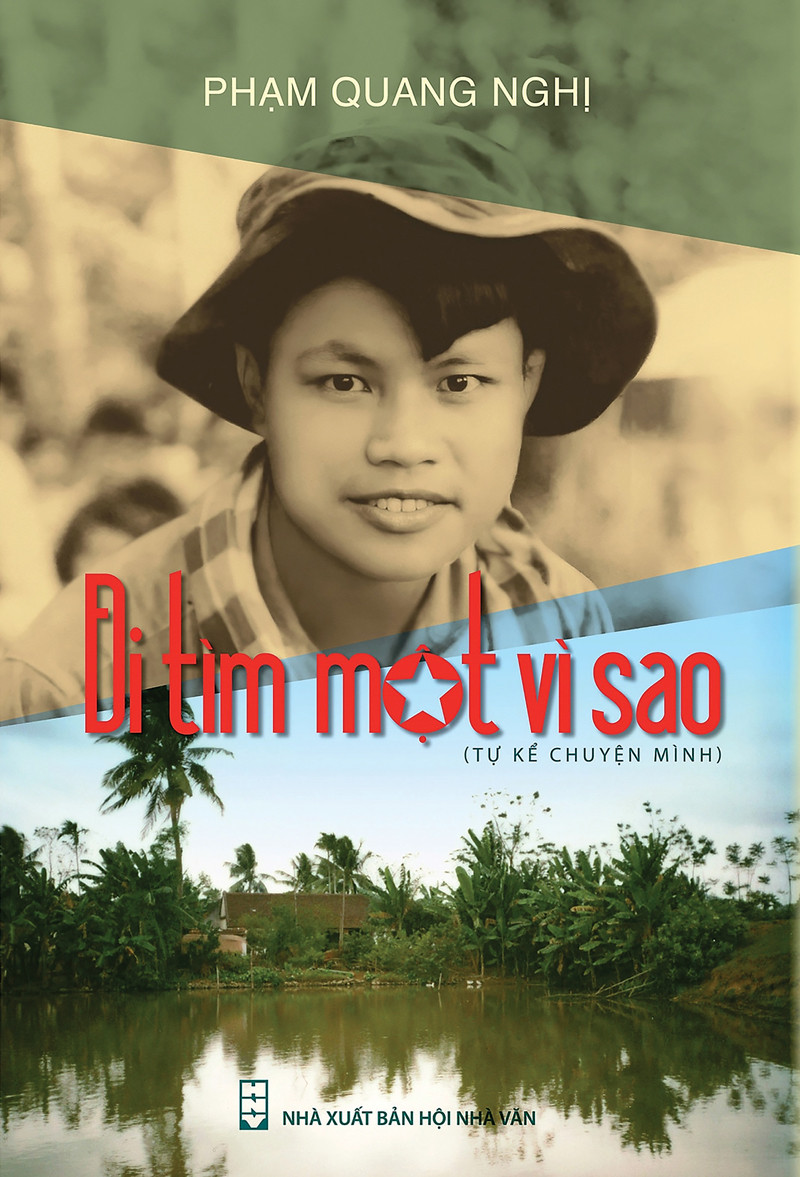
Introduction
Back then, amidst the fierce resistance war against the US to save the nation, student Pham Quang Nghi left his beloved university to join the battlefield in the South. With the enthusiasm of youth and a highly expressive pen, he managed to record the ups and downs of life and the years of fighting with his own blood and flesh.
"Searching for a Star" is a collection of vivid and heroic memories; possessing both documentary and literary value, it is truly precious. While "telling his own story," Pham Quang Nghi's narrative style always focuses on others, portraying and recreating the diverse hearts of people throughout his life's journey. Therefore, even though it is a self-narrative, the pages not only contain Pham Quang Nghi's feelings but also movingly recreate the image of his homeland, his country, and human relationships.
"Searching for a Star," published by the Vietnam Writers Association Publishing House in 2022, continues/connects the ideological thread from his previous works: "Nostalgia for the Outskirts" (poetry, 2019), "That Place Is the Battlefield" (diary, notes, 2019)... And above all, Pham Quang Nghi's writings move people's hearts with their sincerity and simplicity - a sensitive soul full of compassion.
Homeland: Nostalgia, affection
Pham Quang Nghi grew up by the Ma River. The image of his hometown river is always deeply imprinted in his mind. When speaking about his hometown, Pham Quang Nghi expresses a deep love, a respectful and cherished attitude, and a nostalgic, somewhat wistful tone. Hoanh village of more than seventy years ago appears vibrant, peaceful, and full of fond memories. “My village, that is where my ancestors, my grandparents, my parents, generation after generation, along with the villagers, were bound together by the sweat of hard work and diligence, sharing both good times and bad, day and night, building the village together. My village, fortunately, has been a riverside village for generations, on the southern bank of the Ma River. The river is gentle in autumn, with clear blue water; in summer, it is fierce, with swirling red silt. The river has contributed to shaping the character, soul, and spirit of the people of Thanh Hoa, the people of my hometown” (p. 17). The author of "Searching for a Star" was deeply moved to realize the indelible connection between the body, mind, and spirit of the people of Thanh Hoa - a harmonious blend of a sensitive soul, a love of beauty, and a rich poetic sensibility in Pham Quang Nghi.
When recounting stories of his hometown, Pham Quang Nghi expresses his love for his village and community spirit through his cheerful voice, and simultaneously, his pride in the rich history of Hoanh village - his birthplace.
The author is well-versed in the history of the land and its people, knowledgeable in many folk tales, folk songs, proverbs, and poems related to his homeland. This is proof of his pure love for his homeland! At the same time, readers can also see the writer's broad and erudite knowledge. For example, the poem by the ninth-ranked scholar Pham Quang Bat, the inscription on the bell by Professor Vu Khieu praising the virtues of Princess Phuong Hoa; and the original documents on the land register of the Nguyen Dynasty in the 11th year of Minh Mang (1830) concerning his village. Most notably, there is a close connection with folk culture and the soul of the common people. Perhaps this is due to the influence of his grandmother: "Unlike my grandfather, my grandmother didn't know how to quote the literature and philosophy of the sages. She just quoted folk songs and proverbs. She simply expressed them in vernacular language using easily memorable and accessible sayings of the world to teach her children and grandchildren" (p. 32). Despite receiving a solid foundation in education from his family and school , and undergoing a process of striving and improving his knowledge, the roots of his homeland's folk culture remained deeply ingrained in his soul. His love and attachment to the ordinary people in Pham Quang Nghi's heart have never faded over the years.
In Pham Quang Nghi's mind, his hometown appears incredibly dear and simple. Things that seem ordinary and rustic, yet remain in a person's soul throughout their life. And, arguably, homeland is the most deeply ingrained part of one's life's journey: "My village, that's where I, like my brothers, sisters, and nephews, were born. And, the sacred thing that binds us by blood and flesh from the moment we are born – that is, the place where our umbilical cord was cut! From the very first moment we uttered our first cry, we breathed in the unforgettable scents of the countryside, the fragrance of betel nuts and pomelos; the smell of straw and hay in the sun; we listened to the incredibly familiar melodies of the village through the crowing of roosters, the cheerful chirping of birds in the early morning; the clatter of buffaloes and cows returning to their pens in the evening, and the calls of people in the village every day… My village has shimmering riverbanks. There's a cool southerly breeze when the moon rises. There are fields of corn and mulberry trees weaving a vibrant green, beautifying the southern bank of the Ma River."
Pham Quang Nghi cherishes the beautiful memories of his humble village. Writing about his village, the author expresses himself with a gentle, unhurried tone, tinged with a lingering nostalgia; almost as if yearning for the "shimmering waves" of his childhood by the Ma River. In this longing for his homeland, readers will surely recognize a common thread within each of us: a blood connection to the place where we are born; the mindset of the place where we are born is the mindset of a person living amidst heaven and earth. Despite a long journey, accompanying the destiny of the nation, nothing holds a more special place in the author's heart than the simple, rustic charm of his homeland.
Those who have experienced the devastation of bombs and bullets ravaging their homeland will understand the heart-wrenching pain of witnessing the scene of death, destruction, and ruin: “Lightning flashes and deafening explosions shook the earth… Everywhere around me I heard the cries and screams of people. A truly terrifying scene unfolded on the ground. Walking through my familiar village, I felt as if I were stepping into a strange place. The village landscape was so distorted that it was unrecognizable. Trees were broken and scattered everywhere. Many houses had collapsed or had their roofs blown off. Deep bomb craters, along with mud, earth, and bricks, were strewn about. Along the embankment, dead and wounded people lay scattered, along with dead buffaloes, cows, pigs, and chickens” (pp. 54-55).
Reading Pham Quang Nghi's writings, readers deeply feel the brutality of war and the value of peace . Therefore, even from his school days, he was profoundly aware of the fate of his homeland and the deep sense of duty and responsibility that a man should fulfill before pursuing fame and fortune. Family love and patriotism intertwined to form his understanding of the times: “It’s strange, when my heart is full of emotions, whether happy or sad, I often miss home. I miss my mother. I often dream of meeting my grandfather and my two younger sisters who died in the bombing in the village. The longing is overwhelming, the images of loved ones keep appearing, half dreamlike, half real, intertwined. Sometimes I wake up and don’t think that the people I just met were in a dream. I want to cry out, ‘Mother, mother!’ In the deep forest at night, tears don’t well up, but my heart is heavy and restless. I toss and turn in my hammock” (p. 208). Don't think that crying is a sign of weakness, and don't think that if tears don't flow, your lips won't taste bitter!
After years away from home studying, fighting, working, and retiring, Pham Quang Nghi returned with overwhelming enthusiasm and joy, rushing into the loving embrace of his family and neighbors. Pham Quang Nghi remained a son of Hoanh village, a friend of the "children who herded cows and cut grass" from his childhood. Now a grandfather, with graying hair, he still remembered the plowing with his great-grandfather Chanh, Mr. Man, Mr. Thuoc, Ms. Khanh, Ms. Hao… and still felt as if he were reliving his childhood days of gleaning rice in the fields of his hometown. Overwhelmed with emotion, he asked for a toast of reunion, a drink he – a son of the village – had longed for for decades! “Returning to my hometown, surrounded by the warmth and camaraderie of my community, I felt a sense of warmth mixed with sacredness, happiness, and nostalgia that is difficult to describe. The past is a long journey filled with countless hardships and challenges. From my childhood years of tending cattle and cutting grass to adulthood, the memories of a lifetime, with all its joys and sorrows, are beyond words. For me, that day was incredibly special. I received the heartfelt and affectionate feelings of so many people” (p. 629).
On the day of the family reunion, Pham Quang Nghi still felt like a child, like when he was still in his mother's loving embrace. Stepping onto the familiar soil of his homeland, filled with nostalgia, he remembered his mother: “Holding a glass of wine in my hand, greeting everyone in my beloved home, I feel as if my mother's image is always before my eyes. I feel as if I am seeing and hearing her lullabies, the stories she whispered on moonlit nights of yesteryear. I remember clearly every word, every caring gesture of her guidance. I remember the day she struggled to hold back her sad tears as she roasted salt and made dried shredded pork before I left for the Trường Sơn Mountains to go to the front lines… A mother who spent her whole life worrying, toiling, and struggling. A mother who silently sacrificed her whole life. Her strength seemed fragile and weak, but her contributions and resilience were immeasurable. She was always by my side, guiding my every step from my infancy until I grew up and became an adult. And I believe, I feel, now and forever, that she will always be with me. She will protect me throughout my life.” (pp. 629-630).
Despite his deep love for his mother and homeland, Pham Quang Nghi resolutely chose the battlefield to fulfill his duty to his country. On the day he left: "Goodbye, Mother, I'm leaving to become a better person." On the day he returned, Pham Quang Nghi whispered: "Mother, Mother, I'm coming home to you!" Wherever he was, whatever he did, Pham Quang Nghi always kept his heart close to his homeland, to his sacred motherly love! And above all, to his love for his country.
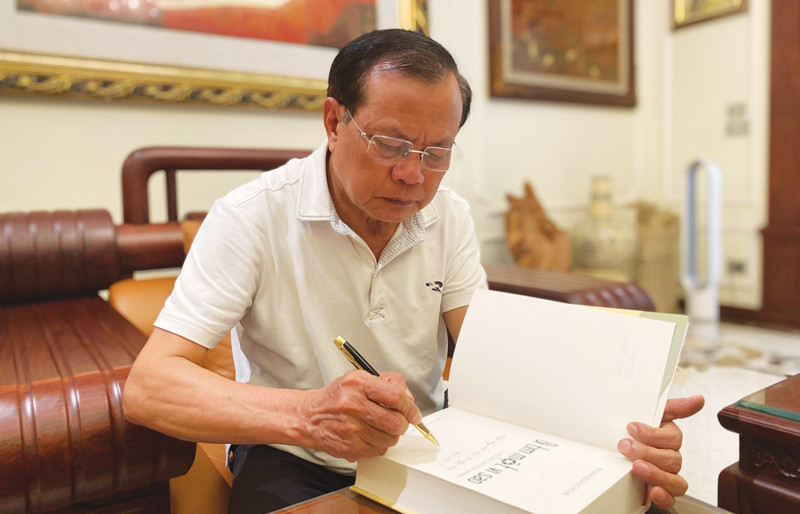
The Nation: Hardship and Heroism
The war against the US for national liberation was at its most intense stage! Pham Quang Nghi, a student who had just completed his third year in History at Hanoi University, answered the call of the nation: He put aside his pen and took up arms! The author of this autobiography entered the war in his twenties, his soul brimming with passion and determination. But "war is no joke"! War truly "made people bolder, more courageous, and more resourceful," as Pham Quang Nghi himself confessed. Forged through the bombs and bullets of the battlefield, the young man's spirit was tempered like steel. In just one year (from April 15, 1971, when he went to the front lines, to May 1972), Pham Quang Nghi had matured and become seasoned. Remembering the time when he first left university to go to the battlefield in the South, who couldn't help but feel bewildered? “We arrived at what was called the guest area, the soldiers' overnight stop. Just a few hours ago, everything had to change completely. In Cu Nam, although close to the battlefield, it was still the rear area of the North. But here was Truong Son. Everything seemed new and unfamiliar. Everyone hurriedly scattered to find a place to hang their hammocks… flashlights had to be wrapped in handkerchiefs to reduce the brightness in order to avoid enemy aircraft. If anyone accidentally shone the light a little too high, dozens of voices would immediately shout in unison: “Whose flashlight is that? Do you want to all die?”” (p. 106).
Just a year later: “We were living in an abandoned house bordering two roads. To guard against enemy infiltrators or commando scouts sneaking in from the forest at night to attack, we spent our days in one house but slept in another at night. After a long time living in the forest and getting used to sleeping in hammocks, now that we had beds and mattresses, we still had to find poles to hang our hammocks” (pp. 177-178).
He changed to become more mature, but one thing about Pham Quang Nghi remains unchanged: his sensitive soul, his compassion for people, and his empathy for the animals suffering amidst the gunfire! Through Pham Quang Nghi's story, young readers today can hardly imagine what it means to "surpass the limits of human endurance"! “War presents countless brutal situations, and no matter how imaginative one may be, one cannot fully comprehend the horrific suffering. Not only does it surpass the limits of human endurance, but even animals face desperate and pitiful situations of starvation and thirst. Humans and animals in war rarely experience a normal death like other creatures born on Earth. Yes, that's true! Few are fortunate enough to die in a home, in bed, or in the loving embrace of those still alive. Death always comes unexpectedly; neither the living nor the dead know they will die” (pp. 179-180).
However, the brutality of war did not frighten him, but only ignited a yearning for peace in the soul of Pham Quang Nghi and his generation. Constantly teetering on the fragile line between life and death, he still saw the image of doves flying from Phuoc Luc market under the blue sky casting shadows over the trenches, "The flock of birds frolicked on the crimson road, following the soldiers, carrying rifles on their shoulders and bundles on their backs" (Excerpt from Diary - p. 177). Accepting the limits beyond human endurance to have the opportunity to be human - a person of a free country! That was also Pham Quang Nghi's farewell to his beloved mother before going to war. The meaning of the words "hardship" and "sacrifice" is actually greater than their inherent meaning! And, when words could not fully express the image of the country at war, Pham Quang Nghi rose to the voice of poetry. The narrative, interspersed with numerous poems, makes the story both specific and profound, recreating a glorious era of young men and women who left their villages and families to fight for their country.
The poem "Behind the Battlefield":
early morning
Behind the front lines
I didn't hear any AK gunfire.
No cheering was heard.
Of the assault infantry
And there was no rattling of the chains.
Our car opened the gate to the police station.
Rear front
I hear the roar of cannons.
In batches,
In batches,
In a rush,
Brave,
The barrage of gunfire
Heating the cold steel barrel until it glows red.
A blinding flash of lightning, thunder of the East
Strike down the enemy in Binh Long town.
*
In the evening,
The AK rifle bobbed on the soldier's shoulder.
The dust of the battlefield stained every step.
Each face was smeared with red earth.
The soldiers returned eagerly.
He led the prisoners, their heads bowed low.
*
The front line is behind
"It's the road to victory!"
(Excerpt from Diary, June 1972)
And, from Pham Quang Nghi's autobiographical writings, the country transforms into poetry. Having lived directly through those brutal years, the country in Pham Quang Nghi's poetry (recorded in diary form) is undoubtedly imbued with heroic and indomitable spirit; but what is even more noteworthy are the green shoots that sprouted in Pham Quang Nghi's poetic soul amidst the devastation of bombs, bullets, death, and tragedy. These are rare poetic green shoots, affirming that no matter how fierce the fighting, it could not destroy the seeds of life in Vietnam. The Vietnamese people are enthusiastic and "Determined to die for the Fatherland," their fervent belief and thirst for life still burning brightly in the soul of every soldier.
In Pham Quang Nghi's poetic diary, readers can easily find lush green grass and a vast sky. It can be said that, amidst the fierce battlefield, the poem, beginning with the line "Oh, the Be River of the Eastern region," is like a warm and heartfelt call. It is one of the most authentic, moving, and beautiful poems about the land of the Southeastern region of Vietnam, "Hardshipful yet heroic"!
Oh, the Bé River in the East,
A clear blue ribbon flows through the land of memories.
…The liberated land, the waves roar with joy.
A stream flowing, sparkling in the summer sun.
The victorious army marched back home in droves.
The entire cool, green bamboo grove was filled with excitement.
*
I returned, my heart overflowing with joy.
After a long journey, my hair was drenched in sweat.
The river's waters are as clear as your smiling eyes.
A vast, deep blue sky.
The banks are shaded by bamboo groves, a cherished memory.
And the river shone brightly with joy.
How beautiful your smiling eyes are!
The stream flowed smoothly and completely.
*
The eastern region is experiencing scorching heat this season.
The Bé River flows cool and refreshing, a verdant stream.
Phuoc Long Forest, May 1972 (pp. 203-204)
Another characteristic of Pham Quang Nghi's poetic diary is the dimension of artistic space. This is because the author repeatedly uses the images of "sky" and "light." This vast, expansive, fresh, and clean spatial dimension evokes feelings of joy, excitement, and confidence. For example, the poem "Our Loc Ninh" was written after Pham Quang Nghi left Loc Ninh for the R.
Lộc Ninh,
I long to return once more.
Visit the small town on the gentle hillside.
The pure sunlight paints the feet a vibrant red.
Revisiting familiar paths and reminiscing about past victories.
Admire the bright and magnificent sky.
The small street is waking up at the beginning of the rainy season.
The charm of the Eastern region, the red soil that captivates visitors.
Every step on the way home brought joy.
*
April arrives, bringing rain that sweeps away the dust.
The sky in the East is a vast, clear blue.
Loc Ninh is bathed in the bright morning sun.
The soldiers marched with excitement, their laughter sparkling.
April, a month of life-changing events, is so joyful.
*
… We are liberated,
Loc Ninh liberated
On the seventh of April, the streets were brightly decorated with flags.
The sun was so golden, the flag looked so beautiful, like something out of a dream.
The red and yellow flag flies atop the street.
The door opened, just as hearts open wide.
Small streets adorned with flowers, liberation army marches in.
So many things I only heard about over the years.
Now we see, the army marches in endless columns.
My soldiers wear rubber sandals.
Gun in hand
A smile bloomed on her lips (pp. 201-202).
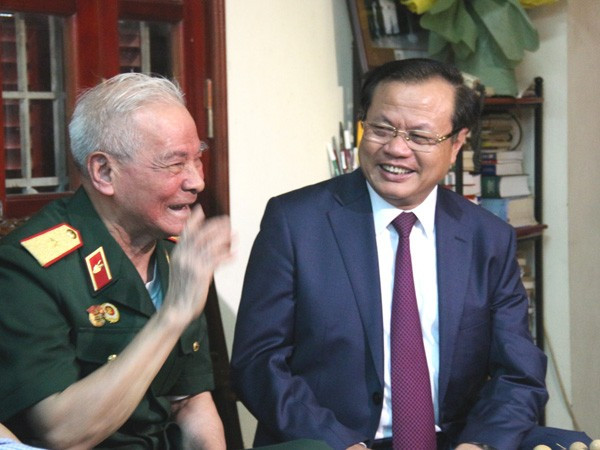
Pham Quang Nghi's autobiography not only resonates with the heroic spirit of battle, but also portrays the image of the country in a simple and authentic way; especially with its beloved people: “Back in R, there were moments sitting on a swaying hammock, looking up at the sky, with sunlight dappling the treetops, and I remembered Bu Dop, Loc Ninh. I remembered the Be River in the East, and the girl named Tam, a nurse who daily trekked through the forest and crossed streams to help carry rice with the men in the unit. Her long, green hair was drenched in sweat. She walked briskly along the winding, narrow forest path with a sack of rice bobbing on her back. I followed behind, trying to walk as fast as I could to hear her stories, feeling immense admiration and affection for her” (pp. 202-203).
Pham Quang Nghi's country is not a generic, towering image like a majestic monument; on the contrary, the country under his pen is a vibrant tapestry of people living and fighting... those who lived through such times will surely be restless and troubled, like waves of memories rushing back. “Late at night. Lying suspended in a fragile hammock. Silence all around. An almost absolute silence and tranquility of the night forest. Birds and animals in the forest are fast asleep... The wind has stopped stirring... At this moment, only the longing in my heart is surging and overflowing...”. Reading the author's autobiographical account, the reader feels as if they are hearing the rustling of leaves in the Truong Son forest, hearing the sound of footsteps treading on dry leaves on the winding, crooked forest path. These are the sounds of our country during the years of resistance against foreign invaders.
Throughout his journey participating in the resistance war, every place where he lived and fought left an imprint on Pham Quang Nghi's mind. These fragments combined to form the image of a vast country. From Truong Son, in the South, to the Dong Thap Muoi region, then Saigon..., wherever he went, Pham Quang Nghi managed to preserve the image of the land and people through his writings. Among them, the land of Huu Dao left an indelible mark on his heart. His first impression of the Mekong Delta (when he received his assignment there) was that it was a fertile, vibrant land, rich in products and with a strong cultural beauty.
Going to the Mekong Delta, teeming with fish and shrimp, you can freely eat fruit and drink sweet Siamese coconut water… Going to the Mekong Delta, you can enjoy fragrant rice wine… Going to the Mekong Delta, you can find all sorts of unique and delicious products from the Southern Vietnamese orchards. Going to the Mekong Delta, you can listen to sweet folk melodies… But, going to the Mekong Delta back then evoked many dangers. Not only hardship, which is a given, but also life and death, sacrifice lurking and waiting ahead every second, every minute (p. 206).
In Pham Quang Nghi's work, such a multifaceted perspective always exists. The perception of the reality of the war is intertwined with the perception of the beauty of the country. These two streams of thought form a continuous flow within the author's inner self. This stream of thought further fuels the yearning for peace for the nation.
In the portrayal of the country, the Đồng Tháp Mười region occupies a significant, if not profound, imprint. This is evidenced by the many surviving diary entries. The author's autobiographical writings meticulously and specifically describe the life, work, and struggles of the people in this delta region. These include the years of intense fighting against the enemy, where people's clothes and bodies were never dry.
“The vast expanse of water is dotted with mangrove trees on all sides. This season, the power line crossing the Đồng Tháp Mười area is flooded up to knee-deep. The mangroves grow thickly, covering the water's surface, and those following behind follow the muddy path left by those ahead. Enemy planes target these trails and bombard them with bullets. Clusters of mangroves are uprooted, the black soil is churned up, and wading into it leads to deep sinkholes. Many people fall into artillery craters, getting wet up to their chests. The mangrove stumps that the enemy burned during the dry season now sprout new leaves. Stepping on them hurts” (p. 211).
Just like in his homeland, the author's autobiography expresses deep sorrow at the devastation inflicted upon the country by bombs and bullets. The lush, green, fertile fields are shrouded in anxiety and apprehension. Pham Quang Nghi's love for his homeland is as profound as his love for the people in the surrounding areas. He rarely recounts his own story, preferring to tell the stories of others. He empathizes with the suffering of the people during the war. After three years of pacification, hundreds of raids, hundreds of artillery bombardments – doesn't what is visible in the daylight speak volumes? The once fresh and fertile land along Highway 4 in My Tho is now barren; the people of Tan Hoi struggle to find even a single tree trunk to build a hut or a bridge across a small ditch. Late at night, in the deep darkness, not a single rooster crows to mark the passage of time. The enemy has repeatedly strangled the last remaining chickens in the villages. Only the lamps illuminating the path to the bomb shelters keep vigil through the night. Those silent halos of light speak to those visiting the outskirts for the first time about the profound suffering, sacrifice, and courage of the people (p. 224).
War inflicted unimaginable suffering on the country and its people. Some of this suffering is difficult to erase. Pham Quang Nghi's portrayal often stems from vivid, immediate details. Then, he embellishes his writing with genuine emotion and sincerity. This is what moves the reader's soul. Only sincerity can allow readers, especially young readers today, to deeply feel the pain and loss suffered by the country during the war.
However, this does not mean that the image of the country in Pham Quang Nghi's writing is shrouded in gloom. Alongside hardships and losses, the author of this autobiography also focuses on the beauty of the Southern region. From the moment he discovered it, he fell in love with it and immersed himself in the lives of its people, working, eating, and living alongside them. Living, working, and fighting closely with the local people left behind incredibly memorable experiences in his wartime life.
"I'm a true 'water spinach' enthusiast, but having lived with the local people for so long, I now eat whatever vegetables they eat, not just raw bean sprouts. Bitter melon, water lilies, water hyacinth shoots, elephant ear plants, wild jasmine flowers, hog plums, green mangoes, and all sorts of leaves picked from the forest—some I know the names of, some I don't—eaten raw, boiled, or in sour soup. Then there are all kinds of animals, big ones like elephants, deer, stags, monitor lizards, pythons, snakes, turtles, toads, mice… Small ones like shrimp, prawns, ant eggs… I try to eat everything my brothers and sisters eat. From a culinary culture perspective, I deserve to be affectionately called 'a child of all regions of the country'… Perhaps that's why, since ancient times, among the countless things to learn, the elders taught us to begin with 'learning to eat.' And I've realized that learning to eat also requires careful observation, listening… and also demands effort and striving. Isn't that right, everyone?" "Preparing snake meat is just a small story. Later, whenever I ate Trang Bang sun-dried rice paper rolls with pork and wild vegetables, I rolled them much more skillfully than many receptionists and chefs" (p. 271).
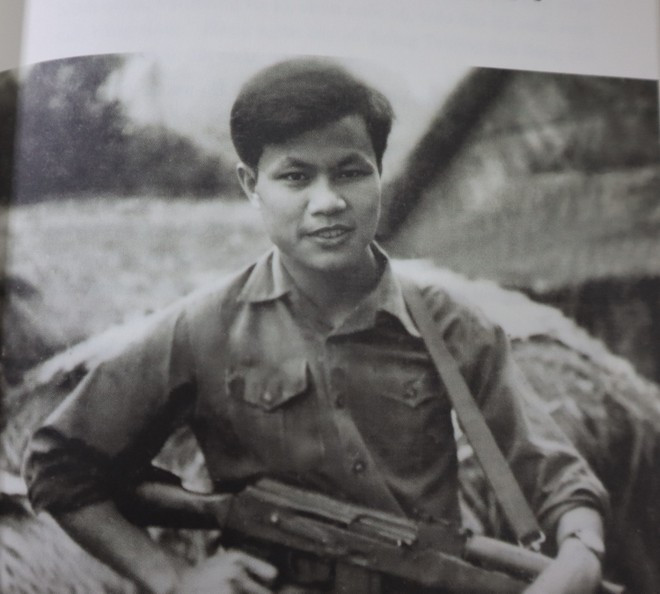
Along the war route, Pham Quang Nghi visited Bu Dop, Loc Ninh, Huu Dao, Thanh Dien... In each place, he had unique memories and remembered the characteristics of the land and people. The country always appears alongside the image of its people. Therefore, readers imagine the country in Pham Quang Nghi's autobiography as a very youthful, vibrant image, full of energy and unwavering will to fight. These people are intertwined with the image of their homeland, merging with the destiny of the nation. Although they are only people with small stature, they have contributed significantly to making the image of the country great and magnificent. These include the young messengers, around 15 years old; Ut, 14 years old; Tu, around 16 years old; the intelligent and courageous cadres and guerrillas in the border regions; and many other ordinary people who contributed their strength to the monument of the nation. We suddenly realize: How simple, endearing, and close the country is in Pham Quang Nghi's writings!
With the country unified, Pham Quang Nghi and his contemporaries fulfilled their historical and contemporary responsibility – the responsibility of a young person to the nation. They left willingly, and returned with a light heart, their backpacks containing only a few old belongings and many memories of the South. Everyone leaving Bach Dang Wharf carried bags, travel bags, and suitcases. Only I still wore my soldier's backpack. The image of the day of departure and the day of return is not much different. The only difference is that my backpack today is lighter than the one I carried when crossing the Truong Son Mountains. And it has faded with time (p. 341). Between April 15, 1971, and 9:35 AM on September 21, 1975, from the first day he set off for the South until he boarded the train to return to his hometown, Pham Quang Nghi traveled the length of the country, leaving behind many memorable imprints and precious memories. It seems that all his "treasure" was contained in a single, battle-worn, faded soldier's backpack!
The day we crossed mountains and forests,
The day of return, crossing the vast ocean (p. 342).
And, unexpectedly, in that battle-worn soldier's backpack, the most precious thing was the battlefield diary—a collection of deep and lingering memories and sentiments!
Source

![[Photo] Head of the Central Propaganda and Mass Mobilization Department visits and congratulates the Ministry of Health and the Military Traditional Medicine Institute.](https://vphoto.vietnam.vn/thumb/1200x675/vietnam/resource/IMAGE/2026/02/24/1771938483290_img-2682-3562-jpg.webp)



![[Photo] White pear blossoms bloom across the border of Pho Bang](https://vphoto.vietnam.vn/thumb/1200x675/vietnam/resource/IMAGE/2026/02/24/1771927665653_a8-8280-jpg.webp)
![[Image] A dreamy "livable city" under pink clouds](https://vphoto.vietnam.vn/thumb/1200x675/vietnam/resource/IMAGE/2026/02/24/1771930060937_tp4-jpg.webp)































Comment (0)