Previously, arrowroot leaves were mainly harvested from the wild. As market demand increased and forest resources became insufficient, many highland households began cultivating arrowroot plants in their hillsides and gardens, gradually forming a stable production area.
The shift from natural harvesting to intensive cultivation helps people secure their own supply, increase economic value, and ensure sustainability.

|
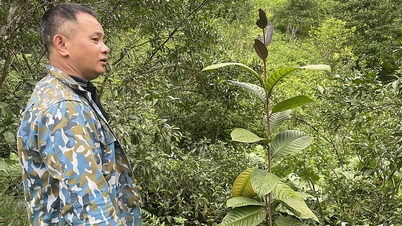
Ms. Trieu Thi Nhung tends to and harvests dong leaves in her home garden, a stable source of income for her family for many years. |
In Na Ngo village, Thuong Minh commune, the arrowroot garden of Mrs. Trieu Thi Nhung's family is nestled under the canopy of a natural forest, thriving and lush. The arrowroot plants have large, broad leaves and a distinctive, mild fragrance. Mrs. Nhung is one of the early arrowroot growers in the area.
From an initial area of about 1,000 square meters, her family has now expanded to over 5,000 square meters. According to Ms. Nhung, the arrowroot plant is suitable for the soil conditions of the highlands, is resistant to pests and diseases, and does not require much care. The leaves can be harvested year-round, but demand is strongest during Tet (Lunar New Year).
On average, the family earns about 100 million VND per year from selling banana leaves alone. Besides selling them retail to people for wrapping cakes and sticky rice, the family also supplies them to traders who buy in large quantities.
You may also like
Enhancing the value of agricultural products through experiential tourism.Without selling through middlemen, about 1 ton of Ha Den grapes was sold out in just one week after opening its doors to visitors. The success of Hong Nam Green Agriculture Investment and Development Cooperative in Tan Hung commune demonstrates an effective approach when combining clean agricultural production with experiential tourism, contributing to increasing the value of agricultural products right in the orchard. 
Going home in distant dreamsAmidst the hustle and bustle of modern life, amidst the never-ending busyness of the city, just catching a glimpse of a photo that resembles my old house is enough to transport my heart back to the Tet holidays of my childhood. 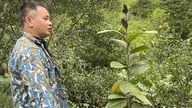
Intercropping yellow camellia tea plants under mandarin orange trees: A solution to improve farming efficiency.For a long time, Bach Thong commune (Thai Nguyen province) has been known for its orange and tangerine orchards, producing delicious fruit that has become the main crop for many households. However, after many years of exploitation, many orchards have entered a stage of aging, with declining productivity and quality, creating a need to find new production methods to improve land use efficiency. Planting golden flower tea under the canopy of fruit orchards is opening up a promising development direction for local people. 
|
Growing and selling banana leaves at the end of the year helps Mr. Dang Ung Hoa's family increase their income. |
In Phong Quang commune, many households also cultivate arrowroot. In the days leading up to Tet (Lunar New Year), Mr. Dang Ung Hoa is busy harvesting to ensure timely delivery. His family's arrowroot hill yields harvests year-round. Each plant produces many branches, each branch yielding 5-6 leaves.
After harvesting, the leaves are bundled together and stored in a cool, shaded place to maintain their green color and firmness for a long time, facilitating transportation and consumption.
Mr. Hoa said: "In previous years, income from cassava reached about 7-8 million VND per Tet season. This year, thanks to good care and increased demand, my family earned over 10 million VND. After each harvest, I prune away the old stems and add organic fertilizer to help the plants continue to grow. This method helps the cassava garden maintain stable productivity."
Currently, at traditional markets, banana leaves are widely available, priced from 50,000 to 150,000 VND per bundle, depending on the type and size. Ms. Hoang Thi Quan from Ban Chang, Phong Quang commune, said: "Every Tet holiday, I sell several million dong worth of leaves. Small leaves cost about 1,000 dong per bunch, while large leaves cost 2,000 dong per bunch. Although the price isn't high, selling in large quantities still brings in a considerable income."

|
Ms. Hoang Thi Quan brings banana leaves to the market to sell during the Tet holiday season. |

Vietnam encourages US businesses to expand investment in high technology.On the morning of June 26th, at the Government Headquarters, Deputy Prime Minister Ho Quoc Dung received Mr. Jeff Place, Supply Chain Director of Coherent Group (USA). During the meeting, the Deputy Prime Minister affirmed that Vietnam encourages US businesses to expand investment, especially in high-tech, innovation, and semiconductor industries. Not only growers, but also traders and businesses that make banh chung (Vietnamese rice cakes) are proactively purchasing them early. According to Ms. Tran Thi Tuyet, a small trader at Duc Xuan market, the dong leaves from the northern highlands of the province have the advantage of being large, thick, and naturally green. When cooked, the leaves retain their beautiful color and create a distinctive aroma, making them popular in the market. During the end of the year, the supply is usually scarce, and businesses have to place orders in advance to ensure timely delivery.
Along with freshly harvested glutinous rice, mung beans, and pork, bundles of lush green dong leaves are transported to many localities, contributing to the completion of banh chung (traditional Vietnamese rice cakes) for Tet (Lunar New Year). From being dependent on natural forest resources, the dong plant has now taken root on the hillsides, becoming a cash crop that provides a stable income for people in the highlands.
Cultivating the dong plant helps expand livelihoods for the people while preserving traditional values. Each green leaf encapsulates the flavor of Tet (Vietnamese New Year), bringing highland produce to the spring feasts of many families. From the hillsides in the northern part of the province, the green color of dong leaves spreads far and wide with traders, contributing to the vibrant and distinctive atmosphere of Tet.
Source: https://baothainguyen.vn/kinh-te/202602/tu-loc-rungden-san-pham-hang-hoa-7104afc/








![[Image] Overview of the construction site for the underground station of metro line 5 at the Hanoi Ring Road 1 intersection.](https://vphoto.vietnam.vn/thumb/1200x675/vietnam/resource/IMAGE/2026/07/03/1783065595682_ndo_br_z7974930852369-100ca093c306e72675f1d3700966a86b-jpg.webp)