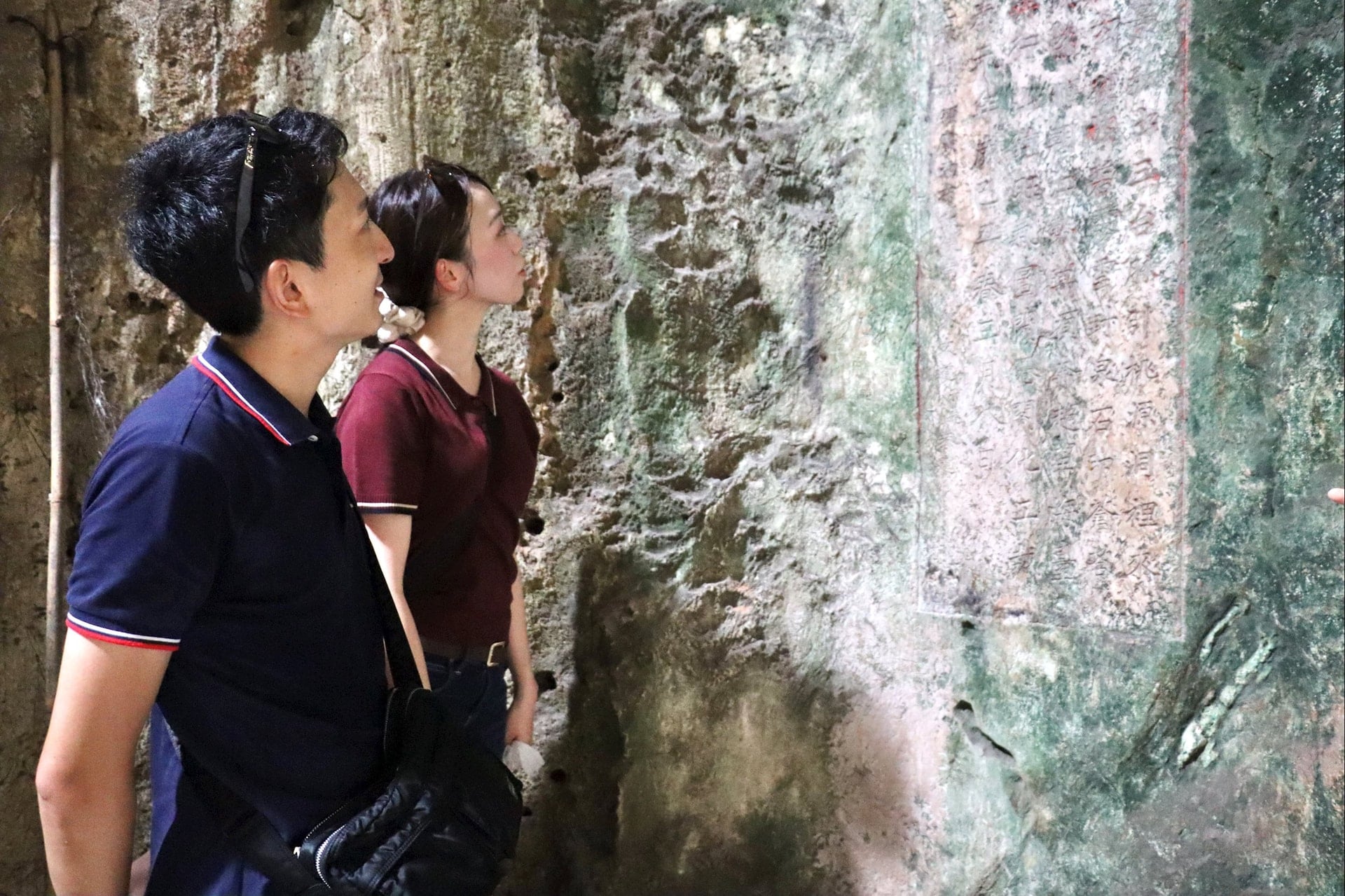
Japanese tourists learn about the documentary heritage of rock carvings at the Marble Mountains scenic area. Photo: Quoc Tuan.
The Marble Inscriptions of Ngu Hanh Son are a system of 78 texts in Chinese and Nom script carved on the cliffs and caves of the Ngu Hanh Son scenic area. They contain diverse content, unique forms, and various literary genres by Nguyen Dynasty kings, officials, high-ranking monks, and intellectuals, dating from the first half of the 17th century to the 20th century.
UNESCO has recognized the rock carvings at the Marble Mountains as a documentary heritage site under the Memory of the World Programme for the Asia-Pacific region.
Letters on stone
"Ma nhai" (摩厓) refers to "writing carved on natural rock faces on mountain slopes or in caves."
The rock carvings at the Marble Mountains in Da Nang consist of 78 inscriptions in both Chinese and Nom script, covering various literary genres and themes from Nguyen Dynasty kings, officials, high-ranking monks, and intellectuals, dating from the first half of the 17th century to the 20th century.
These unique heritage sites are located within caves and mountain slopes, such as Hoa Nghiem Cave with 20 rock carvings; Huyen Khong Cave preserving 30 rock carvings, including the imperial inscriptions of King Minh Mang; Tang Chon Cave with 20 rock carvings…
According to the Da Nang Museum, among the dated rock carvings, the earliest is the rock carving of the Five Aggregates Mountain, the Buddha's Extinction and Bliss (伍緼山古 跡佛寂滅樂) by Zen Master Hue Dao Minh, carved in the year Tan Mui (1631), and the latest is the rock carving of the Statue of Avalokiteshvara Bodhisattva (Buddhist calendar 2518 – At Mui 1955).
This is a unique, rare, and irreplaceable source of information, attracting great interest from Vietnamese and foreign researchers because it possesses value in many aspects: history, geography, literature, art, religion, language, culture, and education .
The story of preserving the rock formations of Ngu Hanh Son is about preserving a part of the documentary memory of this coastal region in Central Vietnam.
However, because the heritage site is both exposed to the elements and located in a humid environment, it faces quite a few challenges in conservation efforts.
Natural weathering causes the lettering to fade; humidity causes moss and mold to grow; and the constant flow of visitors subjects the sensitive area to breath, sweat, and friction.
Protecting heritage
On July 11, 2023, the Prime Minister issued Decision 822/QD-TTg approving the plan for the preservation, restoration, and rehabilitation of the special national scenic site of Ngu Hanh Son, which serves as the basis for the locality to implement specific steps.
The planning area covers 1,049,701 m2, as defined by the map delineating protection zones 1 and 2.

Tourists visit the Marble Mountains (Ngũ Hành Sơn) scenic spot. Photo: Xuân Sơn
Most recently, in November 2025, Da Nang approved a project to promote and develop the value of the archaeological remains of the Marble Mountains at the Ngu Hanh Son scenic area, divided into two phases.
The People's Committee of Da Nang City has assigned Ngu Hanh Son ward to take the lead and coordinate with relevant units to organize the implementation of the tasks and solutions of the project in two phases from now until 2030 and with a vision to 2045.
Accordingly, the initial phase focuses on "preserving and restoring documents in their entirety" as an urgent and long-term task, while also promoting research, interpreting the content, and applying modern preservation technologies to extend the lifespan of the heritage.
Activities focus on developing products to promote and enhance the value of rock carving heritage; restoring and minimizing damage from nature and humans to prolong the lifespan of the documents.
Specifically, content and knowledge about rock formations at the Marble Mountains will be included in the local education curriculum – a compulsory subject (35 lessons/class/academic year, at the lower and upper secondary levels).
Priority should be given to students for field trips and experiences with technological products such as VR360 and virtual museums.
Researchers believe that, if done well, this is an important "soft barrier," because when the younger generation understands heritage, they will know how to preserve it. In the future, when tourists are guided by an informed community, destructive behavior will decrease.
A notable aspect of the project is its technological approach aimed at preserving the original heritage.
Specifically, the local authorities have developed a smart guided tour system; using frosted acrylic boards printed with images of the rock formations along with QR codes for visitors to scan and read information, view images, and watch documentary films instead of touching the rocks.
This is a small detail, but it can make a big difference in reducing direct contact and preventing damage to the rock carvings.
In phase 2, oriented towards 2045, the city plans to invest in artistic lighting to honor the value of rock carvings; build a multilingual virtual museum integrating big data; and continue the regular inventory, numbering, collection, digitization, and restoration of these artifacts.
At a scientific seminar on the influence of Buddhism in rock inscriptions held in March 2025, researchers viewed this heritage as a multi-valued system, thereby suggesting ambitions towards creating a complex of scenic sites with world heritage status.
In their presentations, researchers Vo Van Thang and Ho Xuan Tinh (City Historical Science Association) emphasized the need to view Ngu Hanh Son as a heritage site with both historical and cultural depth and "contemporary cultural vitality"—that is, a heritage site that lives on in today's life.
Source: https://baodanang.vn/giu-di-san-cua-da-3322828.html






























































































Comment (0)