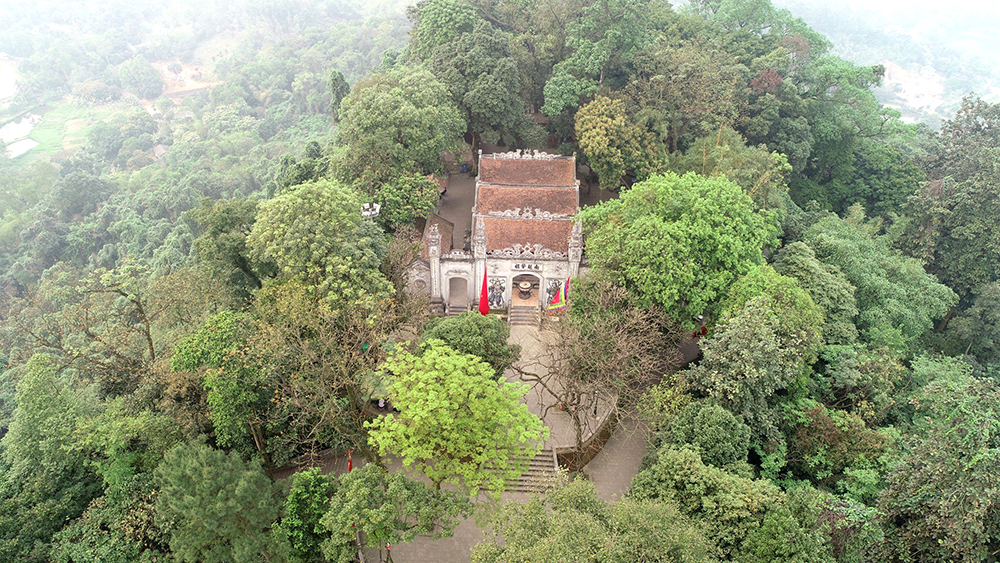
The Upper Temple is located on the summit of Nghia Linh mountain.
The history of the Vietnamese nation begins with the Hung Kings era, with the Hung Kings' contributions in pioneering, developing, and building the Van Lang state. In remembrance of this immense contribution, generations of Vietnamese people have revered the Hung Kings as the ancestors of the nation for thousands of years. The worship of the Hung Kings has become a custom and belief, passed down from generation to generation. Throughout history, this belief has served as a spiritual anchor, a belief in the sacredness and mystery of their ancestors, strengthening national unity, working together to overcome natural disasters and foreign invaders, and protecting the country's borders.
Studies have shown that, thousands of years ago, our ancestors built Hung Temple and organized the Ancestor Commemoration Ceremony with a folk character. The villages of Treo (Hy Cuong commune) and Vi (Chu Hoa commune) built Hung Temple on an initial scale as a small shrine. The He village festival (Hy Cuong and Chu Hoa communes) featured many ancient folk performances: processions with howling cries, chasing the enemy, presenting elephants and horses, processions of the goddess, and humorous theatrical performances. When the Trung Sisters raised the banner of rebellion to drive out the Eastern Han invaders, they went to the Upper Temple in the Hung Temple Complex to worship heaven and earth, vowing to avenge their family and repay their national debt, and continue the legacy of the Hung Kings. The "Thien Nam Ngu Luc" records Trung Trac's oath as follows: "First, I vow to avenge the national enemy; second, I vow to restore the ancient Hung Dynasty..." In 980, when the country gained independence, King Dinh Tien Hoang officially commissioned the writing of the temple's history. Throughout the successive feudal dynasties, Hung Temple was renovated and rebuilt, becoming increasingly magnificent and imposing. Ancient texts such as "Dai Viet Su Luoc" and "Dai Viet Su Ky Toan Thu" affirmed and explained the common origin and roots of the Vietnamese people - the Hung Kings. During the Later Le Dynasty, in the first year of Hong Duc, the "Ngoc Pha Hung Vuong" (Genealogy of the Hung Kings) was compiled, recording: "From the Dinh, Le, Ly, and Tran dynasties to our present Hong Duc Later Le dynasty, incense has always been offered at the temple in Trung Nghia village (Co Tich)," where people from all over the country come to worship and remember the merits of the ancient Holy Ancestor..."
During the Nguyen Dynasty, the capital was located in Hue . In 1823, King Minh Mang ordered the ancestral tablets of Hung Vuong to be moved to the Temple of the Great Emperors, while Hung Vuong Temple was granted a royal decree for worship. The rituals for the Hung Vuong Ancestral Commemoration were specifically and strictly regulated, reflecting the respect of the dynasties and the people for their ancestors.
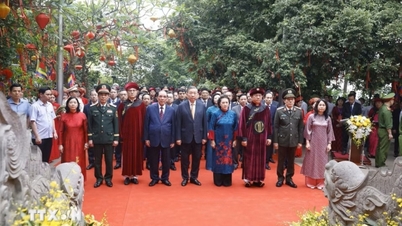
Following the successful August Revolution and national independence, the Party, State, and people of Vietnam paid even greater attention to the worship of the Hung Kings – the common ancestors of the nation – and focused on investing funds in the restoration and preservation of the Hung Temple historical site, making it more magnificent and worthy of being a place of worship for the common ancestors of the nation. Immediately after the establishment of the Democratic Republic of Vietnam on February 18, 1946, President Ho Chi Minh issued Decree No. 22C NV/CC stipulating major annual holidays, which included a one-day holiday for the Hung Kings' Commemoration Day. On April 2, 2007, the National Assembly of the Socialist Republic of Vietnam approved amendments and additions to Article 73 of the Labor Law, granting employees a day off with full pay on the Hung Kings' Commemoration Day (the 10th day of the 3rd lunar month). In 2010, the Hung Kings Commemoration Day - Hung Temple Festival was held for the first time with the most solemn national ceremony in history, presided over by President Nguyen Minh Triet, who offered incense and performed the solemn rituals in commemoration of the Hung Kings on the 10th day of the 3rd lunar month. This event marked a peak in the development of the festival, demonstrating its strong vitality and its widespread influence over time and space. The scale of the festival reflects the spirit of national unity and the preservation of Vietnamese cultural identity, focusing on the nation's origins - a particularly important tradition expressed through the Hung Temple Festival in various periods. It also clearly demonstrates the essence and spirit of the Vietnamese nation throughout history - past, present, and future.
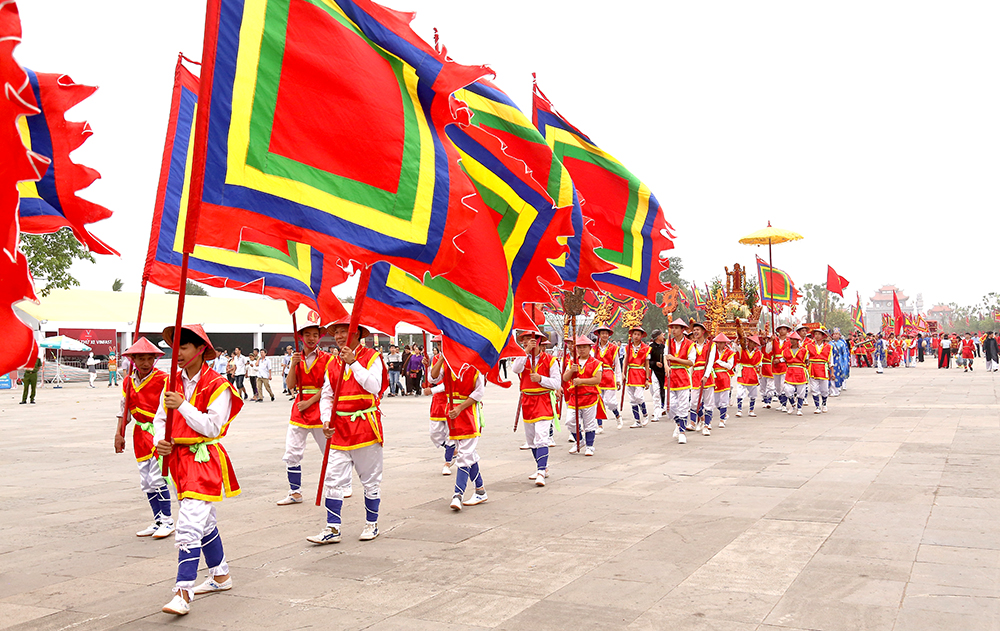 The palanquin is being carried to Hung Temple.
Proud to be the "eldest son setting the precedent," the place where the founding king chose to establish his capital, for many years Phu Tho province has always strived to mobilize all resources to restore and build Hung Temple to be worthy of the status of a Special National Historical Site, organizing the Hung Temple Festival as a model festival nationwide, a place where the essence and brilliance of national culture converge and shine, a beautiful symbol of spiritual cultural values, fully expressing the wisdom, morality, character, resilience, and noble soul of the Vietnamese people...
The enduring vitality, movement, development, and strong spread of the Hung Kings Commemoration Day - Hung Temple Festival - stems from the value and essence of the moral principle of "gratitude," with filial piety as its core. The journey of expressing filial piety, overcoming countless ups and downs of time, has been distilled and refined in every layer of culture. Initially, it involved worshipping mountain gods, river gods, and rice gods... then it transformed into ancestor worship. From the beginning, it was the custom of worshipping gods on Nghia Linh mountain, then progressing to the construction of temples and pagodas, worship, and the organization of the Hung Kings Commemoration Day, which at first was a village festival, gradually transforming into a national festival and a state ceremony, along with the unity and solidarity of the entire nation. According to statistics from the Ministry of Culture, Sports and Tourism, there are 1,417 relics dedicated to Hung Kings and other figures from the Hung Dynasty nationwide. Phu Tho province alone has 345 relics associated with villages dedicated to Hung Kings, with the Hung Temple National Special Historical Relic Site being the largest center for the practice of Hung King worship in the country. These relics, along with their rituals and festivals, are spread throughout the three regions of North, Central, and South Vietnam. Along with the rest of the country, to express gratitude for the merits of their ancestors and the Hung Kings, on the 10th day of the third lunar month each year, Vietnamese expatriates abroad organize the Hung King Commemoration Ceremony, establishing altars to the National Ancestor Hung Kings at the offices of embassies and consulates of various countries to fulfill their need to honor their ancestors and nation. In the United States, Vietnamese expatriates have raised funds to build a Hung King temple named "National Ancestor Vong Tu," inaugurated in 2003 in San Jose, California. The widespread influence and vibrant vitality of the Hung Kings worship and ancestor worship beliefs clearly demonstrate the traditional moral values of the Vietnamese people, preserved and passed down from generation to generation. With these distinctive values, on December 6, 2012, UNESCO officially inscribed the Hung Kings worship belief in Phu Tho as a representative intangible cultural heritage of humanity.
The Hung Kings Commemoration Day and the Hung Temple Festival represent the pinnacle of the tradition of gratitude and remembrance, remembering one's roots and those who planted the tree from which one eats the fruit. The Hung Kings Commemoration Day is a unique historical phenomenon, rare compared to many other nations around the world. The essence of the Hung Temple Festival embodies four basic principles: filial piety; the principle of remembering one's roots; the ideology of national origins; and the unique characteristics of Vietnamese ancestor worship, culminating in the Hung Kings worship tradition, which has been recognized by UNESCO. The transformation and development into a national-level festival (Hung King Commemoration Day - Hung Temple Festival) has united the strength of national solidarity, openly asserting the sovereignty of our state throughout history. Its eternal value forms the foundation for defining the sovereignty of the Vietnamese people: They have their origins, their territories, their organizational structures and administrative systems from ancient times to the present, with their own regimes and regulations, demonstrating national self-reliance against the schemes of hostile forces to infringe upon territorial sovereignty, assimilate the nation, and assimilate their culture. With its vibrant life and the development and maturation of the country, intertwined with the enduring existence of the nation through all ages and overcoming challenges, the Hung Temple Festival will forever remain a beautiful and valuable cultural symbol of the Vietnamese people.
Throughout the long history of nation-building and national defense, the principle of gratitude for the merits of ancestors has become a unifying thread, a spiritual anchor, and a special source of strength for the Vietnamese people, creating the miracle of Vietnam in uniting against natural disasters and foreign invaders, protecting and building the beautiful land. The spiritual strength of the Hung Kings Commemoration Day is like a call from the heart of every descendant of Lac and Hong to return to their roots, to their homeland with the sacred yet familiar word "compatriots." There is nothing better than preserving and developing the legacy passed down from our ancestors to new heights. Therefore, the Hung Kings Commemoration Day is also an occasion for descendants of Lac and Hong from North to South, lowlands or highlands, Kinh or ethnic minorities, religious or non-religious, in the country or abroad, to turn towards the Ancestral Land, the place where the sacred energy of the mountains and rivers converges, to respectfully light incense and express gratitude for the nation-building efforts of the Hung Kings, and to join hands in preserving and building a prosperous and beautiful land, fulfilling the aspirations of our ancestors.
Nguyen Dac Thuy
TUV, Director of the Department of Culture, Sports and Tourism
Source: https://baophutho.vn/quoc-le-cua-dao-ly-tri-an-230470.htm



![[Image] Nearly 125,000 Hanoi students completed the Literature exam for the 10th grade entrance exam.](https://vphoto.vietnam.vn/thumb/1200x675/vietnam/resource/IMAGE/2026/05/30/1780117233041_ndo_br_thiet-ke-chua-co-ten-2-png.webp)









![[Photo] Admire the coral "masterpiece" amidst the million-year-old heritage of Dak Lak province.](https://vphoto.vietnam.vn/thumb/1200x675/vietnam/resource/IMAGE/2026/05/30/1780107638639_y25-jpg.webp)
















































Comment (0)