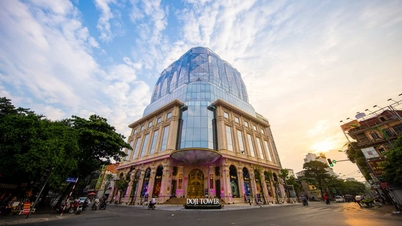
The dream of owning a home is the aspiration of all citizens. (In the photo: a real estate project on Nguyen Van Linh Street, Ho Chi Minh City - Photo: QUANG DINH)
This requires a radical shift in mindset, from focusing on supporting home ownership to ensuring the right to housing for all citizens.
For many years, housing, in the minds of the majority, has always been associated with ownership. Having a stable home is essential for a successful career, and this stability is often understood as owning a house in one's name.
The Constitution recognizes the right of citizens to a legal place of residence, but it does not require that residence to be owned by the person living in it. A legally rented room is also a place of residence protected by law, just as much as a house with a title deed.
Article 4 of the 2023 Housing Law stipulates that the State has a policy of developing housing, creating conditions for everyone to have a place to live through diverse forms, including houses for sale, lease-purchase, and rental.



The novelty of this directive from the Prime Minister is not that it's the first time a major growth pole has been given such a specific task, striving to start construction on at least one large-scale rental housing project in the third quarter.
Choosing Ho Chi Minh City as a starting point also makes sense. This locality had a GRDP growth rate of 8.27% in the first quarter of this year, the highest in five years, and also faces one of the most intense housing pressures in the country.
The areas that create the most jobs also attract the most workers who cannot yet afford to buy a home. Focusing on rental housing in these areas is a wise choice.
For a long time, many people have considered renting a house as a temporary solution. This mindset has its reasons, given the fragmented rental market, short-term contracts, and the fact that tenants are always in a weaker position than landlords. Therefore, the government's initiative to create a stable, reasonably priced rental housing fund is all the more welcome.
At the investment promotion conference for rental housing development held on the afternoon of June 9th, 13 businesses registered to build approximately 97,900 units.
Ho Chi Minh City aims to have approximately 50,000 rental properties by 2030 and is considering providing loan support of up to 300 billion VND for each project, while also streamlining procedures for this type of housing. When the government and businesses work together, tenants are the first to benefit.
Of course, a registration number doesn't automatically mean a house is actually built. The gap between the signing ceremony and the handover of the keys depends on many factors, such as available land, rent kept at a level affordable for workers, and a contract that harmonizes the interests of both parties. Securing the right to affordable housing also means keeping one's word to the commitments made.



Think about the young people who have just left their hometowns for the city, the workers in industrial zones and export processing zones, the families who have never dared to dream of owning an apartment in their own name. For them, a decent place to rent is not a step backward compared to their dream of owning a home.
It is a constitutional right that is being restored to its rightful place. And Ho Chi Minh City, a place where generations have come and stayed, is perhaps the most logical place to start.
Source: https://tuoitre.vn/quyen-co-cho-o-duoc-dat-dung-tam-100260621075658628.htm

![[Image] A look back at the capital's preparations for the century-long master plan.](https://vphoto.vietnam.vn/thumb/1200x675/vietnam/resource/IMAGE/2026/06/29/1782750453122_quy-hoach-100-nam-minh-duy-1-2118-jpg.webp)

![[Photo] General Secretary and President To Lam works with the Party Committee of the Government on the work of preventing and combating storms, floods, extreme natural disasters and climate change.](https://vphoto.vietnam.vn/thumb/1200x675/vietnam/resource/IMAGE/2026/06/29/1782729441945_a1-bnd-0385-9454-jpg.webp)