

 |
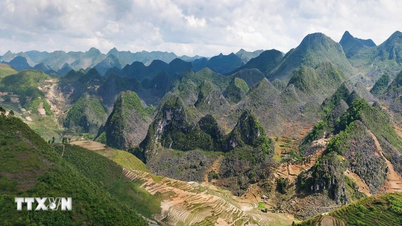
| A lush, green vegetable farming area in the rocky Sa Phin region. |
A turning point from the specialized vegetable farming model.
Sa Phin is a highland border commune in the province, formed by the merger of four communes: Sinh Lung, Sang Tung, Sa Phin, and Sung La. The commune has a natural area of over 83 square kilometers, a population of over 16,000 people, more than 3,200 households, and 11 ethnic groups living together; of which the Mong people account for 86.7%. For many years, the lives of the people have mainly depended on agricultural production on hillside fields.
This region is rich in cultural identity but faces harsh natural conditions. The terrain consists of steep limestone mountains, with limited and fragmented arable land; water resources depend on rain and small streams. Outdated farming practices mean that people can only grow one corn crop per year. Average corn yields are only 1.2-1.5 tons/ha, resulting in low efficiency and insufficient income. At one point, the poverty rate in the commune reached 86% (in 2015). Meals were scarce, and savings were almost nonexistent, making poverty alleviation a major concern for the local Party committee and government.
 |
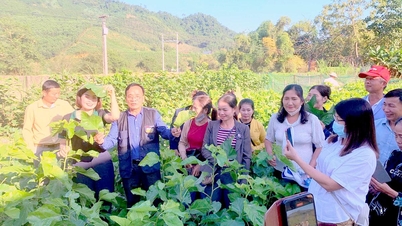
| The people of Seo Lung B village, Sa Phin commune, are tending their cabbage gardens. |
Based on that practical experience, following the directive of the Standing Committee of the former Dong Van District Party Committee regarding the survey and selection of pilot areas for specialized vegetable cultivation models, Sang Tung commune (now merged into Sa Phin commune) was chosen to implement a cabbage cultivation model on 0.9 hectares of low-yield corn land. In the beginning, only 9 households boldly participated. Many households were hesitant because cabbage was not a traditional crop, especially in a village where 100% of the population were Mong ethnic people, so the lack of technical knowledge and experience meant that the people almost entirely relied on professional staff.
With the close guidance of the Party Committee and the People's Committee of the commune; the support of seeds and techniques; and the dedicated efforts of agricultural extension officers, the model has yielded results exceeding expectations. After more than 3 months, the cabbage has grown well, with each plant reaching 1.5 - 2 kg; the average yield is 20 - 25 tons/ha. With a selling price of 6,000 - 7,000 VND/kg, each hectare generates an income of 120 - 150 million VND, more than 10 times higher than growing corn. Mr. Vu Xia Say, from Seo Lung B village, Sa Phin commune, shared: "Although I have lived here for many years, I never thought it was possible to grow vegetables so well. Since the cabbage crop has grown so well, the people have realized that economic development is a long-term and sustainable path."
Initially sold only at local markets, Sa Phin cabbage has gradually become available in many highland communes in the North, Ha Giang 1 and Ha Giang 2 wards, and some supermarkets in Hanoi . The success of this model opens up new avenues and instills confidence in the people of the rocky plateau.
Policies of partnership, people taking ownership.
The policy of converting inefficient corn-growing land to crops with higher economic value is the right direction for the Provincial Party Committee. In recent years, the Provincial Party Committee, the Provincial People's Council, the Provincial People's Committee, and the Party Committee and government of Sa Phin commune have issued many important resolutions and projects aimed at restructuring agriculture, developing commercial crops, applying science and technology, in conjunction with building new rural areas and achieving sustainable poverty reduction.
Notable examples include Resolution No. 05-NQ/TU dated December 1, 2020, on the renovation of unproductive gardens and the development of household garden economies in the 2021-2025 period; and Decision No. 2438/QD-UBND dated December 8, 2023, approving the Project on converting inefficient corn cultivation land in the 2023-2025 period. Along with these are national target programs and funding support for seeds, fertilizers, technology, and production infrastructure.
 |
| People in Sa Phin commune tend to their family's vegetable gardens, contributing to increased income. |
Alongside the policy is the coordination of various departments, agencies, and organizations: the Department of Agriculture and Environment guides planning and technology transfer; the Farmers' Association mobilizes the development of models; the Department of Science and Technology supports research on improved varieties and water-saving irrigation; the Department of Industry and Trade connects to markets; the Cooperative Alliance advises on the establishment of cooperatives; and the press actively promotes and disseminates the model.
From the initial pilot area, Sa Phin commune has now converted 52.6 hectares of single-crop corn cultivation to specialized vegetable farming. For a mountainous commune, this is the result of persistent efforts by the political system and a change in the people's awareness. Mr. Giang No Po, Head of Seo Lung B village, Sa Phin commune, said: "People who were only familiar with corn cultivation have now learned vegetable farming techniques, crop rotation, and focus on fertilization and crop protection. Income has increased, and living standards have improved significantly; many households have renovated their houses, purchased all necessary household items, and some have even bought cars."
From relying on technical staff, the people now independently select seeds, cultivate seedlings, and research cabbage varieties suitable for each season. They plant at least two crops per year, gradually mastering production. The specialized vegetable farming model in Sa Phin has become a learning destination for many localities such as Pho Bang and Dong Van communes. As a result, the poverty rate in the commune has decreased sharply from 70.4% in 2022 to 40.1% at the end of 2024.
According to Do Quoc Huong, Secretary of the Party Committee of Sa Phin commune, alongside expanding the cultivated area, the commune focuses on improving product quality; applying safe production processes, aiming for VietGAP and organic production. The commune's Party Committee is orienting the development of the "Sa Phin Vegetables" brand associated with geographical indications, affirming its position in the market inside and outside the province. In addition, the commune encourages the development of cooperative economics, establishing cooperatives and specialized vegetable production groups to link production, reduce costs, and improve productivity and quality. Infrastructure serving production is invested in through national target programs, facilitating the transportation of agricultural products.
The lush green vegetable plots in the rocky Sa Phin region today not only transform the landscape but also mark a fundamental shift in the production mindset of the people in this border highland area, once considered an economically disadvantaged region. The reality in Sa Phin shows that with the right direction, the support of the government, and the consensus of the people, even in barren rocky areas, it is possible to create prosperous vegetable growing regions, providing stable income and contributing to sustainable poverty alleviation for the people.
Text and photos: Kim Tien
Source: https://baotuyenquang.com.vn/kinh-te/nong-lam-nghiep/202601/rau-xanhsa-phin-eda700f/

![[Image] "Journey of Hope" promotes the organ and tissue donation movement in Vietnam.](https://vphoto.vietnam.vn/thumb/1200x675/vietnam/resource/IMAGE/2026/05/20/1779294400833_1-8910-jpg.webp)
![[Photo] National Assembly Chairman Tran Thanh Man working with the Standing Committee of the National Assembly's Ethnic Council](https://vphoto.vietnam.vn/thumb/1200x675/vietnam/resource/IMAGE/2026/05/21/1779337435930_ndo_br_1-jpg.webp)


![[Photo] White pear blossoms bloom across the border of Pho Bang](https://vphoto.vietnam.vn/thumb/402x226/vietnam/resource/IMAGE/2026/02/24/1771927665653_a8-8280-jpg.webp)
























































Comment (0)