

Tam Anh General Hospital in Ho Chi Minh City has recorded a more than 30% increase in the number of patients seeking treatment for sleep disorders over the past month compared to previous months, mainly those aged 30 and above, who are currently working or retired.
On January 28th, Dr. Hoang Chau Bao Dinh, Department of Neurology, Center for Neuroscience , stated the above, adding that this situation is similar to this time of year. "The number of patients seeking treatment for insomnia in particular, and sleep disorders in general, increases significantly at the end of the year due to erratic weather changes, work stress, and social gatherings that cause illness or worsen pre-existing conditions," Dr. Dinh said.
The changing seasons create favorable conditions for viruses and bacteria to thrive, increasing the risk of respiratory infections. Additionally, work pressure often leads to stress and anxiety disorders at the end of the year, resulting in insomnia.
According to Dr. Dinh, insomnia and sleep disorders not only reduce the quality of life and deplete physical and mental health, but also increase the risk of cardiovascular disease, depression, hypertension, and stroke.
For example, Mr. Long, 41 years old, came to Tam Anh Hospital in Ho Chi Minh City for examination because he had recently been experiencing frequent insomnia. The pressure of work and year-end KPIs led him to often go to bed later, after midnight, experiencing restless sleep, frequent awakenings, and difficulty falling back asleep. Polysomnography results showed he suffered from obstructive sleep apnea.
Dr. Bao Dinh diagnosed Mr. Long with sleep disorders, physical exhaustion, and nervous tension. His sinusitis also worsened due to the changing weather at the end of the year. He also suffered from obesity-induced hypoventilation, which narrowed and obstructed his airways during sleep, leading to a lack of blood and oxygen to the brain.
Mr. Ha, 60 years old, has been experiencing intense daytime sleepiness for nearly half a month. He constantly feels weak and tired. Polysomnography results indicate he has narcolepsy type one. The condition worsens during the stressful end-of-year period when he doesn't get enough rest.
Narcolepsy is a disorder of the brain and nervous system that affects the body's sleep-wake function. It is caused by a decrease in the protein hypocretin to low levels. Patients experience intense daytime sleepiness, to the point of being uncontrollable.
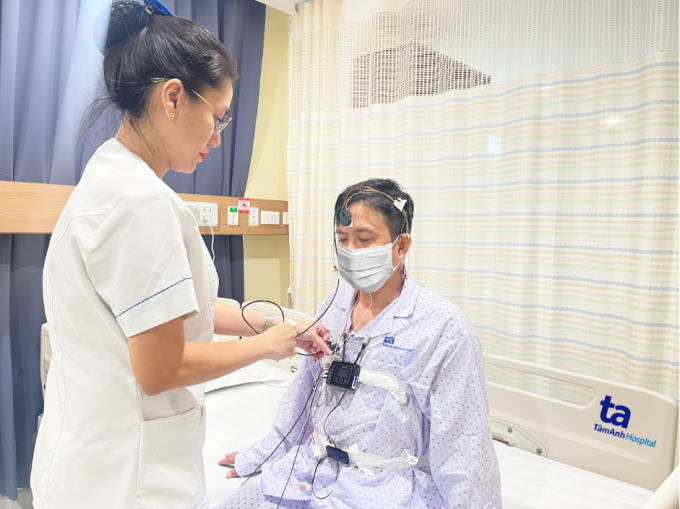
Patients undergo polysomnography at Tam Anh Hospital in Ho Chi Minh City. (Illustrative image: Provided by the hospital)
Dr. Dinh stated that to treat insomnia and sleep disorders, it is necessary to accurately diagnose the underlying cause. The doctor conducts a clinical examination, gathers medical history and habits, and performs an in-depth assessment of the patient using various techniques, tests, and imaging.
Polysomnography is a modern method that helps diagnose neurological and respiratory disorders that cause sleep disturbances, such as sleep apnea, narcolepsy, restless leg syndrome, periodic limb movements, sleepwalking, seizures, etc. From this, doctors can provide appropriate and effective treatment for patients.
Depending on the cause and severity of insomnia, patients are treated according to a multi-modal, individualized protocol. Doctors may combine various methods such as medication, functional exercises, occupational therapy, and neurosurgery to improve treatment effectiveness.
Dr. Bao Dinh advises that people experiencing sleep disorders such as difficulty falling asleep, inability to sleep, waking up multiple times during the night, waking up early, shallow sleep, sleep convulsions, etc., should see a neurologist for timely diagnosis and treatment. Avoid self-medicating with sleeping pills, as this can worsen the condition and make it more difficult to treat.
Truong Giang
| Readers can ask questions about neurological disorders here for doctors to answer. |
Source link

![[Photo] General Secretary and President To Lam meets with National Assembly delegates from ethnic minorities.](https://vphoto.vietnam.vn/thumb/1200x675/vietnam/resource/IMAGE/2026/04/20/1776696701056_a1-bnd-8331-3342-jpg.webp)

![[Image] National Assembly discusses the implementation of the socio-economic development plan.](https://vphoto.vietnam.vn/thumb/1200x675/vietnam/resource/IMAGE/2026/04/20/1776696707422_ndo_br_img-20260420-185419-jpg.webp)




































































































Comment (0)