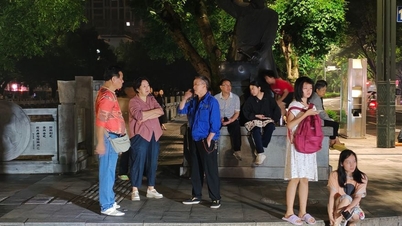
Artist Huu Danh (center), a veteran Cai Luong (traditional Vietnamese opera) artist, mentors young people in the "Southern Jade" program. - Photo: LINH DOAN
Despite experiencing many ups and downs, Ho Chi Minh City is still considered to have the strongest theatrical scene in the country.
The stage has been with us since the beginning.
After 1975, when the reconstruction of Ho Chi Minh City faced many difficulties in the new phase, theatrical arts remained the leading force, providing not only wholesome spiritual nourishment but also serving as a driving force to strengthen the army and people in the endeavor to build a solid Ho Chi Minh City .
According to many veteran artists, achieving this requires recognizing the vision and appreciation of leaders for the role of arts and culture in life. Dozens of Cai Luong and spoken drama troupes are operating vigorously, making the arts and culture atmosphere in Ho Chi Minh City very vibrant.
The artistic community was extremely large and diverse, comprising artists who had relocated from the North, artists who had come from the war zones, and local artists.
From traditional Vietnamese opera to spoken drama, a series of performances have emerged that are both artistically high-quality and meet audience demands.
Never before has Ho Chi Minh City consistently produced such excellent and impactful plays for the public, including some considered classics that have been staged and restaged countless times by various art troupes over the past 50 years.
The theater scene in Ho Chi Minh City is proud to have produced outstanding plays such as "The People of the Suburbs," "The Durian Leaf," "Vietnamese Birds on Southern Branches," "Kieu Nguyet Nga," "The Night of Judgment," "The Drum of Me Linh," "Weaving Silk by the Bridge," "Queen Mother Duong Van Nga," "The Radiant Gem of Con Son," "The Poem of the Horse," "The Great Viet Proclamation," "The Luxurious Hotel," "The Song of the Hau River," "Nang Xe Da," "Da Co Hoai Lang," "The Durian Tree in Bloom," "Ngoc Han's Confession," "Nang Hai Ben Nghe ," etc.
Despite the general difficulties, the efforts of artists and writers to create timeless works are incredibly commendable. The color version of the play "The Drum of Me Linh, " recently restored and broadcast by HTV, has garnered significant acclaim, earning the admiration of many viewers from decades ago and young audiences today for the creativity of the artists of that era.
The late artist Thanh Nga had to reuse old ao dai (traditional Vietnamese dresses) to meticulously create beautiful costumes for the characters Trung Trac and Empress Duong Van Nga. Director Ngo Y Linh used a minimalist yet creative stage design in "The Drum of Me Linh" to save costs.
It was this collective effort and unity that allowed many performances during this period to reach thousands of shows, with audiences lining up to buy tickets, and theater troupes performing for a whole week still unable to meet audience demand.

Artist Thoại Miêu has been closely supporting young talents in the plays and programs of the Trần Hữu Trang Cai Luong Theatre. In the photo: artist Thoại Miêu (right) and Golden Bell Award winner Nguyễn Thanh Toàn - Photo: LINH ĐOAN
When you come to Ho Chi Minh City , you have to go see a play.



After the 1990s, the Cai Luong (Vietnamese traditional opera) stage showed signs of difficulty; however, a new and powerful force emerged: the theater stage. The 5B small theater of the Ho Chi Minh City Theater Association has been a breeding ground and provided opportunities for the development of numerous talented playwrights, directors, and actors.
This place has produced outstanding plays such as "Public Opinion," "In the Halo of Darkness," "A Stolen Life," "Thunderstorm," "International Prostitute," "Night of the Ancient Melody, " etc.
Many young artists were trained and developed their careers from this platform, gradually forming the generation of stage actors considered the "golden generation" of Ho Chi Minh City after 1975, such as Thanh Loc, Kim Xuan, Thanh Hoang, Viet Anh, Hong Van, Hong Dao, Minh Trang, Huu Chau, Ai Nhu, Thanh Hoi, Quoc Thao…
Over the past few decades, that "golden generation" has become increasingly successful and continues its passion for theater, having become theater managers and pillars of more than a dozen major theaters in Ho Chi Minh City today.
The dedication and passion of theater artists have made Ho Chi Minh City's theater scene the only one in the country that can hold performances weekly. Many visitors acknowledge that theater is a "specialty" of Ho Chi Minh City's culture.
Many people who come to Ho Chi Minh City want to see a play at least once. Meanwhile, audiences in Ho Chi Minh City have formed a habit of going to theaters on weekends for entertainment. Each theater has its own unique style, so viewers have plenty of choices.
If you want to cry over tragedies and the human condition, go to Hoang Thai Thanh; if you want a youthful and cheerful atmosphere, go to The Gioi Tre ; if you want to experience something unusual, go to Thien Dang; or if you want to watch Once Upon a Time , go to Idecaf…

Artist Que Tran supports young actor Hoang Hai in the Cai Luong play "General Le Van Duyet - The Man Who Carried 9 Death Sentences" - Photo: LINH DOAN
Young people follow in their footsteps.
At the 50th anniversary of Ho Chi Minh City being honored with the name of President Ho Chi Minh, the city's theater scene continues to maintain its high standards, remaining the most vibrant in the country, encompassing a wide variety of art forms and styles. Priority is given to fostering the development of young people, because without young people to carry on the legacy, the theater, especially traditional art forms, cannot survive.
Artist My Uyen, Director of the 5B Theatre, is a mentor to newly graduated students and directors, guiding them through experimental works. The Idecaf Theatre has undergone a "power transfer," with the next generation of artists now in charge, from management to directing, writing, and acting, capable of handling everything from entertainment plays to historical dramas and children's plays.
Theaters like Hoang Thai Thanh, Truong Hung Minh, and Hong Van maintain training centers, thereby adding young talents to almost all creative aspects.
In the field of Cai Luong (Vietnamese traditional opera), not only does the Tran Huu Trang Theater take the leading position, but other socialized units also voluntarily undertake the task of training and finding young talents, not only to meet the demand for performers for their own theaters but also to contribute to the youthful energy of the Ho Chi Minh City stage.
In the field of traditional Vietnamese opera (hat boi), young actors at the Ho Chi Minh City Traditional Opera Theatre are proving very dynamic by collaborating with organizations to promote hat boi in various spaces; surprisingly, hat boi can even be brought into... bars!
The theater scene in Ho Chi Minh City demonstrates dynamism and adaptability to the times. While there are still concerns about the decline of some art forms, the reality shows that the theater artists in Ho Chi Minh City seem to never give up.



The leaders of Ho Chi Minh City have always been keen to create the best possible conditions, making it a fertile ground for artists to unleash their creativity.

Actress Thanh Thủy in the play "Village of Thieves" at the Idecaf Theatre - Photo: LINH DOAN
The theater scene in Ho Chi Minh City in the early years after 1975 received close attention. Actress Kim Cương once confided to Tuổi Trẻ newspaper that whenever she had problems with scripts or staging, she could discuss and share them with the leaders. They listened attentively and helped artists find solutions. It was this dedication that led to what those in the profession consider a golden age for the theater scene in Ho Chi Minh City immediately after 1975.
Ho Chi Minh City is extremely interested in theater. Not only does it create many favorable conditions for artists to develop, but recently, two theater-related competitions organized by the city have been highly appreciated and gained the trust of professionals in the field. These are the Ho Chi Minh City Theater Festival and the Tran Huu Trang Cai Luong Theater Actor Talent Competition.
For a long time, finding young authors, directors, and actors in the field of traditional Vietnamese opera (hat boi) has been very difficult. Recently, director Tran Ngoc Giau, Chairman of the Ho Chi Minh City Theater Association, directly trained young people in the play "Hien Than" by having three young people from the theater—Thanh Binh, Ngoc Giau, and Bao Chau—co-direct it, and then teaching them as a form of direct apprenticeship. "Hien Than" made a strong impression with its very youthful style.
Teaching young people through theatrical performances has proven effective, with a host of veteran and talented directors voluntarily becoming teachers, such as director Hoa Ha, playwright Hoang Song Viet with Dai Viet Theatre, director Le Nguyen Dat with Sen Viet Theatre, and artist Huu Quoc with Huynh Long Troupe…
Source: https://tuoitre.vn/san-khau-dac-san-van-hoa-cua-tp-hcm-20260429094504988.htm