

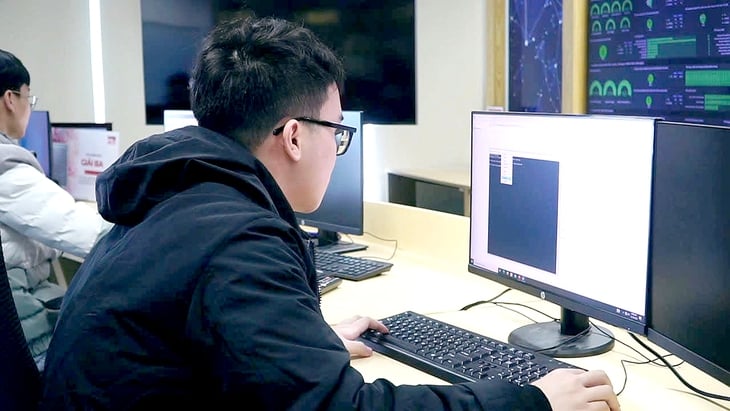
Prolonged sitting at a desk poses a risk of developing a range of musculoskeletal, metabolic, and cardiovascular diseases - Photo: NGUYEN HIEN
Statistics from the World Health Organization (WHO) show that varicose veins in the lower extremities are common in about 35% of working people… Some studies show that people who spend more time sitting have a higher risk of developing diabetes.
Despite warnings, many young people still haven't changed this habit.
I've developed all sorts of illnesses from sitting too much.
Many young people, barely 30 or a little older, have bone and joint problems like those of someone in their 60s. Minh Anh (32 years old), an administrative employee at an import-export company in Hanoi , spends more than 8 hours a day sitting in front of a computer screen, processing paperwork, data, and reports. The job, seemingly easy, has brought about many health problems that Minh Anh didn't anticipate.
Initially, Minh Anh only felt neck and shoulder pain after long hours of work. But gradually, the pain spread down her back, making it difficult for her to bend or turn. Not to mention the numbness in her limbs, especially when sitting for long periods and not moving much.
Not only her joints, but Minh Anh's legs also began to show signs of varicose veins. Pale blue veins became visible, and she felt tightness and discomfort whenever she stood up or sat down. Sometimes, her legs felt heavy and aching in the evenings, due to sitting in one position for too long, preventing proper blood circulation.
At the medical facility, Minh Anh was diagnosed by doctors with early cervical spondylosis, along with the risk of herniated discs due to incorrect sitting posture and lack of exercise.
Perhaps Minh Anh's situation is also a common problem for many office workers. Initially, it's just fleeting pain, but it gradually becomes a chronic condition. The most common of these are musculoskeletal disorders such as cervical spondylosis and herniated discs.
Mr. Nguyen Van Hung, director of the Musculoskeletal Center at Bach Mai Hospital, observed that musculoskeletal diseases appear to be occurring in younger people.
In particular, osteoarthritis in young people is associated with sedentary habits, a sedentary lifestyle, lack of movement, prolonged sitting, and obesity.
According to Associate Professor Hung, the impact of working on a computer every day on the musculoskeletal system is unavoidable. Standing or sitting for too long reduces blood circulation in the legs, and the gluteal and hip muscles become increasingly less flexible.
Bones gradually become thinner, more brittle, and more prone to fractures. The bones of the arms and wrists are constantly in use with the mouse and keyboard, putting strain on the muscles due to continuous activity.
The habit of sitting for more than 2 hours continuously will tire the muscles adjacent to the spine, causing us to hunch over and lean forward, putting strain on the muscles and ligaments behind the spine. This fatigue of the supporting system causes pain, and prolonged fatigue can lead to vertebral damage, herniated discs, cervical spondylosis, etc.
Young people with a range of incurable diseases.
Medical experts say that people who sit for long periods and are inactive are also at risk of obesity and fat accumulation, especially in the abdominal area. In addition, the digestive system, including parts such as the stomach, intestines, and colon, tends to process food more slowly, affecting the ability to metabolize nutrients from food.
Therefore, people who sit for long periods are more likely to experience symptoms such as belching and constipation. Prolonged and frequent sitting also increases the risk of hemorrhoids due to chronic constipation.
In particular, some studies show that people who spend more time sitting have a 112% higher risk of developing diabetes. Dr. Nguyen Quang Bay, head of the endocrinology and diabetes department at Bach Mai Hospital, also said that diabetes is becoming increasingly common among young people.
"Previously, type 2 diabetes was commonly found in people over 40, who were considered a high-risk group, but now it is quite common among younger people under 35. Obesity is closely linked to diabetes."
"In reality, the current lifestyle changes, with less physical activity (previously, walking and cycling were modes of transportation that required physical activity, but now using motorbikes and cars reduces physical activity), spending too much time watching TV, and consuming foods high in fat... are all factors contributing to the increase in diabetes," Dr. Bay said.
Let's "stand up" to maintain our health.
According to Dr. Bay, 90% of type 2 diabetes cases are preventable through lifestyle changes, weight management, diet, and physical exercise. "Therefore, everyone needs to maintain a healthy weight through a scientific diet and engage in regular physical activity for at least 30 minutes a day," Dr. Bay advised.
For office workers who frequently sit for long periods, Dr. Hung advises against sitting continuously for more than 3 hours a day, as this can not only affect the musculoskeletal system but also damage the heart and cause varicose veins.
"Every 1-2 hours, we can stand up and move around or do some light exercises, perform other activities like drinking water... Rest and move around for about 5-7 minutes before returning to work."
In addition, when working, pay attention to keeping the computer screen aligned with your eyes' viewing angle. Use a flat, height-adjustable, and sturdy chair... Adjust it so that your hands rest straight on the keyboard, avoiding muscle strain and eye fatigue," advised Dr. Hung.
Exercises to prevent the risk of cervical spondylosis.
Nurse Nguyen Thi Thanh, from the Department of Internal Medicine and Musculoskeletal Disorders at Military Central Hospital 108, guides patients through some cervical spine exercises to prevent the risk of degeneration.
Exercise 1: Cervical spine flexion: Sit with your back straight, bend your head forward, bringing your chin as close to your chest as possible, then return to the starting position. Repeat 5-10 times.
Cervical spine stretching: Sit with your back straight, tilt your head back as far as possible, then return to the starting position.
Exercise 2: Tilting the cervical spine: Sit with your back straight, use your hand to gently tilt your head to the opposite side and hold for 2 minutes, then do the same with the opposite side.
Exercise 3: Cervical spine rotation: Rotate your head to both sides alternately, as far as possible, looking down at your shoulders. Do this slowly, avoiding sudden changes in posture.
Combined with adequate rest, regular exercise can help prevent many musculoskeletal problems caused by prolonged sitting.























































































Comment (0)