


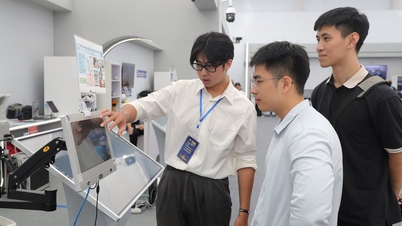
The Ministry of Education and Training 's new regulations tighten the method of calculating enrollment quotas by reducing the coefficient for lecturers with master's degrees to 0.75. (In the photo: Lecturers from Ho Chi Minh City University of Technology participate in advising students at the 2026 Admissions and Career Guidance Fair - Photo: TRAN HUYNH)
The Ministry of Education and Training has recently issued a circular regulating the determination of enrollment quotas for undergraduate, master's, doctoral, and college-level early childhood education programs, with several notable new points.
Reduce the number of master's degree programs included in the enrollment quota.
The new circular from the Ministry of Education and Training on determining enrollment quotas for university, postgraduate, and preschool education colleges introduces notable changes. The most significant change is the method of calculating the lecturer conversion coefficient, a key factor in determining enrollment quotas for each training institution. The new regulation stipulates that lecturers with a master's degree will only be assigned a coefficient of 0.75, while those with a doctoral degree will have a coefficient of 1.0.
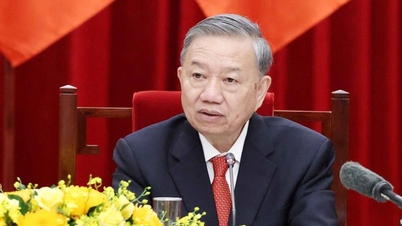
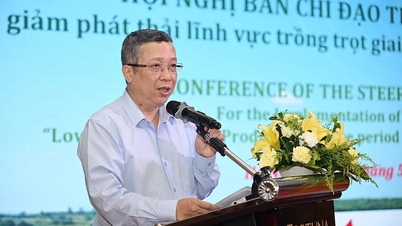
According to Deputy Minister of Education and Training Le Quan, the new circular was developed based on an innovative perspective and underwent a thorough impact assessment and data analysis process before being issued.
The fundamental change lies in the simplified method of determining and converting lecturers, reducing the previously complex calculations. Most lecturers are assigned a coefficient of 1, while those with a master's degree are assigned a coefficient of 0.75.
Mr. Quan emphasized: "In principle, the role of lecturers with master's degrees will gradually be adjusted towards being more limited, similar to the role of teaching assistants in the university training system."
This means that educational institutions whose enrollment relies heavily on master's degree holders will be forced to review and restructure their staff. Without preparation, enrollment targets could be significantly reduced in the future."
Clearly define the criteria for lecturers to be included in the enrollment quota.
The circular also specifies what constitutes a lecturer to be included in determining the number of students to be admitted. These must be individuals who directly teach, work full-time at the training institution, meet the prescribed qualification standards, and are registered in the higher education database system.
Lecturers participating in the enrollment quota calculation must meet the training program standards of the corresponding ngành (field of study) or group of fields of study. Furthermore, they must be full-time lecturers or belong to groups recognized by law.
For public institutions, full-time lecturers are those recruited and managed according to regulations on job positions within public service units.
Meanwhile, at private institutions, full-time lecturers must sign employment contracts of 3 years or more, or indefinite terms, and cannot simultaneously work long-term at other institutions; their salaries are paid by the school according to regulations.
Expand but tighten the conditions for associate lecturers.
The circular clearly stipulates that lecturers included in determining enrollment quotas must meet the qualification standards according to the Law on Teachers, directly teach and supervise students full-time at the training institution, and be registered in the higher education data system.
Full-time lecturers at public institutions are recruited and employed according to regulations on job positions; while at private institutions, they must sign a contract of 3 years or more, or an indefinite term, must not be civil servants or state employees, must not have long-term employment elsewhere, and their salaries are paid by the school according to regulations.
The regulations allow for the inclusion of co-full-time lecturers, but with specific conditions. These lecturers must ensure a minimum teaching workload equal to 50% of the standard for full-time lecturers and must teach at least one full course in the academic year.
Additionally, retired lecturers who continue to work full-time are also included, provided they have a contract of 12 months or more, teach at least one full course in the academic year in which the enrollment quota is determined, and do not have a fixed-term employment contract of 3 months or more with another employer.
For master's and doctoral programs, lecturers must meet the supervisor standards according to current regulations and sign a full-time contract of at least 3 years with the training institution.
Specific regulations for specialized industries
Certain specialized fields, such as languages, culture, arts, and sports, are subject to a more flexible mechanism in calculating faculty numbers when determining university enrollment quotas.
Accordingly, titles such as People's Artist, Meritorious Artist, Meritorious Teacher, coaches/athletes who have won world championships, continental championships, SEA Games championships, or been awarded the title of National Master Athlete, and who also hold a university degree in the same or related field as the training program, will be weighted as lecturers with a master's degree; those with a master's degree will be weighted as lecturers with a doctoral degree.
For the health sector, the circular stipulates that lecturers with a residency or specialist degree (Level I) are considered equivalent to a master's degree, and specialist degree (Level II) is considered equivalent to a doctorate when determining undergraduate enrollment quotas, provided they have at least 3 years of teaching experience. Additionally, practical instructors at training facilities are also counted as full-time lecturers.
Detailed regulations on conversion factors
Another important point is the regulation on the ceiling for the student-to-faculty ratio. The maximum ratio is 40 students per faculty member for all forms and levels of training. The proportion of postgraduate students (master's, doctoral) must account for at least 15% of the maximum number of equivalent students.
The circular also clearly specifies the conversion coefficient for each lecturer's qualification: lecturers with a university degree are assigned a coefficient of 0.50 at higher education institutions (except for early childhood education colleges, where it is 0.75).
Lecturers with a master's degree are given a coefficient of 0.75 (those with a college degree in early childhood education are given a coefficient of 1.00). Meanwhile, lecturers with a doctoral degree, or those holding the titles of associate professor or professor, are given a coefficient of 1.00.
Source: https://tuoitre.vn/siet-cach-tinh-chi-tieu-thac-si-dan-lui-ve-vi-tri-tro-giang-20260422123934783.htm






























































































Comment (0)