

Previously, due to limited irrigation water, most of the terraced rice fields in Dao Xa could only be cultivated for one rice crop. After the harvest, the land was left fallow, generating no additional economic value.
This reality necessitates the search for suitable new crops to utilize land resources and improve production efficiency per unit area. The model of growing green chili peppers for export has partially solved this problem.
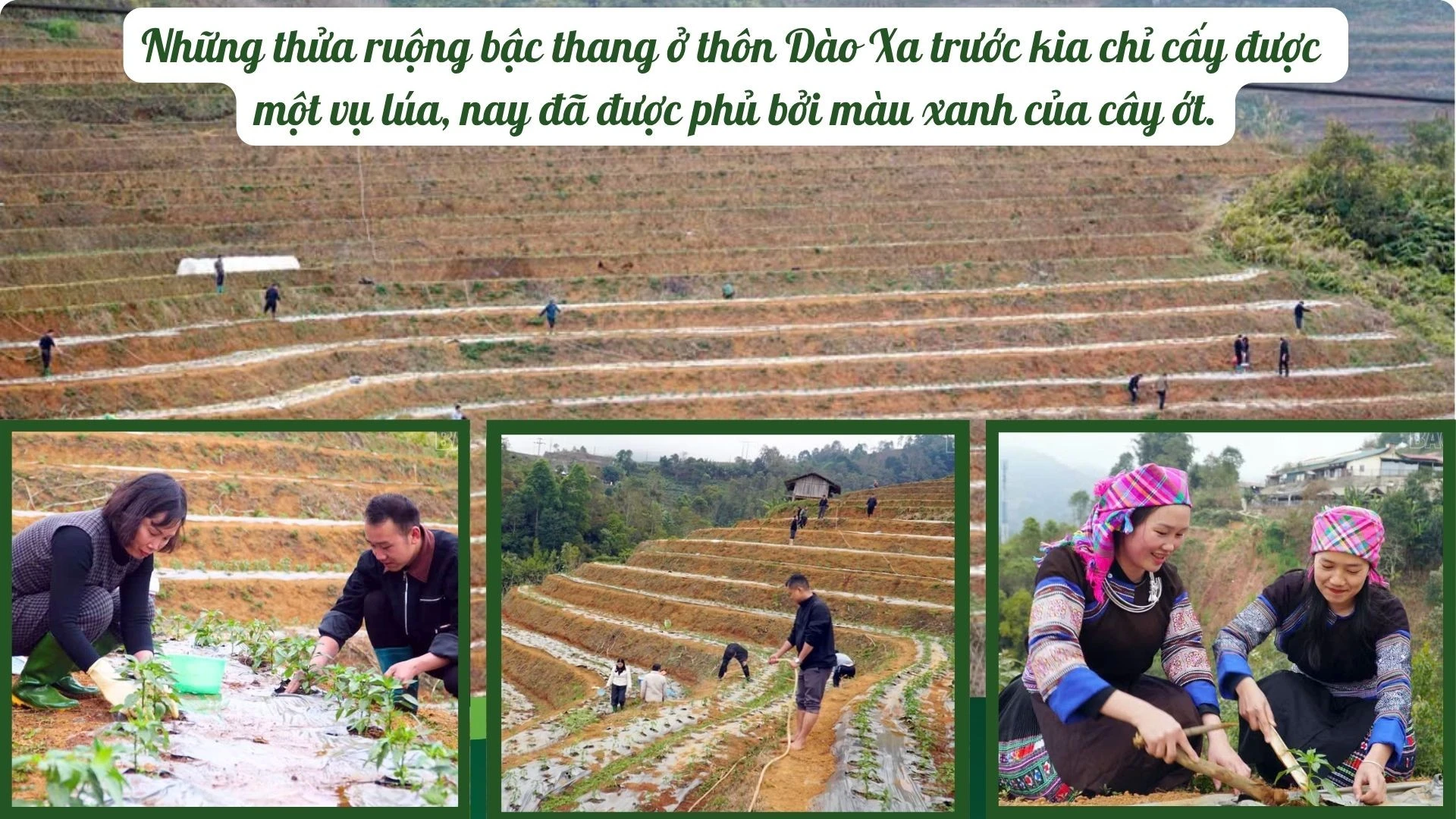
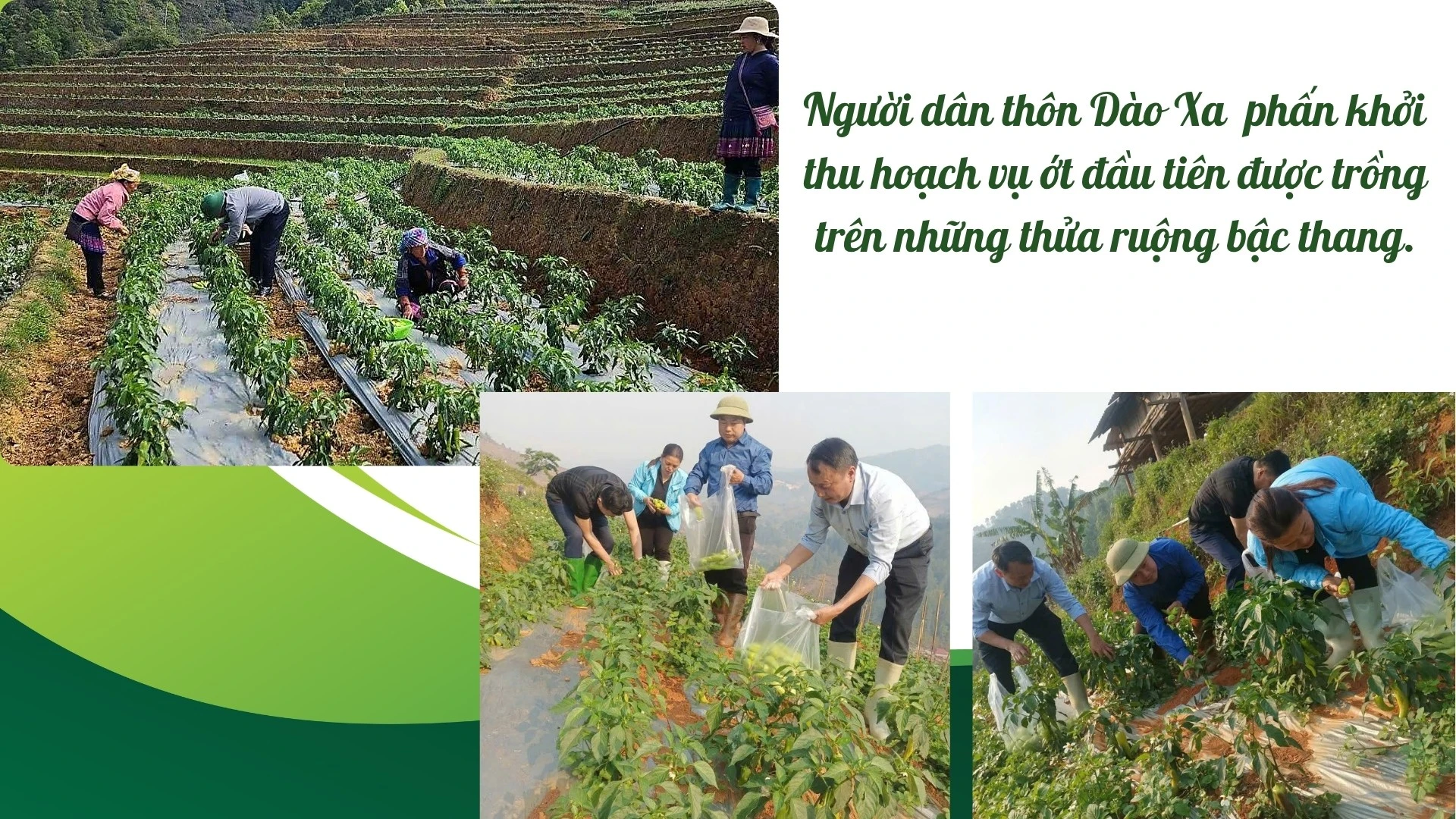
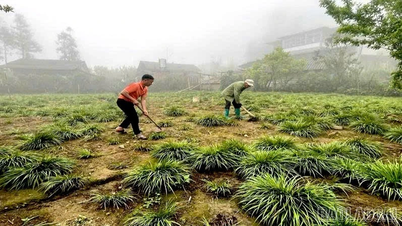
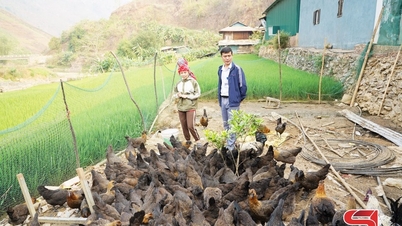
The Giàng A Sinh family is one of the pioneering households participating. With approximately 6,000 m² of single-crop rice fields, at the end of 2025, his family boldly switched to growing chili peppers. After more than two months of care, the first harvests of fruit have begun.
"To date, my family has harvested nearly 300 kg of chili peppers. At a selling price of around 7,000 VND/kg, we've initially earned over 2 million VND. We will continue to expand the chili pepper cultivation area in the next season," Mr. Sinh shared.
It's not just Mr. Sinh's family; many other households are also starting to earn additional income from their single-crop rice fields. Mr. Giang A Dao, with approximately 4,000 m² of green chili peppers, has harvested nearly 100 kg in his first crop. Although the amount is not large, it is a positive sign, showing that the new crop is adapting well to the local climate and soil conditions.
Notably, the model is not implemented in the traditional way but is organized as a linked chain. Farmers receive support in terms of seeds, supplies, technical guidance, and product buyback agreements. As a result, the production process is implemented synchronously, minimizing risks, especially concerns about market access – a long-standing "bottleneck" in highland agricultural production.
Mr. Tran Minh Chien, Director of the GOC Cooperative for the production and processing of agricultural products for export, said: “When implementing the model, we determined that we must accompany the people throughout the entire production process. The cooperative provides seeds, supplies, sends technical staff to provide direct guidance in the fields, and signs contracts to guarantee the purchase of products. The goal is not only to purchase but also to help people produce according to standards, gradually accessing a stable export market.”
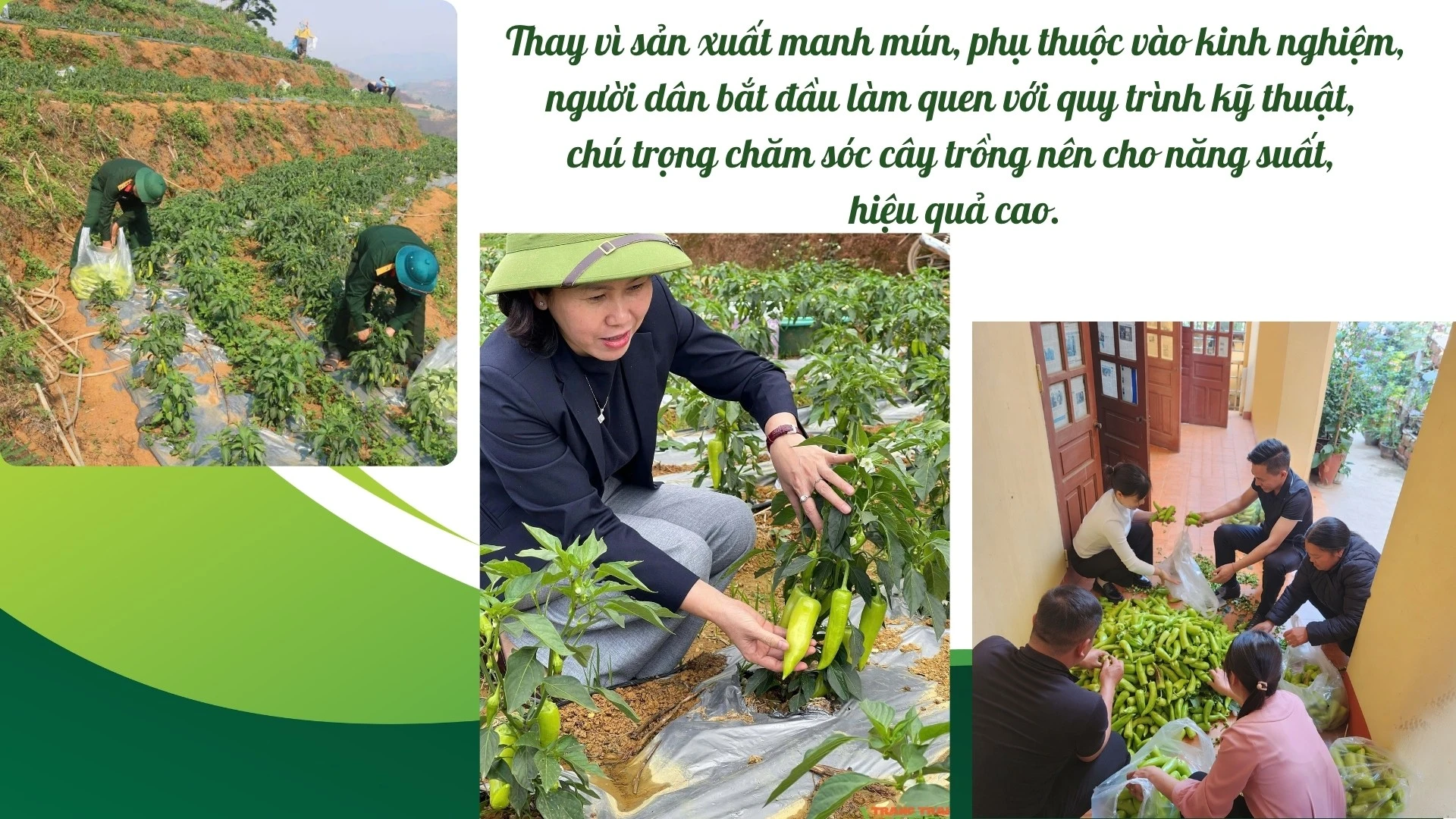
Having businesses as partners has brought about a significant change in the mindset and practices of the people. Instead of fragmented production relying on experience, people have begun to familiarize themselves with technical processes and focus on crop care. Recommendations such as balanced fertilization, increased use of organic fertilizers, and limiting nitrogen fertilization when plants are diseased are gradually being applied in actual production.
Furthermore, organizing production towards a commodity-based approach helps people gradually meet market demands, especially the export market. The chosen green chili variety has a short growing season, ready for harvest after about 60 days. With good care, yields can reach 60-70 tons/ha, bringing much higher economic value than cultivating rice in a single crop.
Based on the implementation experience, local leaders believe this is a suitable direction for restructuring crop patterns.
Introducing chili peppers into single-crop rice paddies has significantly improved land utilization. In the future, the local authorities will continue to monitor, refine the technical procedures, and gradually expand the model.
On the terraced fields, the green of chili peppers is gradually replacing the empty spaces left after the rice harvest. Stories of income, however modest, have provided further motivation for people to boldly make the transition.
Introducing chili peppers into production not only enhances land use but also creates a new direction for agricultural development in the highlands. When the "gaps" left after the rice harvest are filled with suitable crops, production value will increase, and people's lives will gradually improve.
The story in Dao Xa shows that, with the right crop selection, rational production organization, and market linkages, even difficult areas can create value. From familiar terraced fields, a new economic model is emerging that not only generates income but also contributes to changing production mindsets, creating a sustainable foundation for agricultural production in the highlands.
Source: https://baolaocai.vn/sinh-ke-moi-o-dao-xa-post898037.html
![[Photo] General Secretary and President To Lam and General Secretary and President Xi Jinping meet with youth from both countries.](https://vphoto.vietnam.vn/thumb/1200x675/vietnam/resource/IMAGE/2026/04/15/1776245687540_vna-potal-tong-bi-thu-chu-tich-nuoc-to-lam-va-tong-bi-thu-chu-tich-nuoc-tap-can-binh-gap-go-thanh-nien-hai-nuoc-8702371-jpg.webp)
![[Image] Current status of the land area of over 5.5 hectares that Ho Chi Minh City is considering reclaiming.](https://vphoto.vietnam.vn/thumb/1200x675/vietnam/resource/IMAGE/2026/04/15/1776245690095_1-3102-8409-jpg.webp)
![[Photo] General Secretary and President To Lam and his wife, along with General Secretary and President Xi Jinping and his wife, attending a tea party.](https://vphoto.vietnam.vn/thumb/1200x675/vietnam/resource/IMAGE/2026/04/15/1776245678527_vna-potal-tong-bi-thu-chu-tich-nuoc-to-lam-va-phu-nhan-cung-tong-bi-thu-chu-tich-nuoc-tap-can-binh-va-phu-nhan-du-tiec-tra-8702812-9829-jpg.webp)
![[Image] Overview of the Tam Trinh-Giai Phong connecting road section after land clearance is completed.](https://vphoto.vietnam.vn/thumb/1200x675/vietnam/resource/IMAGE/2026/04/15/1776245679644_ndo_br_dji-0195-jpg.webp)
![[Photo] Capturing each moment at the "People We Meet" photography exhibition.](https://vphoto.vietnam.vn/thumb/1200x675/vietnam/resource/IMAGE/2026/04/15/1776245695648_1-8944-jpg.webp)


































Comment (0)