

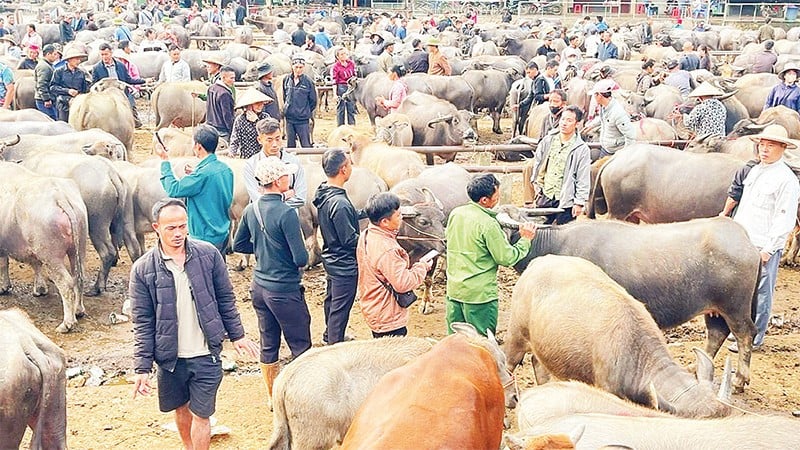
Nghiên Loan commune was formed by merging three communes from the former Bắc Kạn province: Xuân La, Nghiên Loan, and An Thắng. This challenging region is characterized by its biting cold in winter and limited agricultural land; therefore, poverty is ever-present in the more than 28 villages scattered across the high mountain slopes.
Despite numerous studies, experiments, and attempts at cultivating crops such as early-ripening plums, seedless persimmons, and ginger, none have yielded the expected results due to the harsh climate. However, everything changed when the local people and authorities chose to shift their production model and capitalize on the greatest strength of this challenging region: livestock farming.
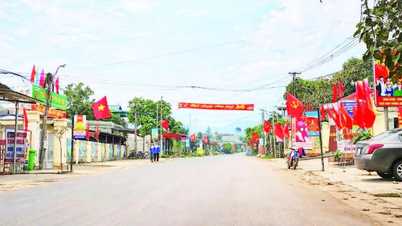
Instead of roaming freely on the hillsides, buffalo and cattle are now raised and fattened in warm barns during the winter, becoming a new livelihood in this old land. The new rural road leading to Ban Dinh village is wide and paved with concrete. The village has many sturdy brick and wooden houses.
On both sides of the road, vast fields of lush green elephant grass stretch alongside buffalo and cow sheds, each containing dozens of large, fat animals grazing on troughs of chopped elephant grass prepared by their owners. Mr. Giang Van Tien recounted that his family had been classified as a poor household for many years. The local area had a buffalo and cow market since 1998, but it was informal and only in 2014 did the local authorities invest in expanding the market to a dedicated area for livestock trading.
From there, the market became well-known and attracted many people to trade and buy goods. Taking advantage of this, and drawing on his family's inherited livestock farming experience, Mr. Tien and his family borrowed capital to develop a model for fattening buffalo and cattle. This approach yielded unexpected economic results, with each buffalo or cow, after one to three months of fattening, generating a profit of 4-5 million VND.
Seeing the positive results, Mr. Tien gathered the villagers to form a livestock farming cooperative with a regular herd of 350-400 buffaloes and cows being fattened. "The best thing is that it's easy for people to raise livestock and also very easy to sell them at the buffalo and cow market right in the commune…," Mr. Tien said. Mr. Vuong Van San's family was previously among the poorest and most disadvantaged households in Ban Dinh due to a lack of sustainable livelihoods.
In 2018, with the support of two breeding buffaloes from the national sustainable poverty reduction program, Mr. Sằn focused his garden land on growing elephant grass and borrowed additional capital from the policy bank to buy more lean buffaloes and cows for fattening. Each animal fattened for one to two months yielded a profit of 4-5 million VND, with some healthy animals bringing in 8 million VND. His barn regularly houses 6-7 buffaloes and cows being fattened, alongside a 4,000 m2 elephant grass garden, which not only provides feed for his family's livestock but also provides grass for sale, increasing his income.
Since 2023, Mr. San's family has escaped poverty and become a model family with this innovative approach in Ban Dinh. According to Nong Xuan Hoan, the head of Ban Dinh village, the village's economy has seen positive changes in recent years, largely due to the development of livestock farming. Of the 160 households in the village, more than 30 have developed buffalo and cattle fattening. The villagers cultivate over 14 hectares of elephant grass to feed the fattening of buffalo and cattle and supply grass to the local livestock cooperative...
Thanks to this livelihood model, Ban Dinh has significantly reduced the number of poor households and has become a shining example of economic development and cultural life building in the locality. It can be said that the key factor creating change in Nghien Loan is the timely implementation of state support policies by the government to encourage the raising of large livestock. As a result, livestock farming, which was previously small-scale and fragmented, has taken shape into small-scale farm-based and family-run livestock operations.
Currently, the commune has 3 households with large-scale livestock farms, 30 households with small-scale family farms, and many households engaged in small-scale fattening of 5 buffaloes and cows or less. The total number of large livestock reaches nearly 8,000. Strengthening and developing the buffalo and cattle market plays a crucial role in ensuring that livestock farming here not only provides a livelihood to escape poverty but also helps farmers become wealthy. Each market session sees transactions of 400-700 buffaloes and cows with a value of around 50 billion VND.
This source of income not only directly improves the lives of households but also promotes accompanying commercial services in the commune. Leveraging the advantages of this market, the commune has increased the frequency of the market to once every five days and the night market to once a month, creating opportunities for people to boldly develop additional services and jobs, thereby increasing their income. With sustainable livelihoods, the government and people have more motivation to invest in improving the rural landscape.
Over the past five years, the commune has invested more than 48 billion VND to build over 55 infrastructure projects. Roads connecting the commune to the village centers have been largely paved in all 28 villages. This road construction not only facilitates the transportation of goods, especially livestock, but also connects the commune with other economic zones. To date, 27 out of 28 villages in Nghiên Loan have access to the national power grid. The percentage of households using national electricity and clean water is steadily increasing. The school and health station systems have been built to solid, standard specifications, ensuring social welfare for all residents.
The telecommunications and internet networks are gradually developing, meeting the needs of production and business. The poverty rate decreased by an average of 2.38% per year during the 2021-2024 period... These changes, which the local people call "unprecedented transformations," were considered difficult for the commune to achieve in previous years. Chairman of the People's Committee of Duong Van Quynh commune stated: "Based on practical experience, we believe that livestock development will be the key economic sector of the locality."
Therefore, in the coming period, the commune will focus on developing livestock and poultry farming in the direction of family farms and large-scale farms, while ensuring disease safety and protecting the ecological environment; striving to bring the total number of buffaloes, cows, horses, and goats to 11,000 or more in the period from 2025-2030.
In addition, the average per capita income is expected to reach 33 million VND/person/year or more by 2030. The commune also aims to transform its management model, upgrade the buffalo and cattle market system, and encourage the organization of events and the development of community tourism at potential locations.
Source: https://nhandan.vn/sinh-ke-moi-tren-vung-dat-cu-post926661.html
![[Photo] Prime Minister Pham Minh Chinh receives the Chinese Ambassador to Vietnam](https://vphoto.vietnam.vn/thumb/1200x675/vietnam/resource/IMAGE/2026/04/05/1775397481797_ndo_br_dsc-5512-jpg.webp)







![[Photo] Prime Minister Pham Minh Chinh receives the Chinese Ambassador to Vietnam](https://vphoto.vietnam.vn/thumb/402x226/vietnam/resource/IMAGE/2026/04/05/1775397481797_ndo_br_dsc-5512-jpg.webp)






















































Comment (0)