

TP - After nearly half a year of collecting banana peels together and sending them back for testing hundreds of times, a group of students from Hanoi University of Science and Technology and National Economics University have successfully manufactured lithium batteries from agricultural waste.
Eat bananas for a whole week to collect the peels for research.
Stemming from research on biomass fuels, a group of students including Nguyen Thang, Nguyen Bao Khanh, Tran Manh Quan, Vu Thi Thu Nga, Tran Minh Huong, Nguyen Van Tu ( Hanoi University of Science and Technology); Le Thi Huyen Trang, Vu Tran Linh Trang, Dinh Thi Thu Thao (National Economics University); and Nguyen Thi Huyen Trang (Foreign Trade University) have been nurturing the startup project Banatery - manufacturing lithium batteries from banana peels.
“In the context of the current circular economy and green economy trends, we have researched several types of biomass fuels such as sugarcane bagasse, acacia leaves, etc. Among them, banana peels are a suitable raw material for manufacturing lithium batteries to supply factories producing environmentally friendly energy storage devices. The supply of banana peels will come from factories that produce dried fruits and dried bananas,” Huyen Trang said.
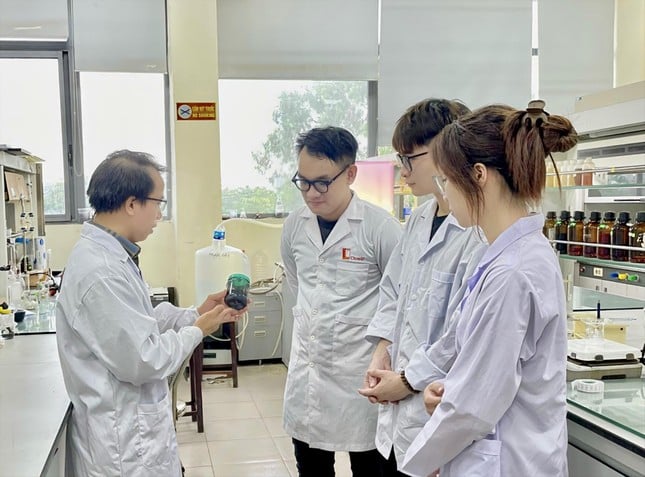 |
Associate Professor Dr. Nguyen Trong Nghia (School of Chemistry and Life Sciences , Hanoi University of Science and Technology) supervised the student group carrying out the project. |
In the early stages of the experiment, Bảo Khánh jokingly said that everyone in the group had to play the role of "banana traders" to obtain the necessary amount of banana peels for the research and measurements. The group members collected peels by asking for them, buying bananas from fruit stalls or supermarkets. "Sometimes we had to mobilize students in our class to actively eat bananas for a whole week, or create dishes from bananas to collect the peels," Khánh recounted.
The Banatery startup project, which manufactures lithium batteries from banana peels, was developed by a group of students under the guidance of Associate Professors Le Thi Thu Hang, Nguyen Trong Nghia, and Hoang Thi Bich Thuy (Faculty of Chemistry and Life Sciences, Hanoi University of Science and Technology). The project won first prize in the 2024 Startupcity Challenge, organized by the Hanoi Youth Union.
Huyen Trang even mobilized her family back home to help collect banana peels. “Everyone was surprised when we went around asking for and buying banana peels. At that time, the whole group spent the day collecting peels together, and only started experimenting in the evening, working together to dry the peels at the right time,” Trang shared.
The team spent countless sleepless nights researching and discussing, and it took them nearly two years to perfect the product. “I remember most vividly the period when the Institute of Materials Science, Vietnam Academy of Science and Technology, returned hundreds of samples of 18650 lithium-ion batteries that didn't meet the standards. Everyone just looked at each other in silence. But then the whole team showed determination and hope, continuing to redo, resubmit, resubmit… and finally, we made it through,” Nguyen Thang recalled.
Environmentally friendly product
“We are ambitious ‘pieces of a puzzle,’ working together and persevering on a journey. Sometimes, economics students and engineering students have different ways of thinking and perspectives, leading to heated debates. But then, we all learn to regulate our individual egos to harmonize with the common ideas and goals of the group,” shared Nguyen Thang, a male student.
Therefore, from a rudimentary idea, Nguyen Thang and his team transformed it into a product that is close to real-life applications and creates great value for the environment. According to the student, Banana Battery is a superior solution to replace traditional batteries. Specifically, the graphite used in traditional battery production will be replaced with activated carbon produced from banana peels.
“This activated carbon shows better overall electrochemical characteristics compared to activated carbon products derived from mined coal. Currently, the project is continuing to research other types of biomass fuels to use as anodes for applications in other fields,” Thang said, adding that batteries made from banana peels will be easily recycled and minimize environmental impact during recycling.
As an advisor to the project, Ms. Nguyen My Anh, who works at the Department of Enterprise Development (Ministry of Planning and Investment), commented that the students have considered a direction that some current businesses have not yet thought of.
“Sustainable development is easy to talk about but difficult to do. The project members have pondered and considered many aspects of the product, such as how to process waste, how to reduce emissions and environmental impact, and how lithium batteries will contribute to the green transition and the circular economy trend… These are advancements that the students can absolutely achieve if they persevere, work together to upgrade techniques and technology, and optimize the effectiveness of this product,” Ms. My Anh said.
Source: https://tienphong.vn/sinh-vien-lam-pin-tu-vo-chuoi-post1647789.tpo
![[Photo] The courage of new recruits of Brigade 144 on the training ground.](https://vphoto.vietnam.vn/thumb/1200x675/vietnam/resource/IMAGE/2026/05/27/1779881651341_anh-man-hinh-2026-05-27-luc-18-32-52.png)
![[Photo] The heat at the fireworks display site on the opening night of the Da Nang International Fireworks Festival 2026](https://vphoto.vietnam.vn/thumb/1200x675/vietnam/resource/IMAGE/2026/05/27/1779889741485_ndo_br_z7872039145157-fecaba5112f39e8352544099d7ef4738-5140-jpg.webp)















































![[Photo] The courage of new recruits of Brigade 144 on the training ground.](https://vphoto.vietnam.vn/thumb/402x226/vietnam/resource/IMAGE/2026/05/27/1779881651341_anh-man-hinh-2026-05-27-luc-18-32-52.png)
















Comment (0)