1. Signs and symptoms of stroke
- 1. Signs and symptoms of stroke
- 2. Things to do when providing first aid for a stroke at home.
- 3. Things you shouldn't do when providing first aid for a stroke at home.
- 4. Stroke prevention
Family members can detect early signs of stroke to provide timely first aid and transport the patient to the hospital if they see the following signs:
- Facial asymmetry: One side of the face may droop, the mouth may be crooked, or the eye may not be able to open.
- Weakness in the arms and legs: Patients are unable to lift one or both arms, or experience sudden weakness, numbness, or stiffness in their limbs.
- Speech difficulties: Difficulty pronouncing words, lisping, or not understanding what others are saying.
- Loss of balance: Difficulty standing or walking.
- Severe headache: A sudden, intense headache with no apparent cause.
The FAST method (Face, Arm, Speech, Time) is an effective way to identify stroke. If you see a patient exhibiting any of these signs suddenly, immediately consider the possibility of a stroke and provide first aid.
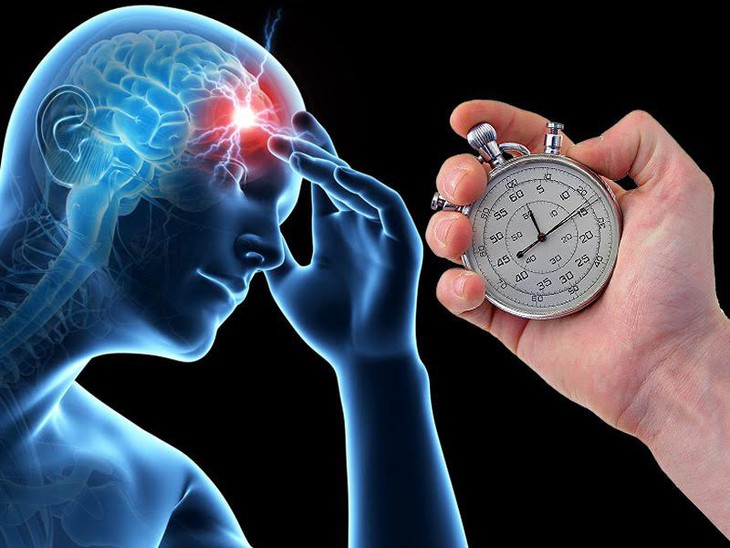
The golden time for stroke emergency treatment is typically calculated as 3-4.5 hours from the time the patient first experiences stroke symptoms.


2. Things to do when providing first aid for a stroke at home.
According to Dr. Nguyen Tien Dung, Deputy Director of the Stroke Center at Bach Mai Hospital, when noticing suspicious signs of stroke in a loved one according to the FAST principle (facial drooping, weakness in the limbs, slurred speech), it is necessary to remain calm and follow these steps:
- Call emergency services (115) immediately and notify medical personnel that someone is suspected of having a stroke.
- If the patient is still conscious: Have them lie down in a cool, well-ventilated place, with their head elevated to about 30 degrees.
- If the patient is unconscious or vomiting: Place the patient in the side-lying position (resuscitation position) to prevent vomit from entering the airway and causing choking.
- Loosen the patient's clothing, tie, and belt to make breathing easier.
- Monitor closely and remember the time of onset.
- Accurately record the time of the first symptom onset. This is especially important information to help doctors decide whether to prescribe thrombolytic therapy (within the first 4.5 hours) or thrombectomy.
- Monitor the patient's breathing rate, complexion, and level of alertness.
- Ensure clear airways.
- If the patient has dentures, they should be removed gently to avoid them falling into the airway.
- You can use a clean cloth wrapped around your finger to wipe away any mucus or vomit from the mouth (if present).
3. Things you shouldn't do when providing first aid for a stroke at home.
- Do not attempt to wake the patient by slapping their face or shaking them vigorously.
- Do not give the patient anything to eat, drink, or suck on, including water or blood pressure medication. Stroke often causes swallowing difficulties, which can easily lead to choking, respiratory failure, and death.
- Do not administer medication to patients without consulting a doctor. Using medication of unknown origin or without proper prescription during the acute phase can worsen the condition or cause aspiration into the lungs.
- Do not use acupuncture or prick the fingertips to draw blood. This method is ineffective in dissolving blood clots and wastes valuable time for medical intervention.
- Don't wait for the patient to "recover on their own." Stroke symptoms may briefly improve, but they can progress very quickly and are dangerous, requiring immediate emergency medical attention.
- Do not drive a motorcycle to transport a patient yourself. In the absence of an ambulance, use a car or taxi to ensure the patient is immobilized and safe during transport.
4. Stroke prevention



To prevent the risk of stroke, it is necessary to adopt a healthy lifestyle such as:
- Choose healthy foods. Ensure you eat enough of the recommended amounts of fruits, vegetables, and whole grains. Opt for foods that are low in saturated fat, trans fat, cholesterol, salt (sodium), and added sugar.
- Exercise daily. Appropriate daily physical activity helps improve cardiovascular health.
- Always keep your mind relaxed. Stress increases blood pressure, putting strain on the heart and blood vessels.
- Quit smoking. Cigarettes increase the risk of stroke.
- Limit your consumption of alcohol and stimulants.
- Monitor your blood pressure: Check it regularly to ensure it remains at a safe level.
- Regular health checkups should be a habit. Listen to your body and seek medical advice and consultation from qualified professionals at reputable healthcare facilities when needed, including early stroke screening.
Source: https://suckhoedoisong.vn/so-cuu-dot-quy-tai-nha-dung-cach-16926062822465448.htm


![[Photo] Strengthening character and expertise: Intense training for artillery soldiers.](https://vphoto.vietnam.vn/thumb/1200x675/vietnam/resource/IMAGE/2026/06/30/1782815602541_lu-368-1875-4571-jpg.webp)