


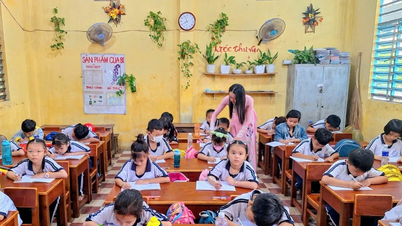
A software application for parents is being piloted in some schools in An Giang province . Photo: GIA KHÁNH
Living in the border region of Nhon Hoi, Ms. Rophiha, a Cham woman residing in Nhon Hoi commune, is quite busy caring for and transporting her two eldest children, who are in primary and secondary school. Her eldest child, Trinh Rolhani, is entering the 6th grade at Quoc Thai Secondary School (Nhon Hoi commune). Like most rural women, her time is divided between her children and household chores.
“In the past, if I wanted to know anything about my children's school or class, I had to drive all the way to the school to check the announcements or call the homeroom teacher. Especially at the beginning and end of the school year, there were so many events that it was difficult to keep track of everything. Now it's so convenient! At the beginning of the school year, the homeroom teacher contacts me via Zalo and adds me to the parent group. I just need to follow the announcements in the group to know what upcoming events my child needs to participate in; what clothes my child should wear, what time they should gather at school… Even the children's report cards are sent directly by the teachers, along with instructions for parents to pay extra attention to in which subjects or areas to help their children with. Thanks to this, I feel much more at ease,” Rophiha expressed.
In the educational process, the role of parents is always decisive. However, with the development of digital technology, the way parents support their children has also changed significantly compared to the past. “In my time, parents managed their children's studies by directly supervising them, checking their notebooks daily, and monitoring their school attendance. As a parent, I couldn't apply all the old methods and switched to technology. The textbooks and curriculum are so different that I can't teach them directly. My husband and I monitor our children's academic progress through learning management applications and group chats with teachers. When we find useful and appropriate materials, we share them with our children for research and reference,” said Ms. Nguyen Thi Huyen Tran, a resident of Rach Gia ward.
Parents' levels of technological proficiency and access to technology are not the same. Therefore, at the beginning of the school year, school administrators must hold meetings to communicate with and guide parents on how to use the school's software, and cooperate with the school to achieve the highest possible digital transformation effectiveness.
Returning to Binh Khanh Junior High School in Binh Duc Ward, this is one of the few schools that have early access to some advanced digital transformation software. Through appropriate guidance and outreach to parents, in the 2024-2025 school year, 100% of the school's parents will use electronic software to collect tuition fees and health insurance payments without cash, participate in feedback surveys via spreadsheets, and vote in class group Zalo.
“However, during the implementation process, we still encountered some limitations and difficulties. In particular, some parents of students, due to economic difficulties, lack the means and equipment to access information technology. This has somewhat affected the digital transformation process in the school,” commented Mr. Doan Van Luc, Deputy Secretary of the Party Committee of Binh Khanh Secondary School.
Just like "digital teachers" and "digital students," the generation of "digital parents" doesn't come naturally; it needs to be formed through a process of awareness, learning, practice, and habit change. Mr. Lam Huynh Manh Dong, Director of the An Giang Provincial Center for Continuing Education, emphasized: "Parents need to understand that digital transformation is not a temporary trend but an essential part of modern education. I hope parents will accompany the school in the digital transformation process, be ready to learn new technologies, proactively cooperate with teachers, create positive learning conditions for students at home, and contribute to shaping a modern learning mindset suitable for the digital age for their children."
According to Mr. Dong, in the digital age, parents not only need to guide and remind students to use online learning platforms effectively, but they themselves must also be proficient in using basic digital tools. For example, they need to know how to use learning management applications such as: electronic communication logs, LMS software (Google Classroom, K12Online…), Zalo, Zoom, Google Meet…; they can check learning results, receive notifications, and provide feedback through online platforms.
Once parents are equipped with the necessary skills, the education sector should promote their participation on digital platforms. Each school needs to build official communication channels: websites, Zalo groups, and student management applications to allow parents to support their children; encouraging parents to provide feedback and exchange information online instead of just meeting in person. At the same time, parents need to set a good example by using social media responsibly, verifying information, and avoiding fake news.
The challenge of the present era is how to harmoniously combine two approaches: preserving the positive traditional values of the traditional parenting model while leveraging the advantages of digital technology to promote the holistic development of children. "Digital parents" may emerge more slowly, but they are essential, forming a three-legged stool of collaboration between teachers, students, and families. Parents must proactively learn and change their parenting habits now, transforming from traditional caregivers into digital companions.
(To be continued)
Source: https://baoangiang.com.vn/so-hoa-hanh-trinh-trong-nguoi-bai-3-phu-huynh-so-a427500.html


![[Photo] Prime Minister Pham Minh Chinh presides over the conference announcing the establishment of the International Finance Centre in Vietnam.](/_next/image?url=https%3A%2F%2Fvphoto.vietnam.vn%2Fthumb%2F1200x675%2Fvietnam%2Fresource%2FIMAGE%2F2025%2F12%2F21%2F1766309817714_ndo_br_dsc-3400-jpg.webp&w=3840&q=75)
![[Photo] Prime Minister Pham Minh Chinh presides over a meeting on private sector economic development.](/_next/image?url=https%3A%2F%2Fvphoto.vietnam.vn%2Fthumb%2F1200x675%2Fvietnam%2Fresource%2FIMAGE%2F2025%2F12%2F20%2F1766237501876_thiet-ke-chua-co-ten-40-png.webp&w=3840&q=75)





























































































Comment (0)