

Upon entering the global arena, Vietnamese banks must compete fairly with international financial institutions, adhering to legal regulations and common standards. To develop, they are compelled to elevate their status and assert their position through their inherent capabilities and strengths.
Opportunities to expand and the challenge of competing with the big players.
The initiative to establish an International Finance Center (IFC) in Vietnam is considered a strategic and timely step. Many international experts warn that any delay could cause Vietnam to lose a valuable opportunity to assert its position on the global financial map.
However, effectively leveraging the opportunities offered by the international financial market remains a major challenge for domestic financial institutions and businesses.
According to Ms. Truong Thi Thu Ba, Deputy Director of the Financial Institutions Department at the Vietnam Investment and Development Bank ( BIDV ), participating in international financial markets opens up many opportunities for the domestic banking system: from expanding markets and upgrading the financial services ecosystem to accessing global standards, thereby improving credit ratings and competitiveness.
She emphasized: “Currently, banking services are not limited to payments or money transfers, but must develop into a comprehensive ecosystem. Participating in international financial markets means that Vietnamese banks need to apply the most advanced technologies such as open banking, cloud computing, artificial intelligence (AI), green finance… while simultaneously improving their governance capacity to meet stringent international requirements such as financial reporting according to international standards, implementing advanced Basel II, etc.”
Although BIDV currently has the largest total assets in Vietnam, its scale is still very modest compared to major global financial institutions. Once entering the global competitive environment and having to comply with international legal frameworks, domestic banks will face considerable pressure.
Ms. Thu Ba frankly admitted that without thorough preparation, Vietnamese banks would find it difficult to compete in the international financial market, and might even fail in their own backyard.
In addition to scale issues, Vietnamese banks are currently facing significant challenges regarding data infrastructure, technology platforms, and digital integration capabilities.
Despite recent efforts to accelerate digital transformation and data collection, Vietnam's banking technology system is still in its early stages compared to international financial institutions – especially in cross-border payments and digital banking services.
In other words, Vietnamese banks are facing the pressure of "internationalizing pressure" while their ability to "internationalize competitiveness" remains limited.
However, according to Mr. Nguyen Duc Lenh, Deputy Director of the State Bank of Vietnam's Ho Chi Minh City branch, these very pressures are the driving force behind development.
He argued that building a system of financial institutions, including commercial banks, finance companies, and leasing companies, within the international financial market space would help improve operational efficiency, create a healthy competitive environment, and serve as a crucial driving force for the safe, sustainable development of the domestic banking system, keeping pace with international standards.
Experts agree that, in order to become part of the international financial market, domestic credit institutions need to proactively "upgrade" themselves, not only to meet the participation requirements, but also to be able to compete with global giants.
Once these barriers are overcome, Vietnamese banks will open the door to strong development, contributing to affirming the nation's position on the regional and global financial map.
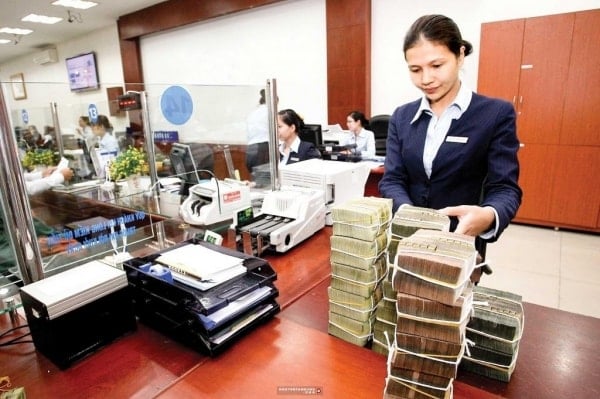
Banks need to expand their product offerings to remain competitive.
Many large banks are currently actively preparing to participate in the international financial and monetary market. Ms. Truong Thi Thu Ba noted that Vietnam possesses a high-quality workforce along with a large number of programmers.
Therefore, banks need to leverage this advantage to provide financial services to international financial markets, such as payment infrastructure, digital identification, or credit assessment through artificial intelligence (AI). At the same time, the banking industry needs to clearly define its roadmap and specific goals for each stage of development.
On BIDV's side, Ms. Thu Ba stated that the bank has determined that in the initial phase of participating in the international financial market, they will not only provide traditional banking services but also high-tech digital services. In particular, BIDV will also provide outsourcing services. Currently, BIDV has a team of 1,000 technology employees and plans to increase this number to 1,400 this year.
Mr. Nguyen Manh Khoi, Head of Capital Markets at VietinBank , acknowledged that the Vietnamese financial market currently mainly offers basic products, while structured and derivative products are developing slowly and have not yet adequately met investors' risk hedging needs.
In fact, some FDI businesses operating in Vietnam have to use derivative products from Singapore to protect their investment capital. Mr. Khoi suggested that the development of new financial products, derivative instruments, and innovative investment products should be encouraged and supported to enhance the flexibility and depth of the market.
Furthermore, according to a representative from VietinBank, when building an international financial center, Vietnam should experiment with and gradually introduce new markets such as commodity markets, foreign exchange markets, and digital asset markets to get closer to the models of international financial centers.
Specifically, the plan is to build a commodity exchange focusing on items in which Vietnam has a competitive advantage, such as agricultural products. "VietinBank will be a pioneer in providing commodity price derivative services to the Vietnamese market," Mr. Khoi affirmed.
Source: https://baodaknong.vn/san-choi-tai-chinh-toan-cau-suc-ep-lon-doi-voi-ngan-hang-viet-250009.html


![[Photo] National Assembly Chairman Tran Thanh Man attends the policy seminar to promote Vietnam-Türkiye cooperation.](https://vphoto.vietnam.vn/thumb/1200x675/vietnam/resource/IMAGE/2026/04/16/1776351415367_vna-potal-chu-tich-quoc-hoi-tran-thanh-man-du-toa-dam-chinh-sach-thuc-day-hop-tac-viet-nam-tho-nhi-ky-8705791-jpg.webp)














![[Image] Bridges and roads connecting the eastern part of Ho Chi Minh City](https://vphoto.vietnam.vn/thumb/1200x675/vietnam/resource/IMAGE/2026/04/16/1776328595108_ndo_br_bh-vt5-jpg.webp)




























![[Infographic] Details of the Hanoi-Quang Ninh High-Speed Railway Project](https://vphoto.vietnam.vn/thumb/402x226/vietnam/resource/IMAGE/2026/04/16/1776338188424_anh-man-hinh-2026-04-16-luc-18-16-10.png)

![[Photo] National Assembly Chairman Tran Thanh Man meets with the Speaker of the Georgian Parliament](https://vphoto.vietnam.vn/thumb/402x226/vietnam/resource/IMAGE/2026/04/16/1776338494029_anh-man-hinh-2026-04-16-luc-18-21-21.png)



















Comment (0)