.jpg)
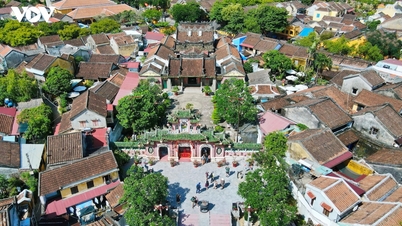
This interesting story is quite common in Hoi An, where for many years, tourists have easily encountered images of farmers wearing conical hats, leisurely leading their healthy, fat buffaloes to the fields to graze, creating a rural scene perfect for photography.
When buffaloes are "toys"
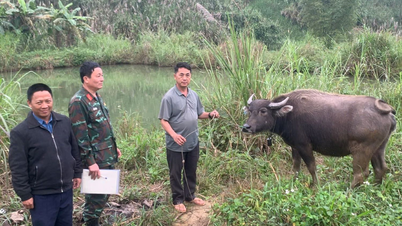
Mr. Le Nhien, a farmer well-known to many European tourists, led his plump, glossy male buffalo, as smooth as a ripe sim fruit, out to the field one morning in early May. Approaching this buffalo and touching its skin, anyone born into a farming family would notice something different: the buffalo didn't have a burnt smell, its skin wasn't scaly but smooth, glossy black, and… smelled like perfume.
Why do buffaloes smell like perfume instead of having the pungent "toughness" of buffalo hide? Hearing this question, an old farmer from Hoi An chuckled: "Even though it's a buffalo, I take better care of it than a human. Every day I take it for a bath, scrub off its scales, rub it with soap, and spray it with perfume so it gets used to the smell," Mr. Nhien said.
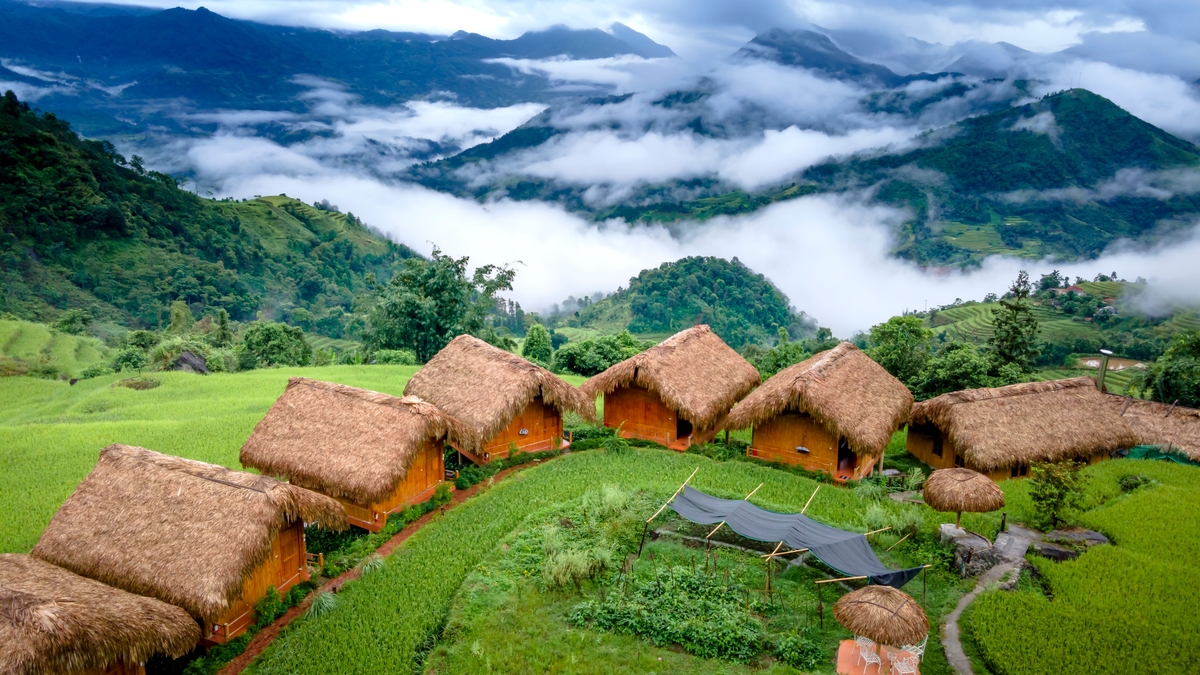
On the rice paddies that resemble a woven carpet on the outskirts of the old town, buffaloes are led by farmers to graze in designated areas. Instead of eating in muddy ponds, the buffaloes graze along the grassy banks of canals and near the road, allowing their owners to sit beside them. Occasionally, while the buffaloes are eating, the herder, sitting on the ground, suddenly jumps up and lies down along the buffalo's back, looking as relaxed as a typical shepherd. In reality, this is a deliberate arrangement to attract the attention of tourists cycling through the nearby rice paddies.
Mr. Tran Van Khoa, Director of Jack Tran Tours Hoi An, one of the first eco-tourism companies to bring tourists to experience the rural life and waterways of Hoi An, said that the sight of people herding buffalo and leisurely working in the fields is one of the images that attracts foreign tourists.
"In many industrialized countries, people don't have buffaloes, so the ecological countryside, where farmers cultivate rice alongside water buffaloes, is a very unusual sight. People who enjoy experiencing rural culture cheer with joy when they see buffaloes while cycling around Hoi An. Tourists are willing to tip the owners to touch the buffalo's skin and horns, and even ride them," Mr. Khoa said.
The buffaloes are happy, and the people benefit from it too.



Old farmer Nguyen Nam, who often herds buffaloes along the tree-lined road of Hai Ba Trung Street, from the An Bang intersection through the rice fields to the center of Hoi An, is a familiar face to many tour guides. Mr. Nam used to be a rice farmer, but 12 years ago, seeing the development of tourism and being commissioned by a company to provide rural tours, he completely switched to the profession of "herding buffaloes."
Mr. Nam's job was incredibly leisurely: Every morning he would lead his buffaloes to the ditch by Hai Ba Trung Street. While the buffaloes grazed, Mr. Nam would sit in the shade, lean back, pull his hat over his face, and doze off with his legs crossed.
The wind from the fields blows in all directions, carrying the scent of fresh mud and the fragrance of spring rice. Western tourists cycling by see this scene and think, "It's so Vietnamese!" so they stop to ask for photos. Some touch the buffalo's ears, others rub its back, and some cautiously feel around before being pushed onto the buffalo's back by Mr. Nam for a photo. On the phone screen, the tourists are shown in the same pose next to the plump buffalo, their smiles melting away.
"Each time I guide tourists like that, they pay me 1 USD. If it's a whole group, I might earn 10-20 USD. Leading buffaloes from morning until noon can sometimes earn me as much as half a month's work as a bricklayer. It's all thanks to tourism," Mr. Nam said.
To be suitable for tourism, the buffaloes of Hoi An live and eat differently from those of ordinary farmers. Instead of being left to roam freely in the forest or grazed around houses, the buffaloes are treated as members of the family and receive special care.
According to farmers Le Nhien and Nguyen Nam, the buffaloes are fed plenty of grass every day without having to do any work. To get the buffaloes used to visitors, Mr. Nam and Mr. Nhien have trained them many times to make their backs "immune" to the scent. In particular, to prevent the buffaloes from smelling bad and jumping around when they smell the perfume of strangers, these buffaloes are washed and scrubbed twice a day, rinsed with soap, and sprayed with perfume on their skin and around their resting areas regularly.
Hoi An offers many tourist services, but the service of herding buffalo and allowing tourists to take photos has developed naturally thanks to the creativity and genuine nature of the farmers. To date, there are about 20-30 buffalo owners doing this work as their main source of income.
Oliver Williams, an Australian national, said that when his family first came to Hoi An, they were very surprised to see buffaloes living alongside people in the countryside, just like they had seen in films about rural life in Southeast Asia. The peaceful scene in the rice fields and villages not far from Hoi An ancient town created a very unique feeling for international tourists.
Businesses collaborate with buffalo owners to develop tourism.



Driven by tourists' curiosity and interest in experiencing buffalo herding and taking photos with the "shepherds" in Hoi An, travel companies in Da Nang have collaborated with farmers for many years to design rural tour programs for visitors. Farmers are responsible for herding buffalo as required by the tour, while the travel company takes tourists to experience the activity and pays for it.
Interestingly, some restaurants and cafes in Hoi An have recently bought buffaloes and hired people to herd them, creating a peaceful atmosphere for tourists to enjoy. Besides knowing the buffalo's habits, the herders are also required to have conversational English skills.
Besides the buffalo riding and photo-taking tour, Hoi An offers many accompanying activities such as plowing fields, planting vegetables, catching fish, or learning to cook local dishes. Some tours also combine rowing in basket boats and exploring mangrove forests. The experience usually lasts from 2-4 hours. The appeal of the tour lies in its closeness to nature, high level of interaction, and the opportunity to learn more about Vietnamese agricultural culture.
Source: https://baodanang.vn/suong-nhu-trau-3335961.html


![[Photo] Strengthening character and expertise: Intense training for artillery soldiers.](https://vphoto.vietnam.vn/thumb/1200x675/vietnam/resource/IMAGE/2026/06/30/1782815602541_lu-368-1875-4571-jpg.webp)