

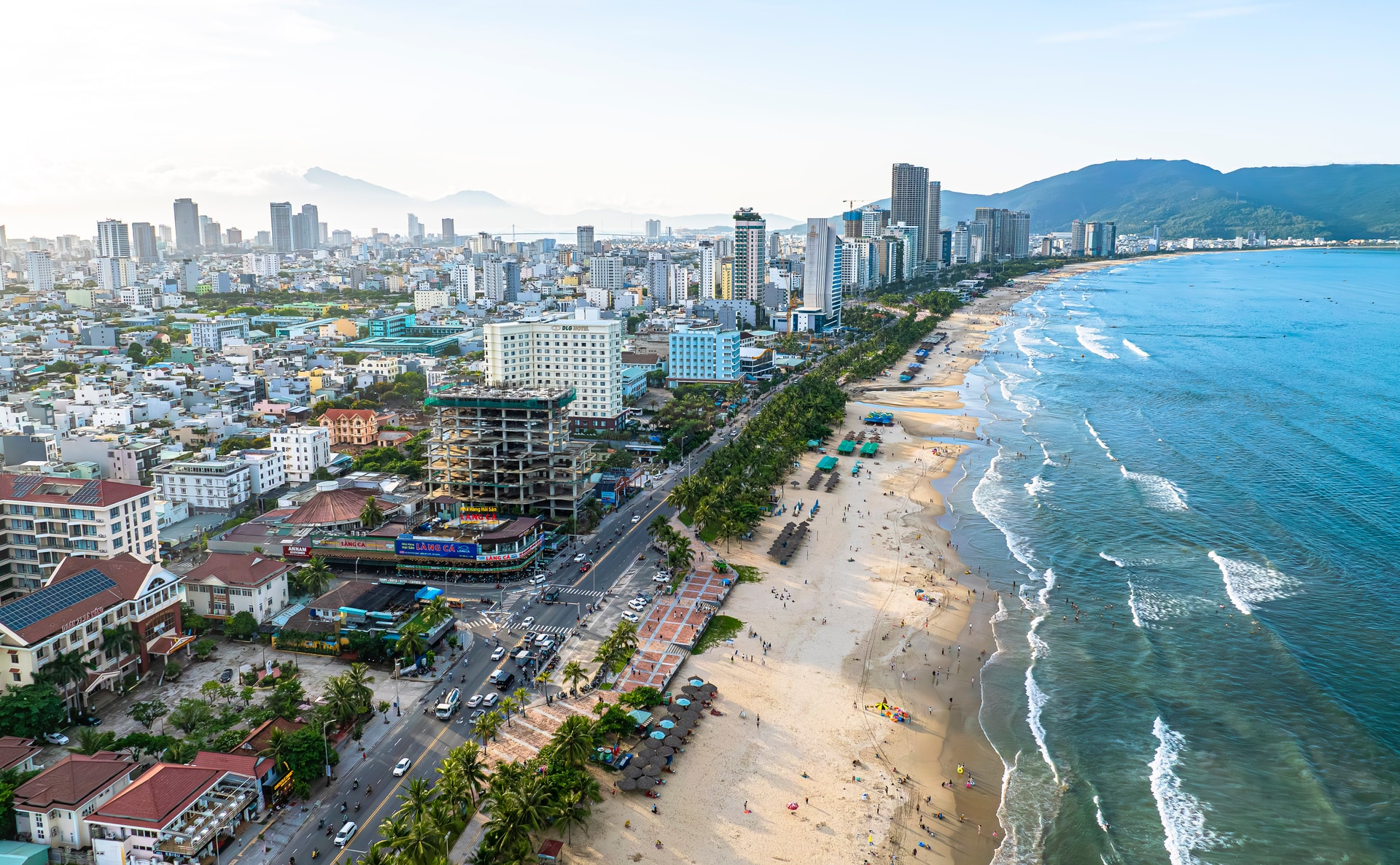
The historical opportunity here lies not in gaining more land or population, but in the ability to redesign the development structure for the next 50-100 years. If the structure is right, the future will be open; if it is wrong, the mistakes will be locked away for generations.
Multi-axis strategy
Feng shui, when understood correctly, is not a mystical story. It is a way of reading the structure of space and the relationship between humans and nature.
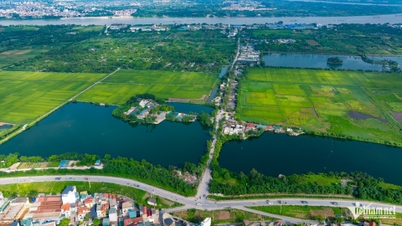
Da Nang possesses a rare geographical advantage: mountains to the west and north provide support, the Han and Thu Bon rivers form the waterways, and the East Sea opens up opportunities for trade. This "mountain-backed, water-fronted" structure, if properly protected and organized, will become the foundation for sustainable development.
But if headwater forests are encroached upon, flood drainage corridors are narrowed, and coastlines are uncontrolledly concretized, then that very structure will be broken. Ancient feng shui called this "breaking the energy flow"; modern planning calls it "ecological imbalance" and "increased risk of natural disasters." Structural mistakes only need to happen once, but the consequences last for decades.
However, a favorable location doesn't automatically generate prosperity. In the modern era, "qi" (energy flow) is no longer just wind and water, but a flow of value: the flow of labor, logistics, capital, data, and innovation. A city with strong "qi" is one where these flows are smooth and well-organized.
If the new Da Nang continues to develop according to a unipolar coastal model, it will soon face infrastructure overload, spatial conflicts, and ecological risks. A more suitable structure is a multipolar strategic model, in which each pole has a clear role and is effectively connected.
The port-logistics axis must be linked to economic corridors; the financial-service axis must be linked to innovation; the industrial-aviation axis must be linked to technology production; and heritage spaces must be preserved as long-term cultural assets. When these axes operate synchronously, the city will form a balanced system, dispersing risks and increasing economic weight.
Generational structure, density, and responsibility
Urban areas cannot distribute the population evenly across the entire space, nor can they be excessively concentrated in a single core. Density needs to be tiered according to function: the TOD core can be high, sub-centers at a medium level, ecological and heritage zones at a low level, and mountain-forest corridors must be strictly protected.
That's the "growth dose." If there's too much, the system will be overloaded; if there's too little, the growth momentum will weaken. Therefore, density control is not just a technical problem, but a strategic principle.
The newly established Da Nang also faces the harsh climate of Central Vietnam. Stronger storms, more extreme rainfall, and faster sea level rise are all challenges. In this context, ecological safety is a prerequisite.
The western ecological corridor must be preserved as the backbone; the flood drainage corridors of the Han and Thu Bon rivers must be protected; the coastline must be considered a public space and a storm protection belt, not just a real estate facade. A special urban area of the 21st century cannot be one that sacrifices forests, rivers, and seas for short-term growth. Living in harmony with nature is no longer an ancient philosophy, but a modern principle of survival.
Parallel to the natural foundation is the data foundation. A new lifeline of the 21st century has emerged. If forests and mountains are the ecological backbone, then data infrastructure is the governance backbone.
Every major decision regarding planning, density, infrastructure, flood control, or public investment needs to be validated through simulation and data analysis. Digital feng shui is not just a slogan for "smart cities," but rather a governance capability based on real-time data. When data becomes the sole source of truth and AI becomes the regulatory tool, cities will be able to scientifically "manage their energy."
Therefore, the question of population size becomes secondary. The weight of a special city lies not only in the number of inhabitants, but also in productivity, GRDP per capita, total factor productivity (TFP), its role as a regional center, and its international connectivity. The new Da Nang may not need to reach an excessively high population threshold, but if each person creates greater value, if each hectare of land is used more efficiently, and if the logistics and innovation systems operate strongly, then its "urban weight" will naturally develop. Increasing the population without increasing productivity only exacerbates the pressure on infrastructure and the environment.
Ultimately, all analyses of feng shui, structure, or data boil down to the responsibility of the present generation. Every decision to adjust planning, every land reclamation project, every industrial zone encroaching on headwater forests is a political and administrative choice, not merely a technical one.
Da Nang is currently at a point where it can redesign its long-term destiny. If short-term gains are prioritized, the structure will be distorted for decades. If structure is placed above term limits, if ecological corridors are legalized, if strategic multipolarity is formalized, and serious investment is made in data infrastructure, then a foundation for the next 100 years will be formed.
Ancient Feng Shui teaches respect for the terrain. Modern Feng Shui teaches designing for the flow of value. Ecological Feng Shui teaches long-term safety and security. Digital Feng Shui teaches intelligent operation using data. When all these layers are integrated into a unified development mechanism, the new Da Nang will not need grand slogans to prove its uniqueness.
Source: https://baodanang.vn/tai-cau-truc-khong-gian-phat-trien-3328061.html




































































































Comment (0)